 Coach
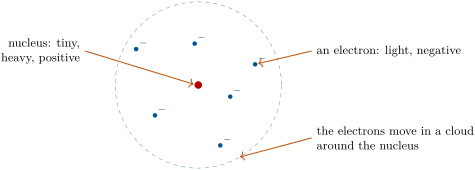
CoachEvery atom has a tiny, heavy core, the nucleus, which carries a positive electric charge. Around it move much lighter particles, the electrons, each carrying the same negative charge, .
Examples
Example 16.9 (Isotopes of carbon and of hydrogen)
Natural carbon is about carbon-12, , and carbon-13, , with a trace of carbon-14, , whose slow change into another nucleus is used to date ancient wood and bones (radioactivity belongs to the physics book). Hydrogen has three isotopes: , with no neutron at all, the commonest by far; deuterium , a few atoms in every hundred thousand; and tritium .
Example 16.12 (A marble in a stadium)
If the nucleus of an atom were a marble across, the atom would be about across: a marble in the middle of a huge stadium, with a few specks of dust — the electrons — whirling around the stands. Matter is mostly empty space.