School Chemistry — Grades 1 to 12 · Grades 1–12
47Electrochemical Cells and Electrolysis
A phone shows 1 % on a winter evening and dies. Plugged in overnight, it is full again by morning. Inside its battery the same chemical reaction runs one way during the day, giving out electrical energy, and is driven the other way at night by the charger. A redox reaction becomes a source of electricity when its electrons are made to travel through a wire; and electricity, pushed through a solution, can force a redox reaction that would never happen by itself.
You already know
Oxidants gain electrons, reductants lose them; half-equations, redox couples and redox reactions (Chapter 35). A system evolves until (Chapter 43). Solutions of ions conduct (Chapter 17); the mole and the Avogadro constant (Chapter 25).

47.1 A redox reaction split in two
When a zinc strip is dipped in copper sulfate solution, zinc is oxidised and copper ions are reduced at the surface of the strip, : the electrons pass directly from metal to ions, and the energy is lost as a little heat. Separate the two halves, and join them by a wire: the electrons must now travel through the wire, and can light a lamp on the way.
Definition 47.1 (Electrochemical cell, half-cell, salt bridge)
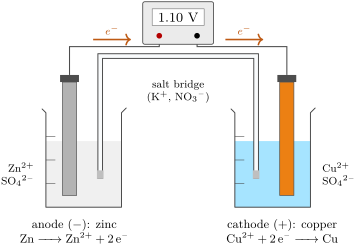
An electrochemical cell produces electrical energy from a redox reaction whose oxidation and reduction take place in two separate compartments. Each compartment, a metal electrode dipped in a solution of its ions, is a half-cell. A salt bridge, a tube or a paper strip soaked in a solution of ions, joins the two solutions and closes the circuit while keeping them apart.
Definition 47.2 (Anode, cathode)
The electrode where an oxidation takes place is the anode; the electrode where a reduction takes place is the cathode.
Proposition 47.3 (Where the electrons go)
In a cell delivering current, electrons leave the cell by the anode, where they are released by the oxidation, travel through the external circuit, and enter by the cathode, where they are taken by the reduction. The anode is the negative terminal, the cathode the positive one. Inside, the current is carried by ions: cations move towards the cathode, anions towards the anode.
Proof. The oxidation produces electrons at the anode; the reduction consumes them at the cathode; the wire is the only path between the two. Each solution would otherwise become charged, which the ions of the bridge prevent. ∎
Method 47.4 (Describing a cell)
- Write the overall redox reaction that takes place spontaneously.
- Split it into two half-equations: the oxidation (anode) and the reduction (cathode).
- Mark the polarity: anode , cathode ; the direction of the electrons in the wire (anode to cathode) and of the current (cathode to anode).
- Describe the motion of the ions in the bridge.
History — Volta’s pile, 1800
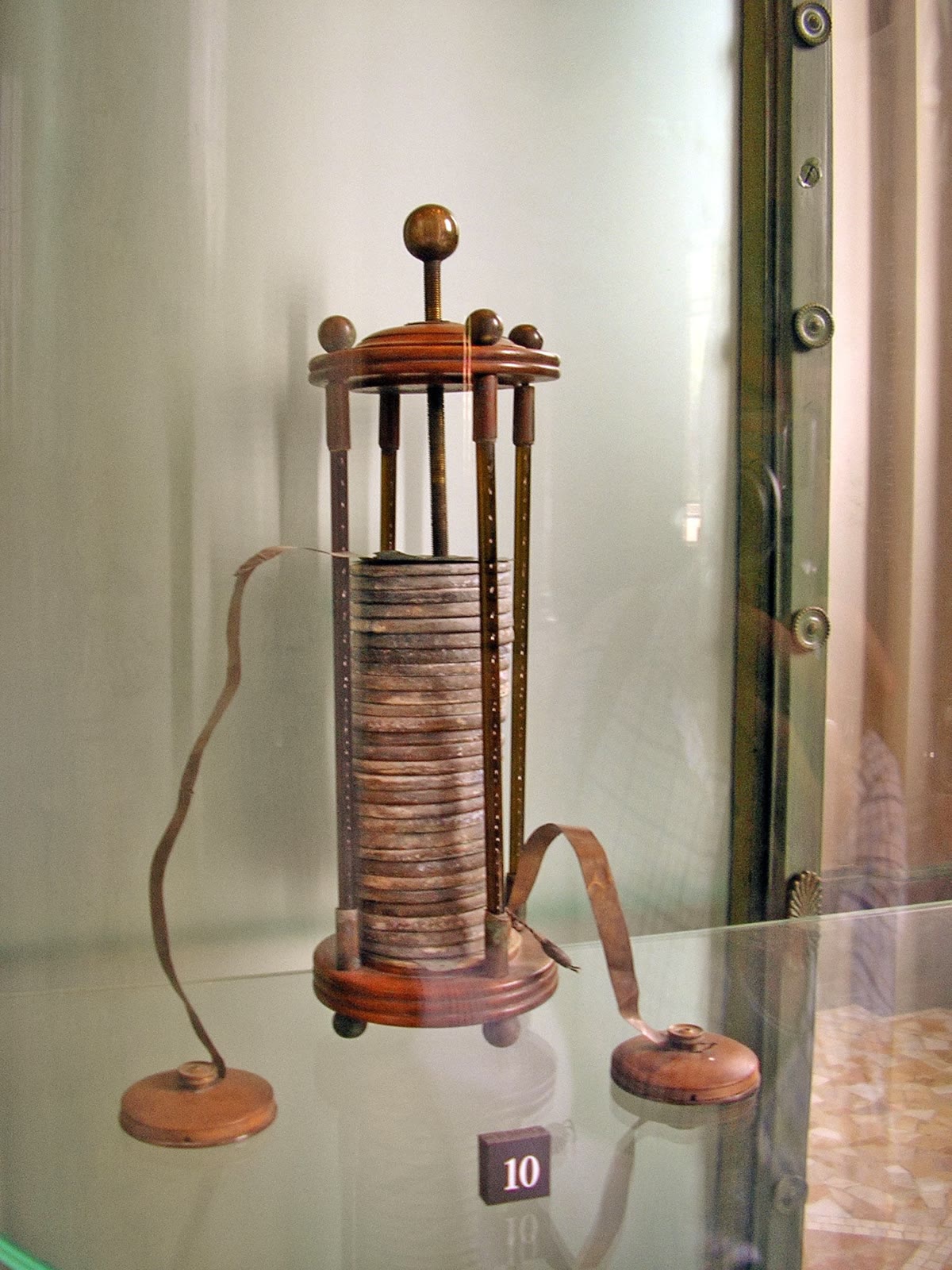
In 1800 the physicist Alessandro Volta stacked discs of two different metals, zinc and copper or silver, separated by pieces of cloth soaked in brine, and obtained a steady electric current: the first battery. It gave physicists their first continuous source of electricity, and chemists a new tool: within a few years electrolysis had isolated sodium and potassium for the first time.
47.2 The voltage of a cell
Definition 47.5 (Cell voltage)
The cell voltage is the voltage measured between the terminals of a cell delivering no current (open circuit), with a voltmeter; it is positive when the voltmeter’s positive terminal is on the cathode.
Example 47.6 (The Daniell cell)
With both solutions at , the Daniell cell gives . How such a voltage is predicted from tables of electrode potentials is shown in the Year 1 volume.
Remark 47.7 (Why a cell runs down)
The reaction of the cell, , has a very large constant . While the cell works, grows, and the reaction keeps running as long as . When a reactant runs out (the zinc, or the copper ions), the current stops: the cell is “flat”.
47.3 Charge and capacity
Definition 47.8 (Faraday constant, capacity)
The Faraday constant is the electric charge of one mole of electrons, . The capacity of a cell is the largest electric charge it can deliver, often given in ampere-hours: .
Proposition 47.9 (Charge and amount of electrons)
A current flowing for a time carries the charge , that is an amount of electrons
Example 47.10 (Capacity of a Daniell cell)
The zinc electrode holds of zinc that can react, that is . Each zinc atom gives two electrons: , so , about , if the copper ions do not run out first.
47.4 Electrolysis
Definition 47.11 (Electrolysis, accumulator)
An electrolysis is a redox reaction forced by an electrical generator, in the direction opposite to the one it would take by itself. An accumulator is a cell that can be recharged: during charging, the generator drives its reaction backwards, as an electrolysis.
In the lab — Electrolysis of water
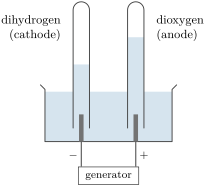
Two electrodes dip in water made conducting with a little sodium sulfate, each under an inverted test tube full of the solution. With a generator of a few volts, bubbles rise from both electrodes: at the cathode (connected to the terminal) dihydrogen, at the anode dioxygen, twice as much of the first as of the second. A lighted splint pops in the first gas; a glowing splint relights in the second.
Example 47.12 (Water, split)
At the cathode: ; at the anode: . For four electrons, two molecules of dihydrogen and one of dioxygen, while the ions and formed at the two electrodes recombine into water: overall , the reverse of the combustion of hydrogen, which needs energy to happen.
Method 47.13 (Mass deposited by an electrolysis)
- Write the half-equation at the electrode where the metal forms, for example .
- Compute the charge and .
- Divide by the number of electrons per atom: ; then .
Example 47.14 (Refining copper)
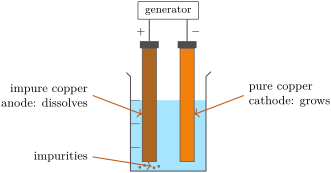
Impure copper from the smelter is made the anode of an electrolysis cell in copper sulfate solution, and a thin sheet of pure copper the cathode. At the anode copper dissolves, ; at the cathode pure copper is deposited, ; the impurities fall to the bottom or stay in solution. A current of for carries , that is , which deposits of copper: .
47.5 Batteries, accumulators and fuel cells
Every battery is a cell, every rechargeable battery an accumulator. A car’s lead–acid accumulator works with lead, lead oxide and sulfuric acid; a phone’s lithium-ion accumulator moves lithium ions between two electrodes, one of graphite and one of a metal oxide, through a liquid or polymer electrolyte, while the electrons go round the outside circuit. A fuel cell is a cell whose reactants are fed in continuously: a hydrogen fuel cell runs the reaction , the reverse of the electrolysis of water, and gives electricity and water. Dihydrogen made by electrolysis with electricity from wind or sun, then used in fuel cells, is one way of storing that electricity.
47.6 Exercises
Exercise 47.1 ★
In the Daniell cell, which electrode is the anode? The cathode? Write the half-equation at each.
Exercise 47.2 ★
A current of flows for . Compute the charge carried and the amount of electrons.
Solution
Solution of Exercise 47.2.
; .
Exercise 47.3 ★
What is the role of the salt bridge? What happens if it is removed?
Solution
Solution of Exercise 47.3.
It closes the circuit and keeps each solution electrically neutral, its ions moving into the compartments. Without it the circuit is open: no current flows, the voltmeter reads zero and a lamp stays dark.
Exercise 47.4 ★
Convert a capacity of into coulombs.
Solution
Solution of Exercise 47.4.
.
Exercise 47.5 ★
In an electrolysis, is the reaction spontaneous? What supplies the energy?
Solution
Solution of Exercise 47.5.
No: the reaction goes in the direction opposite to the spontaneous one. The generator supplies the energy.
Exercise 47.6 ★★
A cell is made of a silver electrode in silver nitrate and a copper electrode in copper sulfate. The voltmeter shows that electrons leave by the copper. Write the half-equations, name the anode and the cathode, and give the overall reaction.
Exercise 47.7 ★★
A watch battery delivers continuously for three years. What is its capacity in ?
Solution
Solution of Exercise 47.7.
Three years are ; .
Exercise 47.8 ★★
A spoon is silver-plated with a current of for , . What mass of silver is deposited?
Solution
Solution of Exercise 47.8.
; ; .
Exercise 47.9 ★★
On the figure of the Daniell cell, give the direction of the current in the wire, and the direction in which the and ions of the bridge move.
Exercise 47.10 ★★
Compare a cell and an electrolysis: the sign of the anode, the direction of the reaction, the conversion of energy.
Solution
Solution of Exercise 47.10.
In both the anode is where the oxidation happens. In a cell the anode is , the reaction is spontaneous and chemical energy becomes electrical energy; in an electrolysis the anode is joined to the of the generator, the reaction is forced and electrical energy becomes chemical energy.
Exercise 47.11 ★★
In the electrolysis of water, of dihydrogen are collected. What volume of dioxygen is collected at the same time? Why?
Solution
Solution of Exercise 47.11.
: the equation gives two molecules of dihydrogen for one of dioxygen, and equal amounts of gas take equal volumes.
Exercise 47.12 ★★★
A Daniell cell contains of zinc and of copper sulfate at . Which reactant runs out first? What is the capacity of the cell? How long can it deliver ?
Solution
Solution of Exercise 47.12.
; ; they react one to one, so the copper ions run out first. , . At : .
Exercise 47.13 ★★★
A battery of delivers . Compute the energy it stores (), in joules and in watt-hours.
Solution
Solution of Exercise 47.13.
; , that is .
Exercise 47.14 ★★★
Water is electrolysed with for . Compute the amounts, then the volumes at (), of dihydrogen and dioxygen produced.
Exercise 47.15 ★★★
In copper refining, the anode loses of material while the cathode gains of copper. What is the percentage of copper in the impure anode, assuming that only copper is oxidised at the anode and the impurities simply fall off?
47.7 Problem: The Phone Battery
Problem 47.1
Weekend problem — what mass of lithium shuttles between the electrodes of a phone battery?
A phone battery is labelled “, ”. In a simplified picture, during discharge each lithium atom stored in the graphite electrode gives one electron and leaves as a lithium ion, ; the ion crosses the electrolyte and is taken up by the metal oxide electrode, which gains an electron at the same time.
Part I — The cell.
- During discharge, is the graphite electrode the anode or the cathode? Why?
- Which is the negative terminal?
- In which direction do the electrons travel through the phone? And the lithium ions inside the battery?
- Why is this cell an accumulator?
Part II — The charge.
- Convert into ampere-hours, then into coulombs.
- Compute the amount of electrons this charge represents.
- How many electrons is that?
- The phone draws on average . How long does a full battery last?
- The screen shows 20 %. What charge, in coulombs, is left?
Part III — The energy.
- Compute the energy stored, , in joules.
- Convert it into watt-hours.
- Compare with the energy released by burning of methane ().
- How many full charges does of electricity give, if no energy were lost?
Part IV — Recharging.
- During charging, which reaction takes place at the graphite electrode? Is it an oxidation or a reduction?
- Why is recharging an electrolysis?
- The charger delivers . How long does a full recharge take at least?
- What amount of lithium ions crosses the electrolyte during one full charge?
- Compute their mass.
- State the final answer: what mass of lithium shuttles between the electrodes in one full charge?
Solution
Solution of Problem 47.1.
1. The anode: lithium is oxidised there.
2. The graphite electrode, the anode.
3. Electrons go through the phone from the graphite electrode to the oxide electrode; lithium ions cross the electrolyte in the same direction, from graphite to oxide.
4. Its reaction can be driven backwards by a charger.
5. , that is .
6. .
7. electrons.
8. .
9. .
10. , about .
11. .
12. Burning of methane releases a little more energy () than a full phone battery stores.
13. : 67 full charges.
14. : a reduction.
15. The charger forces the reaction in the direction opposite to the spontaneous one.
16. , .
17. One lithium ion per electron: .
18. .
19. About of lithium shuttles between the electrodes in one full charge.