All books

Professional

Apps About Coach Log in Start reading

Chemistry · Glossary

What is Anti- and syn-periplanar?

Also known as: anti-periplanar · syn-periplanar

Definition 20.3 University Chemistry — Year 1 · Chapter 20 — -Elimination

Two bonds on neighbouring atoms are anti-periplanar when they lie in one plane on opposite sides (torsion angle 180∘180^\circ), syn-periplanar when they lie in one plane on the same side (0∘0^\circ).

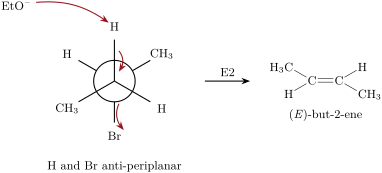
E2 reaction of 2-bromobutane, viewed along the C3–C2 bond (C3 in front, C2 bearing Br behind) in one of its two anti-periplanar conformations; the other one, with the other hydrogen of C3 anti to Br, gives (Z)-but-2-ene. Three electron pairs move together: the base takes the proton, the C–H pair becomes the π bond, the C–Br pair leaves with bromine. The groups that face each other in the Newman projection end on the same side of the double bond.
E2 reaction of 2-bromobutane, viewed along the C3–C2 bond (C3 in front, C2 bearing Br behind) in one of its two anti-periplanar conformations; the other one, with the other hydrogen of C3 anti to Br, gives (Z)-but-2-ene. Three electron pairs move together: the base takes the proton, the C–H pair becomes the π\pi bond, the C–Br pair leaves with bromine. The groups that face each other in the Newman projection end on the same side of the double bond.
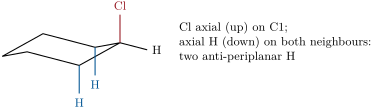
trans-Diaxial arrangement on a chair: the axial chlorine is anti-periplanar to the axial hydrogens of the two neighbouring carbons (blue).
Read in context →