
All books

Professional

Apps About Coach Log in Start reading

Chemistry · Glossary

What is Torsion angle and conformations?

Also known as: torsion angle · eclipsed conformation · staggered conformation · anti conformation · gauche conformation · chair · axial · equatorial · ring flip

Definition 16.10 University Chemistry — Year 1 · Chapter 16 — Stereochemistry in Depth

For four atoms A–B–C–D, the torsion angle θ\theta about B–C is the angle between the planes ABC and BCD, read on a Newman projection along B–C. A conformation is an eclipsed conformation when the bonds of the front and rear carbons are aligned in projection, a staggered conformation when they alternate. In butane, viewed along C2–C3, the staggered conformation with the two methyl groups at 180∘180^\circ is the anti conformation, those at ±60∘\pm 60^\circ are gauche conformations. In cyclohexane, the strain-free puckered ring is the chair; each carbon carries one axial bond, parallel to the ring’s axis, and one equatorial bond, roughly in the ring’s mean plane. The ring flip converts one chair into the other, every axial bond becoming equatorial and the reverse.
Torsional energy of butane about its central bond (solid; = 0 when the methyl groups eclipse each other) and of ethane (dashed), computed from experimental torsional potentials. Ethane: barrier 12.2\, kJ/ mol. Butane: anti most stable; gauche 2.8\, kJ/ mol higher, at = 62; barriers 15.2\, kJ/ mol (methyl eclipsing hydrogen) and 16.5\, kJ/ mol (methyl eclipsing methyl).
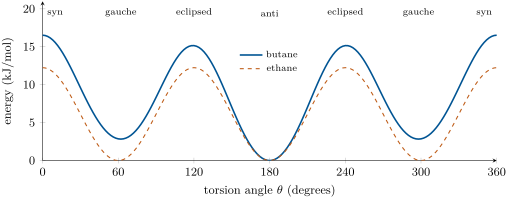
Torsional energy of butane about its central bond (solid; θ=0\theta = 0 when the methyl groups eclipse each other) and of ethane (dashed), computed from experimental torsional potentials. Ethane: barrier 12.2 kJ/mol12.2\,\mathrm{kJ}/\mathrm{mol}. Butane: anti most stable; gauche 2.8 kJ/mol2.8\,\mathrm{kJ}/\mathrm{mol} higher, at θ=62∘\theta = 62^\circ; barriers 15.2 kJ/mol15.2\,\mathrm{kJ}/\mathrm{mol} (methyl eclipsing hydrogen) and 16.5 kJ/mol16.5\,\mathrm{kJ}/\mathrm{mol} (methyl eclipsing methyl).
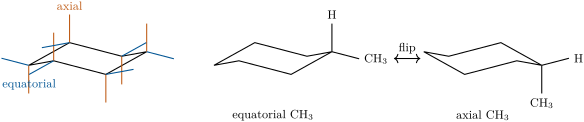
Left: the chair of cyclohexane with its six axial bonds (orange, alternately up and down) and six equatorial bonds (blue). Right: the two chairs of methylcyclohexane, interconverted by the ring flip; the methyl group is equatorial in one, axial in the other.
Read in context →