University Chemistry — Year 1 · Bachelor Year 1
20-Elimination
Treat 2-bromo-2-methylpropane with sodium ethoxide in ethanol at room temperature and the main product is an ether; heat the same mixture and the main product is an alkene, 2-methylpropene, with no ethoxy group in it. The ethoxide ion has acted not as a nucleophile, attacking carbon, but as a base, removing a proton from the carbon next door while the bromide left. This competition between substitution and elimination runs through all of organic synthesis. This chapter describes the two elimination mechanisms, their remarkable geometric requirement, the rule that predicts which alkene forms, and how to steer a reaction one way or the other.
You already know
SN1 and SN2 (Chapter 19); Newman projections, conformations of cyclohexane and / descriptors (Chapter 16); carbocations and bases (Chapter 18).
20.1 The E2 mechanism
Definition 20.1 (-elimination, E2 and E1)
A -elimination removes a leaving group Y from a carbon (the carbon) and a proton from a neighbouring carbon (a carbon), forming a double bond between them. In the E2 mechanism a base takes the proton while Y leaves, in one elementary step; in the E1 mechanism Y first leaves, giving a carbocation, which then loses a proton.
Proposition 20.2 (Rate law of E2)
For E2, , where B is the base.
Proof. One bimolecular elementary step, involving substrate and base: the law of mass action of elementary steps (Chapter 9). ∎
Definition 20.3 (Anti- and syn-periplanar)
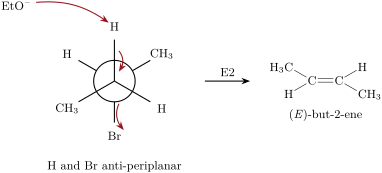
Two bonds on neighbouring atoms are anti-periplanar when they lie in one plane on opposite sides (torsion angle ), syn-periplanar when they lie in one plane on the same side ().
Proposition 20.4 (E2 is anti and stereospecific)
E2 proceeds from the conformation in which the C–H and C–Y bonds are anti-periplanar. It is stereospecific: diastereomeric substrates give different alkene stereoisomers, fixed by the anti arrangement.
Proof. In the transition state the C–H bonding pair must enter the antibonding region of the C–Y bond while the two carbons become trigonal; the overlap is best when the two bonds are parallel, in one plane. The anti arrangement is staggered (low energy) and keeps the base far from the leaving group; the syn one is eclipsed. With H and Y anti, the two other groups on each carbon are fixed: those that are on the same side in the Newman projection end cis on the double bond. A diastereomer has two groups exchanged on one carbon, and gives the other alkene. ∎
Proposition 20.5 (E2 on a cyclohexane)
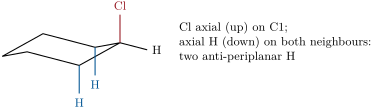
On a cyclohexane ring, E2 requires the leaving group and the hydrogen to be both axial (trans-diaxial); a leaving group held equatorial cannot react until the ring flips.
Proof. On adjacent carbons of a chair, two axial bonds are anti-periplanar (one up, one down, parallel to the axis); an equatorial bond is anti to ring C–C bonds only, never to a C–H bond. ∎
20.2 The E1 mechanism
Proposition 20.6 (Rate law of E1)
For E1, , the rate being that of the ionisation.
Proof. As for SN1 (Proposition 19.7): the carbocation is formed in a slow step and consumed fast, here by loss of a proton to the solvent or a weak base; the steady-state approximation leaves . ∎
E1 shares its carbocation with SN1: tertiary substrates in protic solvents give both, the alkene being favoured by heating. Since the carbocation is planar and the proton is lost afterwards, E1 has no geometric requirement and is not stereospecific; it gives mainly the more stable alkene, usually the (E) one.

20.3 Regioselectivity: Zaitsev’s rule
Definition 20.7 (Regioselective and stereoselective reactions)
A reaction that can give several constitutional isomers but forms one mainly is a regioselective reaction; one that can give several stereoisomers but forms one mainly is a stereoselective reaction.
Proposition 20.8 (Zaitsev’s rule)
When several hydrogens can be removed, the major alkene is usually the most substituted (the most stable), and the (E) isomer rather than the (Z) (Zaitsev’s rule). Bulky bases, and geometric constraints such as the trans-diaxial requirement, can override it.
Proof. Alkyl groups on the carbons of a double bond stabilise it (as they stabilise carbocations), and (E) alkenes avoid the crowding of cis groups. The transition states of E2 and E1 have partial double-bond character, so the more stable alkene is formed faster. A bulky base reaches the less hindered hydrogens more easily; and a hydrogen that cannot be anti-periplanar to the leaving group is not removed by E2 at all, whatever the stability of the alkene it would give. ∎
Method 20.9 (Predicting the alkene)
- List the carbons that carry hydrogens.
- For E2, keep only hydrogens that can be anti-periplanar to Y (on a ring: trans-diaxial, in a chair that can actually form).
- Among them, favour the one that gives the most substituted alkene (Zaitsev), unless the base is bulky.
- For each, draw the Newman projection in the anti conformation to read the (E)/(Z) geometry.
20.4 Substitution or elimination?
Proposition 20.10 (Substitution against elimination)
Elimination is favoured by strong, bulky bases, by high temperature and by tertiary or crowded substrates; substitution by good nucleophiles that are weak bases, by low temperature and by primary substrates.
Proof. Base strength favours the attack on hydrogen; bulk hinders the attack on a crowded carbon but not on an exposed hydrogen. A tertiary carbon is inaccessible to SN2, and its carbocation loses protons easily. Elimination turns one molecule into two or three (alkene, leaving group, protonated base): it is favoured as the temperature rises, a result justified in the Year 2 volume. ∎
| substrate | strong base, small | strong base, bulky | weak base, good nucleophile |
|---|---|---|---|
| primary | SN2 (some E2) | E2 | SN2 |
| secondary | E2 (and SN2) | E2 | SN2 (aprotic), SN1/E1 (protic) |
| tertiary | E2 | E2 | SN1/E1 (protic) |
20.5 Exercises
Exercise 20.1 ★
Give the alkenes that can form by elimination of HBr from 2-bromobutane, from 2-bromo-2-methylbutane and from bromocyclohexane, and the one Zaitsev’s rule predicts as major.
Solution
Solution of Exercise 20.1.
2-Bromobutane: but-1-ene, (E)- and (Z)-but-2-ene; major (E)-but-2-ene. 2-Bromo-2-methylbutane: 2-methylbut-2-ene (major, trisubstituted) and 2-methylbut-1-ene. Bromocyclohexane: cyclohexene only.
Exercise 20.2 ★
Write the rate laws of E1 and E2. How would you tell them apart experimentally for 2-bromo-2-methylpropane in ethanol containing ethoxide?
Solution
Solution of Exercise 20.2.
E1: ; E2: . Measure the initial rate of alkene formation at several ethoxide concentrations: it grows in proportion for E2, it does not change for E1.
Exercise 20.3 ★
Draw the Newman projections of 2-bromobutane along C2–C3 in its three staggered conformations, and say which can undergo E2.
Solution
Solution of Exercise 20.3.
Along C2–C3, the Br on C2 can be anti to either hydrogen of C3 or to the C4 methyl group: the two conformations with an H anti to Br can react by E2 (giving the (E) and (Z) alkenes); the third cannot eliminate towards C3.
Exercise 20.4 ★
Predict the main reaction (SN1, SN2, E1, E2): bromoethane with sodium hydroxide in water at ; 2-bromo-2-methylpropane with potassium tert-butoxide; 2-bromopropane with sodium iodide in propanone; 2-bromo-2-methylpropane in hot ethanol.
Solution
Solution of Exercise 20.4.
SN2 (primary, hydroxide, low temperature); E2 (tertiary, strong bulky base); SN2 (iodide, a good nucleophile and weak base, aprotic solvent); SN1 and E1, E1 increasing with heating.
Exercise 20.5 ★★
Show, with Newman projections, that the E2 elimination of HBr from the two diastereomers of 2-bromo-3-methylpentane that can lose the C3 hydrogen gives the two stereoisomers of 3-methylpent-2-ene.
Solution
Solution of Exercise 20.5.
C3 carries a single hydrogen. In each diastereomer, placing that H anti to the Br of C2 fixes the positions of the other groups: the methyl of C2 and the ethyl of C3 are on the same side in one diastereomer and on opposite sides in the other. One gives (E)-, the other (Z)-3-methylpent-2-ene: a stereospecific reaction.
Exercise 20.6 ★★
Write the mechanism of the dehydration of 2-methylbutan-2-ol in hot concentrated sulfuric acid (E1) and give the major alkene.
Solution
Solution of Exercise 20.6.
The OH is protonated, ; water leaves, giving the tertiary carbocation ; a base (water, ) removes a proton from a neighbouring carbon. Major product (Zaitsev): 2-methylbut-2-ene.
Exercise 20.7 ★★
Explain why trans-1-bromo-4-tert-butylcyclohexane reacts very slowly by E2 while its cis isomer reacts fast. (The tert-butyl group stays equatorial.)
Solution
Solution of Exercise 20.7.
The tert-butyl group locks the chair with itself equatorial. In the trans isomer the bromine is then equatorial too, never anti to a C–H: E2 must wait for the very unfavourable flipped chair. In the cis isomer the bromine is axial, with two trans-diaxial hydrogens: fast E2.
Exercise 20.8 ★★
2-Bromo-2-methylbutane with sodium ethoxide gives mainly 2-methylbut-2-ene; with potassium tert-butoxide, mainly 2-methylbut-1-ene. Explain.
Solution
Solution of Exercise 20.8.
Ethoxide, small, removes the hydrogen that gives the more substituted alkene (Zaitsev). tert-Butoxide, bulky, reaches the exposed hydrogens of the methyl group more easily than the hydrogen of the internal : the less substituted alkene.
Exercise 20.9 ★★
Why is elimination never observed with bromomethane? With 1-bromo-2,2-dimethylpropane by E2?
Solution
Solution of Exercise 20.9.
Bromomethane has no carbon. In 1-bromo-2,2-dimethylpropane the carbon is quaternary and carries no hydrogen.
Exercise 20.10 ★★★
In ethanol at , 2-bromo-2-methylpropane gives a mixture of the ether (SN1) and the alkene (E1) whose proportions do not depend on the concentration of the substrate. Show that both products come from the same carbocation and that their ratio is the ratio of two rate constants.
Solution
Solution of Exercise 20.10.
Both products need the carbocation, formed in the slow step at the rate . It is then shared between capture by ethanol (rate constant ) and loss of a proton (rate constant ), both pseudo-first-order in the solvent: the fraction of alkene is , independent of the substrate concentration.
Exercise 20.11 ★★★
One diastereomer of 1,2-dibromo-1,2-diphenylethane (the meso one) gives, by E2 with ethoxide, a single stereoisomer of 1-bromo-1,2-diphenylethene. Find which, with a Newman projection.
Solution
Solution of Exercise 20.11.
Starting from the conformation of the meso compound with the two Br anti (the two phenyls then anti, the two H anti), rotate C1 by to put its H anti to the Br of C2. The two phenyl groups are then on the same side of the H–Br axis: they end cis. On C1, Br outranks Ph; on C2, Ph outranks H; Br and the phenyl of C2 are trans: (E)-1-bromo-1,2-diphenylethene.
Exercise 20.12 ★★★
Using the energies of Chapter 16, explain why an E2 reaction on a cyclohexane can be slowed by a factor of hundreds when the leaving group must become axial in a crowded chair. Express the rate as the product of a conformer fraction and a rate constant.
Solution
Solution of Exercise 20.12.
Only the chair with the leaving group axial reacts: , with the fraction of that chair. Each axial alkyl group it requires costs several kJ/mol ( for a methyl), dividing by about ten per group at room temperature: with two or three such groups, falls to or and the reaction is that much slower.
20.6 Problem: Menthyl and Neomenthyl Chlorides
Problem 20.1
Weekend problem — the chairs of two diastereomeric chlorides, the anti-periplanar hydrogens available in each, the alkenes formed, and the ratio of their E2 rates
Menthyl chloride and neomenthyl chloride are the chlorides of menthol and neomenthol (Chapter 16): on the ring, C1 carries Cl, C2 the isopropyl group, C5 the methyl group. In menthyl chloride the three groups can all be equatorial; in neomenthyl chloride, Cl is axial when the two alkyl groups are equatorial. Both are treated with sodium ethoxide in ethanol, an E2 reaction. Data of the problem: of neomenthyl chloride is in the chair with Cl axial; for menthyl chloride, the chair with Cl axial (all three groups axial) is a fraction ; assume that each anti-periplanar hydrogen of a reactive chair reacts with the same rate constant. Neomenthyl chloride gives of the trisubstituted alkene.
Part I — The chairs.
- Draw the preferred chair of menthyl chloride.
- Draw the preferred chair of neomenthyl chloride.
- Are the two chlorides enantiomers or diastereomers?
- State the geometric requirement of E2 on a ring.
- In which chair can menthyl chloride react? Draw it.
- Why is that chair rare? Use the energy cost of axial groups.
Part II — The anti hydrogens.
- List the carbons of the chloride (C2 and C6) and their hydrogens.
- In the reactive chair of neomenthyl chloride, which hydrogens are anti-periplanar to Cl?
- In the reactive chair of menthyl chloride, is the hydrogen of C2 axial? Is a hydrogen of C6 axial?
- How many anti-periplanar hydrogens does each chloride offer?
- Draw a Newman projection along C1–C6 for the reactive chair of menthyl chloride.
- Why could a syn-periplanar elimination not rescue the reaction?
Part III — The products.
- Name the alkene formed by removing the C2 hydrogen and the one formed by removing a C6 hydrogen.
- Which one does Zaitsev’s rule favour, and why?
- What does neomenthyl chloride give? Is the 78/22 ratio consistent with Zaitsev’s rule?
- What does menthyl chloride give? Is this consistent with Zaitsev’s rule?
- Which reaction is stereospecific, regioselective, or both?
- Why is substitution (SN2) minor with ethoxide here?
Part IV — The rates.
- Write the rate of each reaction as a function of the fraction of reactive chair and the number of anti-periplanar hydrogens.
- Compute the relative rate of neomenthyl chloride.
- Compute the relative rate of menthyl chloride.
- Compute the ratio of the rates .
Solution
Solution of Problem 20.1.
1. A chair with Cl, isopropyl and methyl all equatorial. 2. Isopropyl and methyl equatorial, Cl axial. 3. Diastereomers: they differ only at C1. 4. Leaving group and hydrogen trans-diaxial. 5. Only in the flipped chair, with Cl, isopropyl and methyl all axial. 6. All three groups axial: the methyl alone costs about , the larger isopropyl group more, the chlorine a little: together some , so a fraction of about , the value the problem takes. 7. C2 (one H, it carries the isopropyl group) and C6 (two H). 8. With Cl axial on C1, the axial H of C2 (the isopropyl being equatorial) and the axial H of C6: two. 9. In the triaxial chair the isopropyl group occupies the axial position of C2, so its H is equatorial: not anti. C6 has an axial H: anti. 10. Neomenthyl chloride two, menthyl chloride one. 11. Along C1–C6: Cl (axial, up) on C1 opposite the axial H (down) on C6; the ring bonds and the equatorial H staggered between. 12. On a chair no C–H bond is syn-periplanar to the C–Cl bond; forcing it would mean an eclipsed, strained ring. 13. Removing H of C2: 4-methyl-1-(propan-2-yl)cyclohex-1-ene (trisubstituted); removing H of C6: 3-methyl-6-(propan-2-yl)cyclohex-1-ene (disubstituted). 14. The trisubstituted alkene, the more substituted and stable. 15. Both alkenes, trisubstituted: consistent. 16. Only the disubstituted alkene: the opposite of Zaitsev’s prediction, imposed by the only anti hydrogen available. 17. Both are stereospecific (anti requirement); neomenthyl chloride reacts regioselectively (78/22); menthyl chloride gives a single constitutional isomer. 18. The carbon bearing Cl is secondary and flanked by an isopropyl group: crowded for SN2, while ethoxide is a strong base. 19. : fraction of reactive chair times number of anti hydrogens. 20. . 21. . 22. .