Also known as: primary cell · accumulator · specific energy
Definition 11.3University Chemistry — Year 2 · Chapter 11 — Batteries, Fuel Cells and Electrolysis
A primary cell is an electrochemical cell used once, until its reagents are spent. An accumulator is a cell that can be recharged by forcing a current through it in the reverse direction, which reverses its reaction. The specific energy of a cell is the electrical energy it delivers per unit mass, usually in Wh/kg.
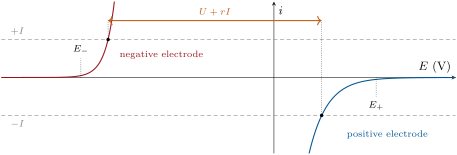
The operating point of a cell (model curves). At a current I the negative electrode sits on its anodic curve, the positive electrode on its cathodic curve; the difference of the two potentials, less the ohmic drop rI, is the voltage delivered. It falls as I grows.
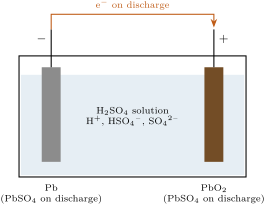
The lead–acid accumulator, schematic. On discharge lead is oxidised and lead dioxide reduced, both to lead sulfate, and the acid is consumed: the density of the solution tells the state of charge.
Examples
Example 11.6(The lead–acid accumulator)
At the negative electrode Pb+SOX4X2−PbSOX4+2eX−; at the positive one PbOX2+4HX++SOX4X2−+2eX−PbSOX4+2HX2O. Overall
Pb+PbOX2+4HX++2SOX4X2−2PbSOX4+2HX2O,
ΔrG∘=2(−813.14)+2(−237.13)−(−217.33)−2(−744.53)=−394.1kJ/mol, E∘=394100/(2×96485)=2.04V. Both electrodes are covered by lead sulfate as the cell discharges; charging reverses the reaction. The reduction of HX+ on lead and the oxidation of water on lead dioxide are slow: that is why a cell of 2V can be charged in water, whose thermodynamic window is only 1.23V wide.
 Coach
Coach