
All books

Professional

Apps About Coach Log in Start reading

Chemistry · Glossary

What is Carbon-13 NMR?

Also known as: broadband decoupling · equivalent carbons

Definition 33.1 University Chemistry — Year 2 · Chapter 33 — Structure Determination: 13C NMR, MS and IR Together

Carbon-13 NMR records the resonances of the X13X2213C\ce{^{13}C} nuclei of a sample. It is usually run with broadband decoupling: the protons are irradiated over their whole range of frequencies during the measurement, which removes every carbon–proton coupling, so that each kind of carbon gives one single line. Equivalent carbons, exchanged by a symmetry of the molecule (or by a fast rotation), give the same line.
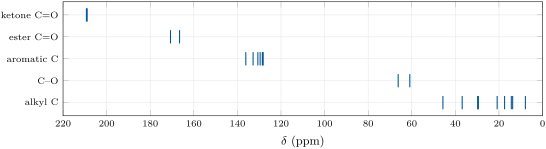
Measured 13C shifts of butan-2-one, pentan-2-one, ethyl benzoate and benzyl ethanoate, sorted by kind of carbon (CDCl_3; PubChem data). Ketone carbonyls lie near 209, ester carbonyls near 167–171, aromatic carbons between 128 and 137, carbons bonded to an ester oxygen near 61–66, and alkyl carbons below 46.
Measured X13X2213C\ce{^{13}C} shifts of butan-2-one, pentan-2-one, ethyl benzoate and benzyl ethanoate, sorted by kind of carbon (CDCl3_3; PubChem data). Ketone carbonyls lie near 209, ester carbonyls near 167–171, aromatic carbons between 128 and 137, carbons bonded to an ester oxygen near 61–66, and alkyl carbons below 46.
Read in context →