University Chemistry — Year 2 · Bachelor Year 2
33Structure Determination: 13C NMR, MS and IR Together
A fragrance laboratory receives a vial of a colourless liquid that smells of jasmine. Nobody has written a label. A mass spectrum gives its molecular formula, an infrared spectrum its functional groups, a carbon-13 spectrum its skeleton and a proton spectrum the way the pieces are joined; within an hour the liquid has a name. This chapter adds carbon-13 NMR to the proton NMR and infrared spectroscopy of the Year 1 volume and to the mass spectrometry of Chapter 32, and turns the four into one method.
You already know
The Year 1 volume: chemical shift and shielding, equivalent protons, integration, spin–spin coupling and the rule, infrared wavenumbers of functional groups and the fingerprint region, the degree of unsaturation, solving a structure from three spectra. Chapter 32: the molecular ion, isotope patterns, fragmentation.
33.1 Carbon-13 NMR
Carbon-12, the main isotope, has no nuclear spin and gives no NMR signal. Carbon-13 has a spin of , like the proton, but it makes up only 1.1 % of natural carbon and its signal is weaker, nucleus for nucleus, than that of a proton; a carbon spectrum therefore needs more sample or more scans.
Definition 33.1 (Carbon-13 NMR)
Carbon-13 NMR records the resonances of the nuclei of a sample. It is usually run with broadband decoupling: the protons are irradiated over their whole range of frequencies during the measurement, which removes every carbon–proton coupling, so that each kind of carbon gives one single line. Equivalent carbons, exchanged by a symmetry of the molecule (or by a fast rotation), give the same line.
Proposition 33.2 (No carbon–carbon coupling)
Couplings between neighbouring carbon atoms do not appear in a natural-abundance spectrum.
Proof. A coupling between two carbons is seen only in molecules where both are . For two given neighbouring positions the probability is : about one molecule in eight thousand. The signal of each carbon comes almost entirely from molecules in which its neighbours are , invisible to the spectrometer; the coupled satellites are a hundred times weaker than the noise of an ordinary spectrum. ∎
Proposition 33.3 (Number of lines)
A decoupled spectrum shows one line per set of equivalent carbons, unless two sets happen to have the same shift.
Argument. Equivalent carbons are in identical surroundings, so they have the same shift; non-equivalent carbons generally differ. With couplings to protons removed and couplings between carbons absent (Proposition 33.2), nothing splits a line. Accidental overlap happens when two different carbons have shifts closer than the resolution, which is common for the carbons of a benzene ring near . ∎
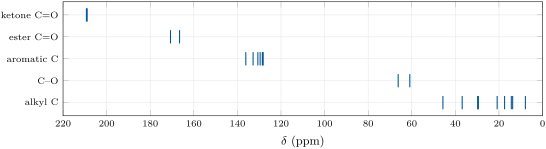
Shifts spread over about , twenty times the range of protons, so overlaps are rarer than in proton spectra, and the shift alone tells the kind of carbon. The chart below shows the shifts measured for the compounds of this chapter.
Proposition 33.4 (Heights are not counts)
In a routine decoupled spectrum the heights of the lines are not proportional to the numbers of carbons they represent; carbons without hydrogens give weak lines.
Argument. Routine spectra repeat the measurement faster than the slowest carbons relax back to equilibrium, and carbons without attached protons relax slowly, so their signal is partly saturated. Decoupling also enhances the signals of carbons carrying protons, by an amount that depends on their surroundings. In butan-2-one, the carbonyl line is the weakest of the four although it stands for one carbon like the others. Integration, so useful for protons, is therefore not used for routine carbon spectra. ∎
33.2 DEPT
Definition 33.5 (DEPT)
DEPT (distortionless enhancement by polarisation transfer) is a set of carbon-13 experiments that give the signals of carbons with attached protons a sign or an absence depending on their number of hydrogens. A quaternary carbon carries no hydrogen (bonded to four other atoms, or a carbonyl or aromatic carbon without H); it gives no DEPT signal.
Proposition 33.6 (Reading DEPT)
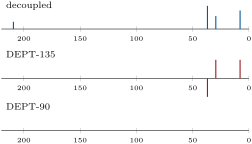
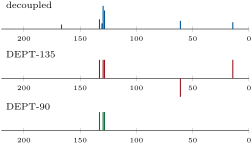
In DEPT-135, and carbons point up, carbons point down and quaternary carbons are absent. In DEPT-90, only carbons appear.
Proof. Admitted at this level. ∎
The experiment transfers magnetisation from the protons to the carbon they are bonded to, through a sequence of radio-frequency pulses whose last angle selects the response; how the pulses do it is explained in the Year 3 volume. Comparing the decoupled spectrum with DEPT-135 and DEPT-90 sorts every line into C, CH, or .
33.3 Combining the techniques
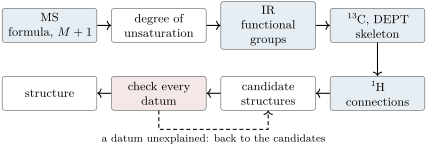
Each technique answers its own question, and the answers are assembled in a fixed order: the formula first, because it bounds everything else; then the functional groups and the skeleton; then the connections.
Method 33.7 (Solving an unknown)
- Formula: molecular ion, for the number of carbons, isotope patterns, nitrogen rule; an exact mass if available. Degree of unsaturation.
- Infrared: (and which kind), , , , aromatic or alkene above .
- Carbon-13 and DEPT: number of kinds of carbon (symmetry), their classes from the shifts, and C, CH, , from DEPT. Compare with the formula.
- Proton NMR: integrations, shifts, multiplicities; neighbours from the rule.
- Assemble the fragments; write every candidate structure.
- Check each candidate against every datum, including the mass-spectrum fragments; keep the one that explains them all.
33.4 Worked cases
Example 33.8 (A ketone, CHO)
An unknown has , an IR band near , carbon lines at 208.9, 45.7, 29.8, 17.4 and 13.7 ppm, and proton signals at 2.41 (t, 2H), 2.13 (s, 3H), 1.61 (sextet, 2H) and 0.91 (t, 3H). One degree of unsaturation, a saturated ketone (no aldehyde proton near 9.7). Five carbons, five lines: no symmetry. The singlet of three protons at 2.13 is a next to the carbonyl; the triplet, sextet, triplet sequence is a propyl group whose at 2.41 touches the carbonyl. Pentan-2-one, . Its symmetric isomer pentan-3-one would show three carbon lines and no singlet; its mass spectrum has the McLafferty ion at 58 that pentan-3-one lacks (Chapter 32).
Example 33.9 (An aromatic ester, CHO)
An unknown of formula (five degrees of unsaturation) shows a carbonyl band and seven carbon lines: 166.5 (C), 132.8 (CH), 130.6 (C), 129.6 (CH), 128.3 (CH), 60.9 () and 14.3 (). Its proton spectrum: 8.05 (m, 2H), 7.35–7.63 (m, 3H), 4.37 (q, 2H), 1.38 (t, 3H). A monosubstituted benzene ring (four aromatic carbon lines, two of them for two carbons each; five aromatic protons) accounts for four unsaturations, the carbonyl for the fifth. The quartet–triplet pair is an ethyl group; its at 4.37 (and at 60.9 in carbon) is bonded to oxygen. The ester carbonyl at 166.5 is bonded to the ring: the two protons at 8.05, next to it, are pushed downfield. Ethyl benzoate, .
33.5 Traps
- Exchangeable protons (, ) give broad signals at variable shifts, are often not coupled to their neighbours, and disappear when a drop of is shaken with the sample.
- Overlapping signals: two carbons of a benzene ring, or several of a chain, may share one line; count lines against the formula before concluding on symmetry.
- Diastereotopic protons: the two protons of a next to a stereocentre are not equivalent, may have different shifts and couple to each other.
- Second-order patterns: when two coupled protons have shifts closer than a few times their coupling constant, the multiplets lean towards each other and the rule fails; a higher-field spectrometer restores simple patterns.
Safety


Butan-2-one is flammable. The magnet of an NMR spectrometer is always on: no steel tools, gas cylinders or magnetic cards near it, and no access for people with pacemakers.
33.6 Exercises
Exercise 33.1 ★
How many lines does the decoupled spectrum of each xylene (1,2-, 1,3- and 1,4-dimethylbenzene) show?
Solution
Solution of Exercise 33.1.
1,2-Dimethylbenzene: 4 (; C1/C2; C3/C6; C4/C5). 1,3-: 5 (; C1/C3; C2; C4/C6; C5). 1,4-: 3 (; C1/C4; C2/C3/C5/C6).
Exercise 33.2 ★
Predict the DEPT-135 and DEPT-90 spectra of butan-2-ol.
Solution
Solution of Exercise 33.2.
. DEPT-135: C1 () up, C2 (CH) up, C3 () down, C4 () up. DEPT-90: C2 only.
Exercise 33.3 ★
To which kind of carbon does a line at 209, 170, 129, 64 and 14 ppm most likely belong?
Solution
Solution of Exercise 33.3.
209: ketone carbonyl; 170: ester (or acid) carbonyl; 129: aromatic carbon; 64: carbon bonded to an oxygen; 14: alkyl .
Exercise 33.4 ★
Compute the degree of unsaturation of and propose a structure containing a benzene ring.
Solution
Solution of Exercise 33.4.
: a benzene ring (4) and a (1). For instance methyl benzoate, , or 4-methylbenzoic acid.
Exercise 33.5 ★★
A liquid shows an IR band at and carbon lines at 209, 37, 29 and 8 ppm (DEPT-135: 37 down, 29 and 8 up, 209 absent). Identify it.
Solution
Solution of Exercise 33.5.
One unsaturation, a ketone (, line at 209, quaternary); one and two , four different carbons: butan-2-one, .
Exercise 33.6 ★★
How would you tell pentan-2-one from pentan-3-one with NMR alone? With proton NMR? With mass spectrometry?
Solution
Solution of Exercise 33.6.
Carbon: pentan-2-one shows five lines, symmetric pentan-3-one three. Protons: pentan-2-one has a three-proton singlet (); pentan-3-one only a quartet and a triplet. Mass spectrum: pentan-2-one has its base peak at 43 () and a McLafferty ion at 58; pentan-3-one has its base peak at 57 ().
Exercise 33.7 ★★
An ester has and proton signals at 4.12 (q, 2H), 2.04 (s, 3H) and 1.26 (t, 3H) (exercise data). Identify it.
Solution
Solution of Exercise 33.7.
, 88: the quartet–triplet pair is an (the at 4.12 is on oxygen), the singlet a . Ethyl ethanoate, .
Exercise 33.8 ★★
Distinguish 1,2-dichlorobenzene from 1,4-dichlorobenzene by NMR.
Solution
Solution of Exercise 33.8.
1,2-Dichlorobenzene: three lines (C1/C2, C3/C6, C4/C5). 1,4-Dichlorobenzene: two (C1/C4, the four CH). DEPT-90 shows two CH lines for the first, one for the second.
Exercise 33.9 ★★
In 2-chlorobutane, why are the two protons of the group not equivalent? What does that do to the proton spectrum?
Solution
Solution of Exercise 33.9.
C2 is a stereocentre. Replacing one or the other proton of C3 by a deuterium gives two diastereoisomers, not enantiomers: the two protons are diastereotopic, in different surroundings. They can have different shifts and couple to each other as well as to their neighbours, so the gives a complex multiplet instead of a simple quintet.
Exercise 33.10 ★★★
An unknown shows an IR band at , carbon lines at 200.8 (C), 137.0 (C), 132.9 (CH), 128.6 (CH), 128.0 (CH), 31.8 () and 8.3 (), and proton signals at 7.95 (m, 2H), 7.40–7.55 (m, 3H), 2.98 (q, 2H) and 1.22 (t, 3H) (exercise data). Identify it, and explain the low carbonyl wavenumber.
Solution
Solution of Exercise 33.10.
Five unsaturations; a monosubstituted ring (three CH lines and one C line at 137.0, five aromatic H); a ketone (200.8, C); an ethyl group ( 31.8 quartet at 2.98 next to the carbonyl, 8.3). 1-Phenylpropan-1-one, . Conjugation with the ring delocalises the electrons and weakens the bond: the band falls below the of a saturated ketone.
Exercise 33.11 ★★★
Four isomers : pentanoic acid, methyl butanoate, ethyl propanoate and propyl ethanoate. Give for each one feature of its IR or proton NMR spectrum that tells it from the other three.
Solution
Solution of Exercise 33.11.
Pentanoic acid: the very broad band from 2500 to and a proton near 11–12 ppm. Methyl butanoate: a three-proton singlet in the range of protons on a carbon bonded to oxygen (3.3–4.5). Ethyl propanoate: two quartets, one on oxygen and one next to the carbonyl. Propyl ethanoate: a three-proton singlet next to the carbonyl (2.0–2.4) and a triplet on oxygen.
Exercise 33.12 ★★★
A report assigns the line at 166.5 ppm of ethyl benzoate to the ring carbon bearing the ester and the line at 130.6 ppm to the carbonyl carbon. Show, with the DEPT data and the shift chart, that the assignment cannot be right.
Solution
Solution of Exercise 33.12.
Both lines vanish in DEPT, so both are quaternary, and DEPT alone cannot tell them apart. The shifts can: ester carbonyls lie near 167–171 and aromatic carbons between 128 and 137 in the chart of this chapter. A ring carbon at 166.5 and a carbonyl at 130.6 would both lie far outside their classes; the correct assignment is the reverse.
33.7 Problem: Four Spectra of Jasmine
Problem 33.1
Weekend problem — the formula from the molecular ion, the infrared carbonyl band, carbon-13 and DEPT, the proton spectrum, and a structure checked against the fragments
A colourless liquid with a flowery odour of jasmine gives the following data. Mass spectrum (NIST WebBook): 150 (31.7), 151 (3.1), 108 (100), 91 (71.7), 90 (40.6), 43 (37.6). Infrared (exercise data): strong bands at 1740 and , weak bands just above , no broad band near . Carbon-13, CDCl (PubChem data): 170.70, 136.14, 128.56, 128.24, 66.24, 20.82 ppm. Proton, CDCl, : 7.33 (m, 5H), 5.09 (s, 2H), 2.06 (s, 3H).

Part I — The formula.
- From the 151/150 ratio, estimate the number of carbons.
- What does the nitrogen rule say?
- With nine carbons, what remains of the mass 150? Propose a formula with oxygen.
- Why is , also of nominal mass 150, less likely?
- Compute the degree of unsaturation.
- Compute the monoisotopic mass of the formula retained.
Part II — Infrared.
- Assign the band at . Which family does its position suggest?
- Assign the band at .
- What do the weak bands above indicate?
- What does the absence of a broad band near exclude?
- Is the carbonyl conjugated with the ring? Explain from its wavenumber.
Part III — Carbon-13 and DEPT.
- Assign each line to a kind of carbon.
- Which line points down in DEPT-135?
- Which lines vanish in DEPT-135?
- Which lines remain in DEPT-90?
- How many kinds of carbon does a monosubstituted benzene ring have? Explain why only two aromatic CH lines appear.
- The line at 128.24 is the tallest. Does it stand for the most carbons?
Part IV — Proton NMR and structure.
- Assign the three proton signals.
- Why are the signals at 5.09 and 2.06 singlets?
- Why is the at 5.09 so far downfield?
- Assemble the structure and name it.
- Its isomer methyl 2-phenylethanoate, , has the same formula. Which datum rules it out?
- Explain the fragments at 108, 91 and 43.
- How many lines would a perfectly resolved decoupled spectrum of the compound show, and how many of them point down in DEPT-135?
Solution
Solution of Problem 33.1.
1. ; carbons. 2. Even mass: no nitrogen (or two). 3. : fits (10 + 32): . 4. Ten carbons would give of , not 9.8 %; and the IR shows a carbonyl, which needs a second oxygen besides the band. 5. . 6. . 7. A stretch at the position of a saturated ester (near ). 8. The stretch of the ester. 9. Aromatic (or alkene) bonds. 10. An group: no alcohol, no carboxylic acid. 11. No: a carbonyl conjugated with a ring absorbs at lower wavenumber; here it sits where saturated esters do, so a non-conjugating group separates it from the ring. 12. 170.70: ester ; 136.14: ring carbon bearing the substituent; 128.56 and 128.24: aromatic CH; 66.24: bonded to oxygen; 20.82: . 13. 66.24, the . 14. 170.70 and 136.14, the two carbons without hydrogen. 15. 128.56 and 128.24. 16. Four: the carbon bearing the substituent, the two ortho, the two meta and the para CH. Three CH kinds are expected; two of them have shifts too close to be resolved at this field, and share a line. 17. Not necessarily: heights are not counts (Proposition 33.4), though here the line may well contain two overlapping CH kinds. 18. 7.33: the five aromatic protons; 5.09: the ; 2.06: the . 19. Their neighbouring atoms (the ring carbon and the oxygen for the , the carbonyl carbon for the ) carry no hydrogen. 20. It is bonded to the electronegative oxygen of the ester and to the ring: both deshield it. 21. , benzyl ethanoate. 22. In the isomer the is not bonded to oxygen, so it could not appear at 5.09, and the methyl, on oxygen, would appear in the 3.3–4.5 range, not at 2.06 next to a carbonyl.
23. 108: loss of 42 (ketene, ) by rearrangement, the radical cation of ; 91: , the benzyl cation; 43: . 24. Seven kinds of carbon (, the substituted ring carbon, ortho, meta and para CH, , ): seven lines, one of them (the ) pointing down in DEPT-135.