 Coach
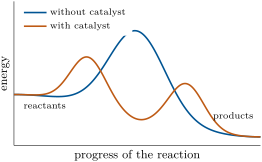
CoachA catalyst is a species that makes a reaction faster without being used up: it takes part in the mechanism but is given back, unchanged, at the end, and it does not appear in the overall equation. The speeding up of a reaction by a catalyst is catalysis.
Examples
Example 42.4 (Iodide ions and hydrogen peroxide)
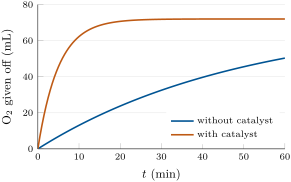
Hydrogen peroxide decomposes very slowly on its own: . With a little potassium iodide dissolved in it, it froths at once. The iodide ion opens a path in two steps:
Added, the two steps give back : the iodide ion, used in the first step and returned in the second, is the catalyst; the ion is an intermediate.
Example 42.5 (Iron(III) ions)
Iron(III) ions also catalyse the decomposition, through the couple / (Chapter 35): they first oxidise hydrogen peroxide, , then the iron(II) ions formed are oxidised back by more hydrogen peroxide, . The pale orange colour of the solution turns greenish while the gas is given off, then comes back when the hydrogen peroxide is used up: a sign that the catalyst takes part and is regenerated.
Example 42.6 (The catalytic converter)
The exhaust of a petrol engine contains carbon monoxide and nitrogen monoxide, both toxic, and unburnt fuel. In the catalytic converter, a ceramic honeycomb coated with platinum and rhodium, they react on the metal surface:
and the hydrocarbons burn to carbon dioxide and water. The gases cross the converter in a fraction of a second, too fast for any reaction without a catalyst.