School Chemistry — Grades 1 to 12 · Grades 1–12
35Oxidation and Reduction
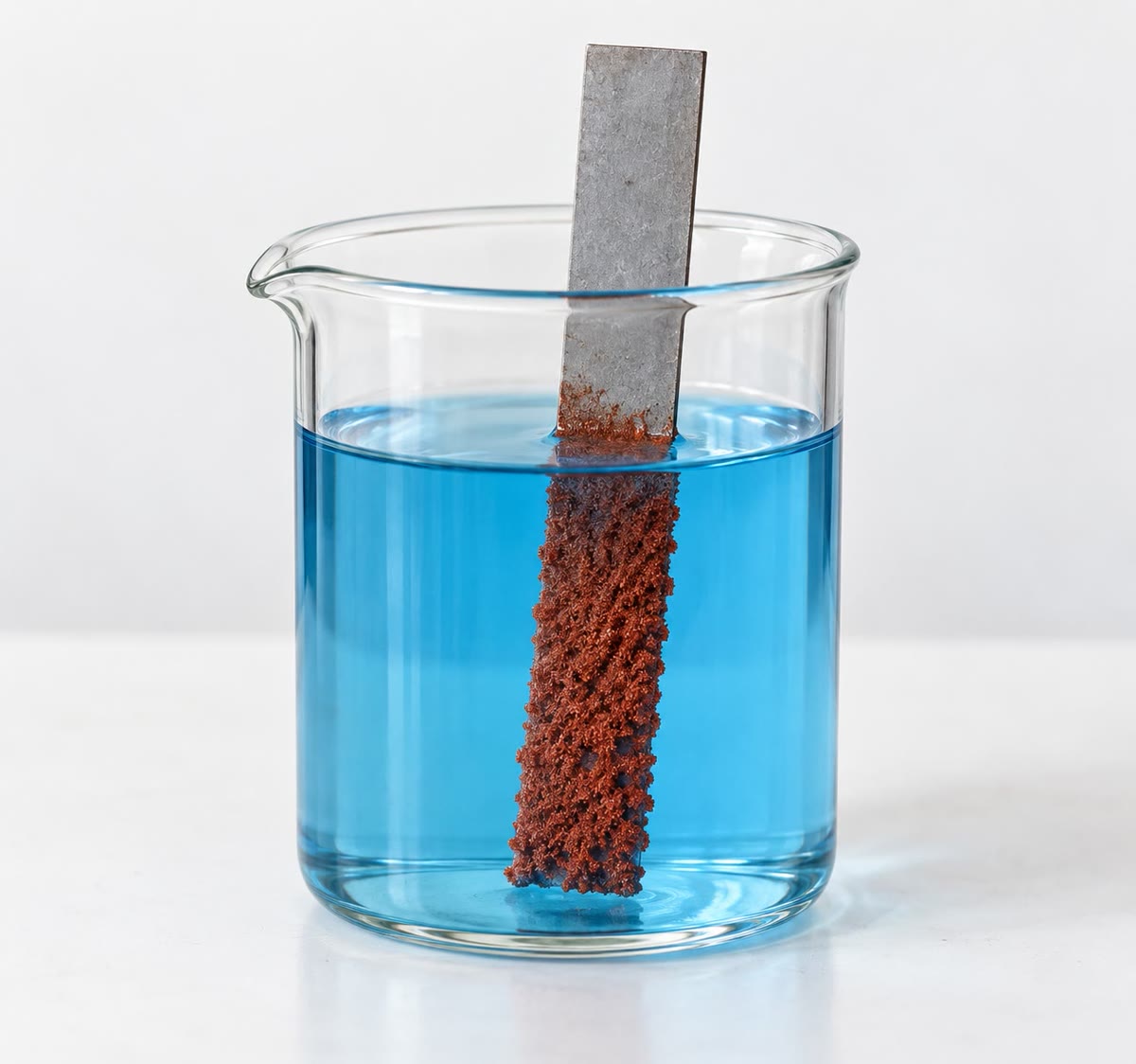
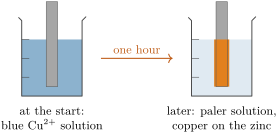
A zinc strip is dipped into a blue solution of copper sulfate. Within minutes its surface darkens under a spongy, reddish-brown coat; an hour later the blue of the solution has faded. Copper metal has appeared where there was none, and zinc has gone into solution as invisible ions. Nothing was heated, no gas was given off, no oxygen took part — and yet chemists call this an oxidation. The word once meant “combining with oxygen”; it now means something more general and more useful: the loss of electrons. This chapter follows the electrons.
You already know
An ion is an atom or a group of atoms that has gained or lost electrons (Chapter 17). A metal such as iron or zinc reacts with hydrochloric acid to give hydrogen and metal ions (Chapter 19). An amount of substance , in moles, is computed from a mass by (Chapter 25).
35.1 Oxidants and reductants
Definition 35.1 (Oxidant and reductant)
An oxidant is a species able to gain one or more electrons. A reductant is a species able to give one or more electrons away.
Definition 35.2 (Oxidation and reduction)
An oxidation is a loss of electrons; a reduction is a gain of electrons. A reductant is oxidised; an oxidant is reduced.
Remark 35.3 (A way to remember)
In reduction the charge of the species is reduced: gaining two electrons becomes , charge . In an oxidation the charge goes up: , .
Definition 35.4 (Redox couple and half-equation)
An oxidant and the reductant it becomes by gaining electrons form a redox couple, written Ox/Red with the oxidant first: /, /. The exchange of electrons inside a couple is described by its half-equation,
balanced in atoms and in charge, for instance . The double arrow says that the exchange can go either way.
Example 35.5 (Metals and their ions)
Every metal forms a couple with its ion:
| couple | half-equation |
|---|---|
| / | |
| / | |
| / | |
| / | |
| / |
Ions can form couples too: for the couple /, and for /. So can hydrogen: for /.
Remark 35.6 (One species, two roles)
A species can be the reductant of one couple and the oxidant of another. The ion is the oxidant of / and the reductant of /. Which role it plays depends on its partner in the reaction.
35.2 Redox reactions
Definition 35.7 (Redox reaction)
A redox reaction is a transfer of electrons from the reductant of one couple to the oxidant of another. The reductant is oxidised and the oxidant is reduced, at the same time.
Proposition 35.8 (No free electrons)
Electrons do not exist free in a solution: every electron given by the reductant is taken by the oxidant. The equation of a redox reaction is therefore obtained by adding the two half-equations, each multiplied by the number that makes the electrons given equal to the electrons taken; the electrons then cancel and do not appear in the equation.
Example 35.9 (Zinc and copper ions)
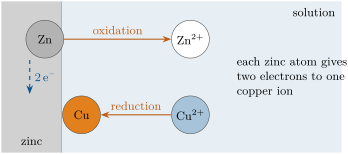
In the opening scene the zinc is oxidised and the copper ions are reduced:
Two electrons pass from each zinc atom to one copper ion. The blue colour of the solution is the colour of the ions; it fades as they are used up, while the colourless ions take their place.
Example 35.10 (Metals in acid, revisited)
When iron dissolves in hydrochloric acid, the iron is oxidised and the ions are reduced to hydrogen:
The couples are / and /; the chloride ions take no part.
In the lab — The silver tree
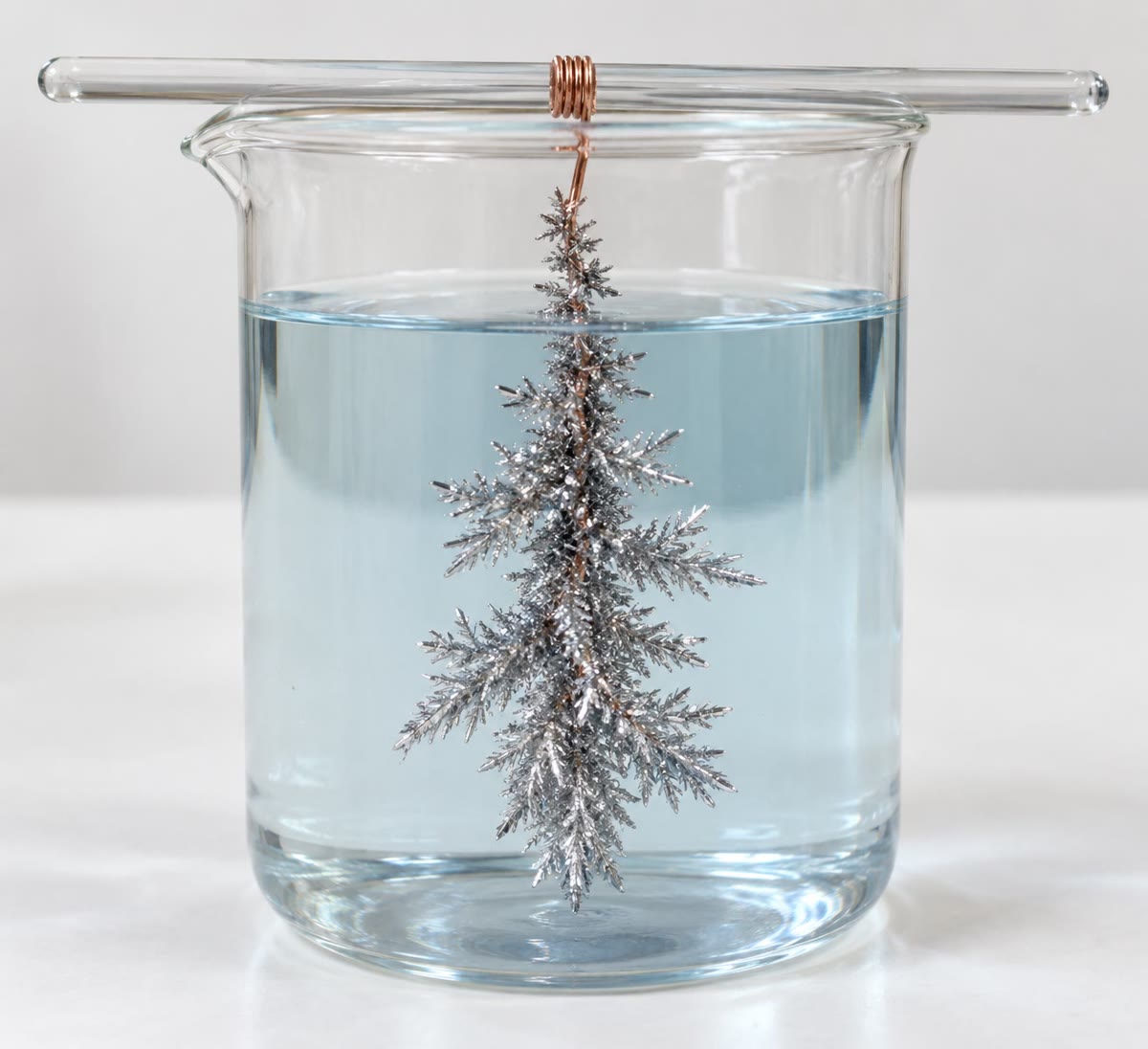
A coil of clean copper wire is hung in a beaker of dilute silver nitrate solution, . Within an hour, branching needles of shiny silver grow along the wire, and the colourless solution turns pale blue: . The experiment is made by the teacher, with gloves and goggles, and the solution is collected afterwards as hazardous waste.
Safety


Silver nitrate: an oxidiser that can feed a fire (GHS03); corrosive to skin and eyes, and it stains the skin black (GHS05); a health hazard (GHS08); very toxic to aquatic life, so it never goes down the sink (GHS09).
35.3 Balancing half-equations
Many important couples contain oxygen and are written for acidic solutions, where ions are present. Their half-equations need water molecules and ions to balance.
Method 35.11 (Balancing a half-equation in acidic solution)
To write the half-equation of a couple Ox/Red in acidic solution:
Example 35.12 (The permanganate ion)
For the couple / (deep purple to almost colourless): manganese is balanced; four O on the left give on the right; their eight H give on the left; the charge on the left is , on the right , so five electrons are added on the left:
Example 35.13 (The dichromate ion)
For / (orange to green): two chromium on the right; seven O give ; fourteen H give ; charge on the left against on the right, so six electrons:
Method 35.14 (Writing a redox equation)
To write the equation of the reaction between the oxidant Ox of one couple and the reductant Red of another:
- write both half-equations, the first in the direction of the reduction (Ox Red), the second in the direction of the oxidation (Red Ox);
- multiply them by the smallest numbers that make the electrons equal;
- add them; the electrons cancel, and so may some and that appear on both sides;
- check atoms and charge once more.
Example 35.15 (Permanganate and iron(II))
The permanganate ion oxidises ions to :
Charge on the left: ; on the right: . This reaction is used in the next chapter to measure an amount of iron(II).
35.4 Oxidants and reductants around us
Proposition 35.16 (Some common oxidants and reductants)
The following species are met again and again in the laboratory and in everyday life:
Example 35.17 (Copper turns green)
Copper roofs and statues, left in the open air for decades, slowly turn pale green. Oxygen from the air oxidises the copper to ions, which, with water and carbon dioxide, form a thin green crust, the patina. Unlike rust on iron, the patina sticks to the metal and protects it from further attack.

Remark 35.18 (Antioxidants)
An “antioxidant” added to food is a reductant that is oxidised by the oxygen of the air before the food is. Vitamin C (ascorbic acid) is the commonest: a cut apple sprinkled with lemon juice browns much more slowly, because the vitamin C of the lemon is oxidised first.
35.5 Exercises
Exercise 35.1 ★
Define an oxidant, a reductant, an oxidation and a reduction.
Exercise 35.2 ★
For each pair, write the redox couple in the form Ox/Red: and ; and ; and ; and .
Solution
Solution of Exercise 35.2.
/; /; /; /.
Exercise 35.3 ★
Write the half-equations of the couples /, /, / and /.
Solution
Solution of Exercise 35.3.
; ; ; .
Exercise 35.4 ★
Is the transformation an oxidation or a reduction? Is iron acting as an oxidant or a reductant?
Exercise 35.5 ★
In the reaction , name the species oxidised, the species reduced, the oxidant and the reductant, and give the number of electrons transferred for each zinc atom.
Exercise 35.6 ★★
Balance, in acidic solution, the half-equation of the couple /, following Method 35.11 step by step.
Solution
Solution of Exercise 35.6.
Start from : oxygen: two O on the left, so on the right; hydrogen: 2 on the left, 4 on the right, so on the left; charge: on the left, 0 on the right, so two electrons on the left: .
Exercise 35.7 ★★
Write the equation of the reaction between iodine and the thiosulfate ion , which gives iodide ions and tetrathionate ions .
Exercise 35.8 ★★
Write the equation of the silver tree reaction from its two half-equations, and explain why the solution turns blue.
Exercise 35.9 ★★
Vitamin C, , reacts with iodine . Write the equation of the reaction, and say which species is the reductant.
Exercise 35.10 ★★
Aluminium reacts with copper(II) ions. Write the equation, and explain why the half-equations must be multiplied by 2 and by 3.
Solution
Solution of Exercise 35.10.
gives 3 electrons, takes 2; the smallest common number is 6, so the first is multiplied by 2 and the second by 3: .
Exercise 35.11 ★★
Hydrogen peroxide oxidises iron(II) ions to iron(III) ions in acidic solution. Write the equation.
Solution
Solution of Exercise 35.11.
and (): .
Exercise 35.12 ★★★
A zinc strip loses in a solution containing an excess of copper(II) ions. What mass of copper is deposited? Take and .
Exercise 35.13 ★★★
Write the equation of the oxidation of iron(II) ions by dichromate ions in acidic solution. What amount of is oxidised by of dichromate ions?
Exercise 35.14 ★★★
Bleach contains hypochlorite ions and chloride ions . Using the couples / and /, write the equation of the reaction that takes place when bleach meets an acid, and explain why the labels of bleach and of acidic descaling products both warn never to mix them.
Exercise 35.15 ★★★
In the figure of the zinc surface, the electrons travel through the metal, not through the solution. Using Proposition 35.8, explain why the copper is deposited on the zinc strip itself and not elsewhere in the beaker.
35.6 Problem: The Breath Test
Problem 35.1
Weekend problem — the chemistry of a breath-alcohol tube: two couples, an orange-to-green colour change, the mass of ethanol a tube can detect, and the fuel cell that replaced it
The first breath-alcohol tests used a glass tube filled with grains of silica coated with orange potassium dichromate, , in acid. Ethanol, , in the breath blown through the tube reduces the dichromate ions to green ions and is oxidised to ethanoic acid, ; the length of the green zone measures the ethanol. Suppose that a tube contains of potassium dichromate. Use , , , , , and .
Part I — Two couples.
- Name the two redox couples involved, oxidant first.
- Is ethanol oxidised or reduced? Is it the oxidant or the reductant?
- Write the half-equation of the couple / in acidic solution.
- Write the half-equation of the couple / in acidic solution.
- Deduce the equation of the reaction in the tube.
Part II — What one tube can measure.
- Explain the colour change of the grains.
- Compute the molar mass of potassium dichromate.
- Compute the amount of dichromate ions in the tube.
- What amount of ethanol is needed to turn the whole tube green?
- Deduce the largest mass of ethanol one tube can measure.
Part III — From breath to blood. A person blows of breath through the tube; the green zone grows in proportion to the mass of ethanol that reaches it.
- The breath contains of ethanol per litre. What fraction of the dichromate is used?
- The tube is long. How long is the green zone?
- Breath analysers assume that of breath carry as much ethanol as of blood. Estimate the mass of ethanol per litre of blood, in grams.
- Why does the green zone start at the inlet of the tube and grow towards the outlet, instead of the whole tube turning slightly green?
- Why can a tube be used only once?
Part IV — The fuel cell. Potassium dichromate carries the pictograms 


 . Modern devices use instead a fuel cell, in which the ethanol of the breath is oxidised by dioxygen on an electrode, and the electrons released flow through a wire.
- Give two reasons, read from the pictograms, why dichromate tubes were abandoned.
- Write the equation of the oxidation of ethanol by dioxygen, using the couple /.
- How many electrons does one ethanol molecule give up when it is oxidised to ethanoic acid?
- For of ethanol, compute the amount of ethanol, then the number of electrons released.
- Deduce the electric charge that flows through the fuel cell. Why is this charge a good measure of the ethanol in the breath?
Solution
Solution of Problem 35.1.
1. / and /.
2. Ethanol is oxidised: it is the reductant.
3. .
4. Carbon is balanced (two on each side). Oxygen: two on the left, one on the right, so on the right. Hydrogen: four on the left, on the right, so on the left. Charge: on the left, 0 on the right, so four electrons on the left: .
5. Twelve electrons: the first, the second reversed: .
6. Orange ions are reduced to green ions wherever ethanol reaches them.
7. .
8. .
9. Three ethanol molecules per two dichromate ions: .
10. , so , about .
11. : about of the dichromate.
12. .
13. per litre of blood, about .
14. The breath meets the grains at the inlet first; the dichromate there is in excess and removes all the ethanol, so the reaction is complete in a first stretch of the tube, which turns fully green, before any ethanol reaches further.
15. The reaction is total: the green ions do not go back to dichromate, so a used tube cannot measure again.
16. It is acutely toxic (GHS06) and a serious health hazard (GHS08: its hazard statements include “may cause cancer”), as well as corrosive and toxic to aquatic life; a device used by the public must not contain it.
17. and : .
18. Four electrons.
19. of ethanol; electrons , that is electrons.
20. . Each ethanol molecule sends exactly four electrons through the wire, so the charge is proportional to the amount of ethanol: measuring it measures the ethanol.