School Chemistry — Grades 1 to 12 · Grades 1–12
42Catalysis
A bottle of hydrogen peroxide solution sits in a bathroom cabinet for months without change. Poured on a grazed knee, it foams at once: something in the blood makes it decompose in seconds into water and oxygen. That something is not used up, and it does not appear in the equation of the reaction. It is a catalyst. Catalysts make most of the chemical industry possible, clean the exhaust of cars, and run every reaction of life.
You already know
The rate of a reaction and the kinetic factors that change it (Chapter 41). A mechanism is a series of elementary steps, through intermediates (Chapter 40).
42.1 What a catalyst is
Definition 42.1 (Catalyst, catalysis)
A catalyst is a species that makes a reaction faster without being used up: it takes part in the mechanism but is given back, unchanged, at the end, and it does not appear in the overall equation. The speeding up of a reaction by a catalyst is catalysis.
Proposition 42.2 (A catalyst changes the path, not the destination)
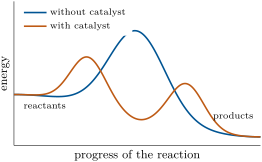
A catalyst opens a different mechanism, whose energy barriers are lower than that of the uncatalysed reaction, so that more of the meetings between particles succeed. It does not change the products formed, nor the final state reached; it only reaches it sooner.
Proof. Admitted: the profile is studied in the Year 1 volume. That the final state is unchanged follows from the catalyst being given back: the overall reaction, reactants and products, is the same. ∎
42.2 Homogeneous catalysis
Definition 42.3 (Homogeneous and heterogeneous catalysis)
The catalysis is homogeneous catalysis when the catalyst is in the same phase as the reactants (for example dissolved with them), heterogeneous catalysis when it is in another phase, usually a solid whose surface the reactants reach from a gas or a liquid.
Example 42.4 (Iodide ions and hydrogen peroxide)
Hydrogen peroxide decomposes very slowly on its own: . With a little potassium iodide dissolved in it, it froths at once. The iodide ion opens a path in two steps:
Added, the two steps give back : the iodide ion, used in the first step and returned in the second, is the catalyst; the ion is an intermediate.
Example 42.5 (Iron(III) ions)
Iron(III) ions also catalyse the decomposition, through the couple / (Chapter 35): they first oxidise hydrogen peroxide, , then the iron(II) ions formed are oxidised back by more hydrogen peroxide, . The pale orange colour of the solution turns greenish while the gas is given off, then comes back when the hydrogen peroxide is used up: a sign that the catalyst takes part and is regenerated.
42.3 Heterogeneous catalysis
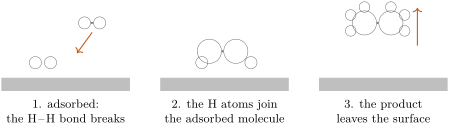
Many industrial catalysts are solids: metals such as platinum, palladium, nickel or iron, or oxides. The reaction takes place on their surface, in three stages: the reactant molecules are held on the surface (adsorbed), where their bonds are weakened; they react there; the products leave the surface, which is free for new molecules. A catalyst is therefore made with as large a surface as possible: fine powder, or a thin coat on a porous support.
Example 42.6 (The catalytic converter)
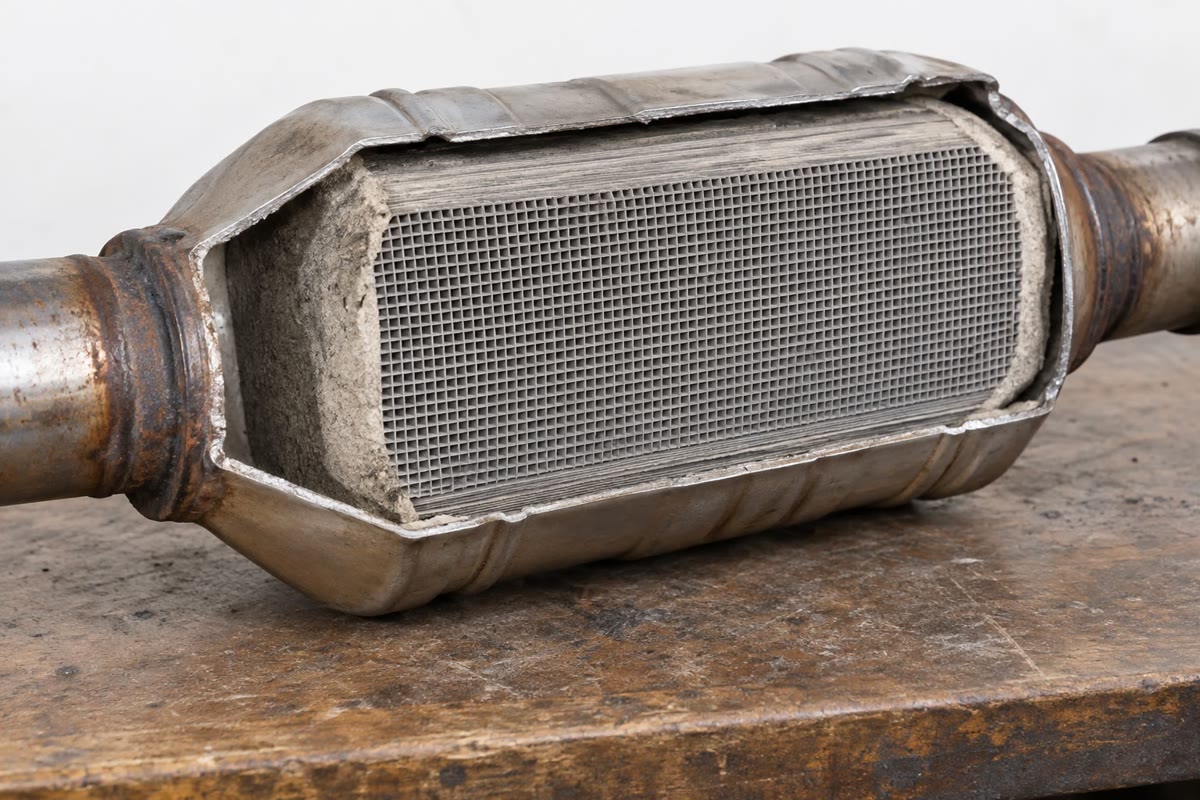
The exhaust of a petrol engine contains carbon monoxide and nitrogen monoxide, both toxic, and unburnt fuel. In the catalytic converter, a ceramic honeycomb coated with platinum and rhodium, they react on the metal surface:
and the hydrocarbons burn to carbon dioxide and water. The gases cross the converter in a fraction of a second, too fast for any reaction without a catalyst.

History — Haber, Bosch and ammonia
At the beginning of the twentieth century the chemist Fritz Haber found how to combine the nitrogen of the air with hydrogen, , on an iron-based catalyst, and the engineer Carl Bosch turned it into an industrial process. It still runs today at 400 to and 150 to . In 2024 the world made ammonia containing about 150 million tonnes of nitrogen, most of it for fertilisers: a large share of the nitrogen in the food we eat has passed through such a catalyst.
42.4 Enzymes
Definition 42.7 (Enzyme)
An enzyme is a protein made by a living organism that catalyses one reaction of its chemistry. Enzymes are very efficient and very specific: each fits a few molecules only, and they work best in a narrow range of temperature and acidity.
Example 42.8 (Catalase)
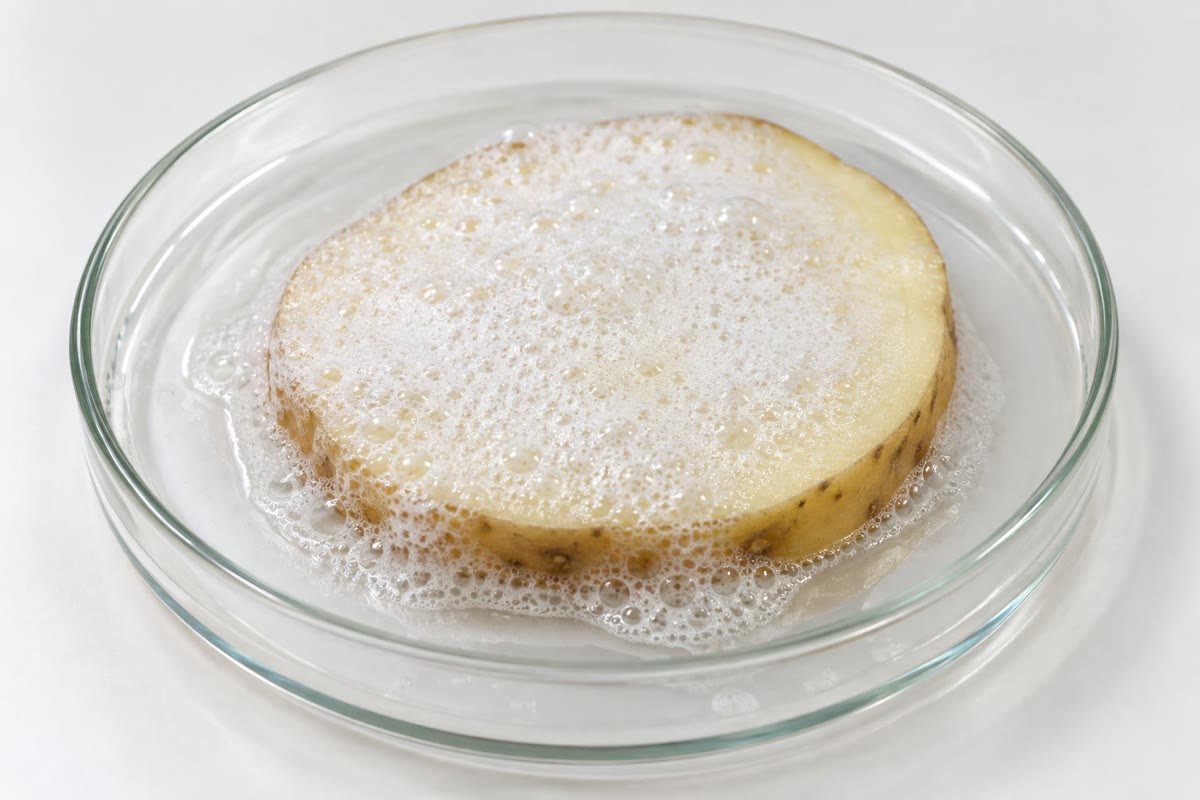
Hydrogen peroxide is formed in cells as a by-product, and is harmful to them. The enzyme catalase, present in blood, liver and many plant tissues, decomposes it into water and oxygen at enormous speed: that is the foam on a grazed knee, or on a slice of raw potato. Boiled potato gives no foam: heating has destroyed the shape of the enzyme.
42.5 Selectivity
Definition 42.9 (Selective catalyst)
When the same reactants can give several reactions, a selective catalyst speeds up one of them much more than the others, and so decides which products form.
Example 42.10 (Two fates of ethanol)
Hot ethanol vapour passed over alumina loses water and gives ethene, (an elimination); passed over hot copper, it loses hydrogen and gives ethanal, . Same reactant, two catalysts, two products.
Remark 42.11 (Industry and life run on catalysts)
Most products of the chemical industry, from fuels to plastics and fertilisers, are made with catalysts; finding a more active or more selective catalyst saves energy and waste. Every reaction of a living cell is catalysed by an enzyme.
Safety


Concentrated hydrogen peroxide is a strong oxidant that can feed a fire, burns the skin and the eyes, and is harmful if swallowed. The dilute solutions of the laboratory still need goggles and gloves; the decomposition releases oxygen, so it is never done in a closed vessel.
42.6 Exercises
Exercise 42.1 ★
In the decomposition of hydrogen peroxide catalysed by iodide ions, which species are reactants, which are products, which is the catalyst, which is an intermediate?
Exercise 42.2 ★
Homogeneous or heterogeneous catalysis: iodide ions in hydrogen peroxide solution; platinum in a catalytic converter; iron in the ammonia synthesis; iron(III) ions in hydrogen peroxide solution?
Solution
Solution of Exercise 42.2.
Homogeneous; heterogeneous; heterogeneous; homogeneous.
Exercise 42.3 ★
On the energy profiles, which path has the higher barrier? Are the starting and final energies the same on both paths? What does this mean for the products?
Solution
Solution of Exercise 42.3.
The uncatalysed path. The start and end levels are the same: the same products form, with the same energy released; only the path differs.
Exercise 42.4 ★
Why does a catalyst not appear in the overall equation of a reaction?
Solution
Solution of Exercise 42.4.
It is used in one step and given back in another: it appears on both sides of the sum of the steps, and cancels.
Exercise 42.5 ★
Why are the solid catalysts of industry used as fine powders or as thin coats on porous supports?
Exercise 42.6 ★★
Add the two steps of the iron(III)-catalysed decomposition of hydrogen peroxide, and show that the iron ions and the hydrogen ions cancel.
Exercise 42.7 ★★
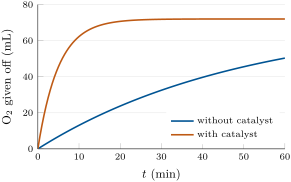
Read the curves of the oxygen given off. How long does each run take to release half of the final volume? By what factor does the catalyst shorten it?
Exercise 42.8 ★★
Leaded petrol is not used in cars fitted with a catalytic converter: the lead deposits on the platinum and stays there. Explain why this ruins the converter, although the platinum is not used up by the normal reaction.
Exercise 42.9 ★★
A student measures the foam produced by potato slices in hydrogen peroxide at 10, 25, 37, 60 and : the foam grows up to about , then falls, and nearly vanishes at . Explain both parts of the curve.
Solution
Solution of Exercise 42.9.
Up to about , the reaction speeds up with the temperature, like any reaction. Above, the enzyme, a protein, loses its shape and with it its activity; at it is destroyed.
Exercise 42.10 ★★
Write the equation of the reaction in a catalytic converter between carbon monoxide and nitrogen monoxide, and check that it is balanced. Why are both pollutants removed at once?
Solution
Solution of Exercise 42.10.
: C 2 = 2, O 4 = 4, N 2 = 2. Carbon monoxide is oxidised by nitrogen monoxide, which is reduced: each pollutant removes the other.
Exercise 42.11 ★★
of hydrogen peroxide solution give off of oxygen at when decomposed completely. Compute the amount of oxygen (), then the concentration of the solution in hydrogen peroxide.
Solution
Solution of Exercise 42.11.
; in : .
Exercise 42.12 ★★★
Ethanol vapour passed over alumina gives ethene; over copper it gives ethanal. Write both equations, give the category of the first, and explain what a selective catalyst is.
Solution
Solution of Exercise 42.12.
, an elimination; . A selective catalyst speeds up one of several possible reactions much more than the others, and so decides the product.
Exercise 42.13 ★★★
A catalyst makes a reaction ten times faster. A student claims it also gives ten times more product. Correct the claim, using the curves of the oxygen given off.
Solution
Solution of Exercise 42.13.
The catalyst does not change the final state: the curves with and without catalyst end at the same volume of oxygen. The same amount of product is obtained, only sooner.
Exercise 42.14 ★★★
A molecule of catalase decomposes about a few million molecules of hydrogen peroxide per second. Taking per second, how long does one enzyme molecule take to decompose one mole of hydrogen peroxide? How many enzyme molecules would do it in one second? (A computation on orders of magnitude; the rate is exercise data.)
Exercise 42.15 ★★★
The world made about 150 million tonnes of nitrogen in ammonia in 2024. What mass of ammonia is that? What amount of dinitrogen was combined?
42.7 Problem: The Hairdresser’s Peroxide
Problem 42.1
Weekend problem — what is the concentration of “20-volume” hydrogen peroxide?
Hairdressers use hydrogen peroxide solutions labelled in “volumes”: a “20-volume” solution is one of which gives off of oxygen when it decomposes completely, the gas being measured at and normal atmospheric pressure, where one mole of gas occupies .
Part I — The decomposition.
- Write the equation of the decomposition of hydrogen peroxide.
- Is the decomposition a redox reaction? Find the oxidant and the reductant (hydrogen peroxide is both).
- Why does a bottle keep for months, though the reaction is possible?
Part II — What “20 volumes” means.
- What amount of oxygen does of the solution give off?
- Deduce the amount of hydrogen peroxide in .
- Give the molar concentration.
- Compute the molar mass of hydrogen peroxide and the mass concentration.
- What would “10 volumes” mean in moles per litre?
Part III — Two catalysts.
- A drop of blood (catalase) and a few drops of iron(III) chloride are each added to a sample. Which catalysis is each?
- Write the two steps of the iron(III) catalysis and check that their sum is the decomposition.
- Using the curves of the oxygen given off, describe how the volume of oxygen changes with and without catalyst, and what stays the same.
- Why does the colour of an iron(III)-catalysed sample change during the reaction and come back at the end?
- Why does a boiled potato not make the solution foam?
Part IV — The bottle.
- What volume of oxygen, measured at , can a bottle give off?
- What volume is that at ()?
- Why must the cap of such a bottle let gas escape slowly?
- A bottle stored for a long time is titrated and found to contain . How many “volumes” is that now?
- What fraction of the hydrogen peroxide has decomposed?
- State the final answer: what is the molar concentration of a “20-volume” hydrogen peroxide solution?
Solution
Solution of Problem 42.1.
1. .
2. Yes: hydrogen peroxide is the oxidant of the couple / and the reductant of the couple /; it oxidises and reduces itself.
3. Without a catalyst the reaction is extremely slow.
4. .
5. Two moles of hydrogen peroxide per mole of oxygen: .
6. .
7. ; .
8. Half: .
9. Catalase: an enzyme, dissolved, a biological catalyst; iron(III) ions: homogeneous catalysis.
10. and ; their sum is .
11. With a catalyst the volume rises much faster; both curves level off at the same final volume.
12. The iron(III) ions (orange) are turned into iron(II) (pale green) in the first step and back into iron(III) in the second; at the end, all the iron is iron(III) again.
13. Boiling has destroyed the enzyme.
14. .
15. , that is .
16. The slow decomposition releases oxygen, which would build up pressure in a tight bottle.
17. of oxygen per litre, that is : “16.8 volumes”.
18. .
19. .