
All books

Professional

Apps About Coach Log in Start reading

Chemistry · Glossary

What is Catalyst, homogeneous and heterogeneous catalysis?

Also known as: catalyst · homogeneous catalysis · heterogeneous catalysis

Definition 9.15 University Chemistry — Year 1 · Chapter 9 — Reaction Mechanisms: Elementary Steps and Approximations

A catalyst is a species that increases the rate of a reaction without appearing in its overall equation: consumed in one step of the mechanism, it is regenerated in a later one. In homogeneous catalysis the catalyst is in the same phase as the reactants (dissolved acids, metal complexes, enzymes); in heterogeneous catalysis it is a separate phase, usually a solid on whose surface the reaction takes place (platinum, iron, zeolites).
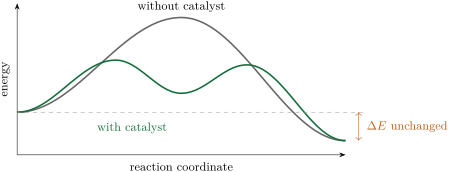
A catalyst opens a path with lower barriers (green), often in several steps; the start and the end, hence the energy of reaction and the equilibrium, are the same.
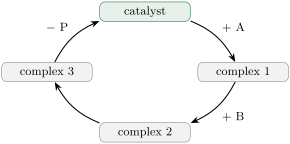
A catalytic cycle: the catalyst binds the reactants A and B in turn, the product P is released, and the catalyst is regenerated to start again. Catalytic cycles of metal complexes are studied in the Year 2 volume.
Read in context →