University Chemistry — Year 1 · Bachelor Year 1
9Reaction Mechanisms: Elementary Steps and Approximations
Nitrogen monoxide, formed in car engines and lightning, combines with the oxygen of the air: . Measured in the laboratory, the rate of this reaction is proportional to — and it goes slower when the gas is heated. A single collision of three molecules could explain the first fact, never the second: every collision gets more energetic with temperature. The explanation is that the reaction is not one event but a sequence of simpler ones, its mechanism. This chapter defines these elementary steps, the energy profile along which they run, and the approximations that turn a mechanism into a rate law; it ends with catalysis, the art of opening an easier path.
You already know
Book 1 (grade 12) described a reaction mechanism as a sequence of steps drawn with curly arrows, with intermediates formed and consumed, and a catalyst as a species that speeds a reaction without being consumed. Rate laws, orders and the Arrhenius law were defined in Chapter 8.
9.1 Elementary steps
Definition 9.1 (Elementary step, molecularity, mechanism)
An elementary step is a reaction that takes place in a single molecular event, as it is written, without any intermediate. Its molecularity is the number of particles that react in that event: 1 (unimolecular, a decomposition or rearrangement), 2 (bimolecular, a collision), rarely 3. A reaction mechanism is the set of elementary steps whose sum is the overall reaction. A species formed in one step and consumed in a later one, absent from the overall equation, is a reaction intermediate.
Proposition 9.2 (Rate law of an elementary step)
An elementary step has an order, and its partial orders equal its stoichiometric coefficients: has ; has ; has . The converse is false: a reaction whose orders equal its coefficients need not be elementary.
Reasoning. A bimolecular step happens when an meets a ; the number of such encounters per unit volume and time is proportional to the number of per unit volume and to the number of , hence to . A unimolecular step happens to each molecule with a fixed probability per unit time, hence a rate proportional to . ∎
Remark 9.3 (Why molecularity rarely exceeds two)
Three particles meeting at the same instant, each with the right energy and orientation, is a rare event; a reaction of overall order 3 is almost always the result of two successive bimolecular steps, as in the weekend problem.
9.2 Energy profiles
Definition 9.4 (Reaction coordinate, energy profile, transition state)
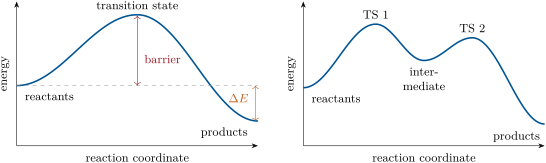
Along an elementary step the atoms move from the arrangement of the reactants to that of the products; a variable that measures this progress (a bond length that grows, another that shrinks) is the reaction coordinate. The graph of the potential energy of the system along it is the energy profile. Its maximum is the transition state, an arrangement of the atoms with bonds half-made and half-broken, which lasts no longer than a molecular vibration and cannot be isolated. The height of this maximum above the reactants is the energy barrier of the step.
Proposition 9.5 (Barriers and the Arrhenius law)
The activation energy of an elementary step is close to its barrier: only the collisions that bring at least that energy reach the transition state. For the forward and reverse directions of a step, , the energy of reaction of the step.
Reasoning. The reverse step climbs the same barrier from the other side: its height measured from the products exceeds the forward one by . ∎
Proposition 9.6 (The Hammond postulate)
The transition state of an elementary step resembles, in structure and energy, the species to which it is closer in energy: the products for a step strongly uphill (endothermic), the reactants for a step strongly downhill (exothermic). Consequently, for a step that forms a high-energy intermediate, whatever stabilises the intermediate also lowers the barrier that leads to it.
Proof. Admitted at this level. ∎
9.3 Rate-determining step and pre-equilibrium
Definition 9.7 (Rate-determining step)
In a sequence of steps, the rate-determining step is a step much slower than all the others; the overall rate equals its rate, the faster steps adjusting to it as the cars of a road follow its slowest point.
Definition 9.8 (Pre-equilibrium approximation)
In the pre-equilibrium approximation, a fast reversible step that precedes the rate-determining step is assumed to remain at equilibrium all along: the concentrations of its species obey its equilibrium constant .
Proposition 9.9 (Rate law from a pre-equilibrium)
For the mechanism
the rate is , of overall order 3, with the apparent constant .
Proof. The rate is that of the slow step, . The first step stays at equilibrium: , so . Substituting gives the result. ∎
9.4 The steady-state approximation
Theorem 9.10 (Consecutive first-order reactions)
For , both steps of order 1, with and at and :
The intermediate goes through a maximum at .
Proof. gives . Then , a first-order linear equation: multiplying by , , whose integral from 0, where , is . Conservation of matter gives . The derivative of vanishes when , that is at . ∎
Definition 9.11 (Steady-state approximation)
In the steady-state approximation (or quasi-steady state), the concentration of a very reactive intermediate, consumed much faster than it is formed, is taken as constant and small after a short induction period: its rate of formation equals its rate of consumption, .
Proposition 9.12 (When the steady state holds)
For with : after a time of order , (which is what gives), stays small, and the product forms at the rate : the first step is rate-determining.
Proof. For and , is negligible beside and , so . Then . ∎
![Consecutive reactions A B C. Left: the intermediate accumulates and peaks at k_1t = 1.39. Right: when it is consumed twenty times faster than it forms, it stays small and follows the steady-state value k_1[ A]/k_2 (dashed) after a brief induction.](/images/onecourse/chapters/chemistry-2/b1-elementary-steps/fig-48ec13f91136.svg)
Method 9.13 (Rate law from a mechanism)
To derive the rate law of a mechanism:
- write the rate of each elementary step (Proposition 9.2);
- express the overall rate as the rate of formation of a product (divided by its coefficient);
- eliminate each intermediate with the steady-state approximation (, an algebraic equation) or, if a fast equilibrium precedes a slow step, with its constant;
- simplify in the limits where one term dominates, and compare with the experimental law.
Example 9.14 (An acid-catalysed reaction)
For (fast, constant ) followed by (slow, ), the rate is : first order in substrate and in acid, although the acid is not consumed.
9.5 Catalysis and the control of selectivity
Definition 9.15 (Catalyst, homogeneous and heterogeneous catalysis)
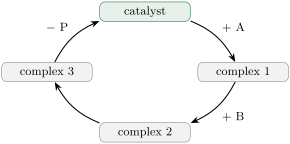
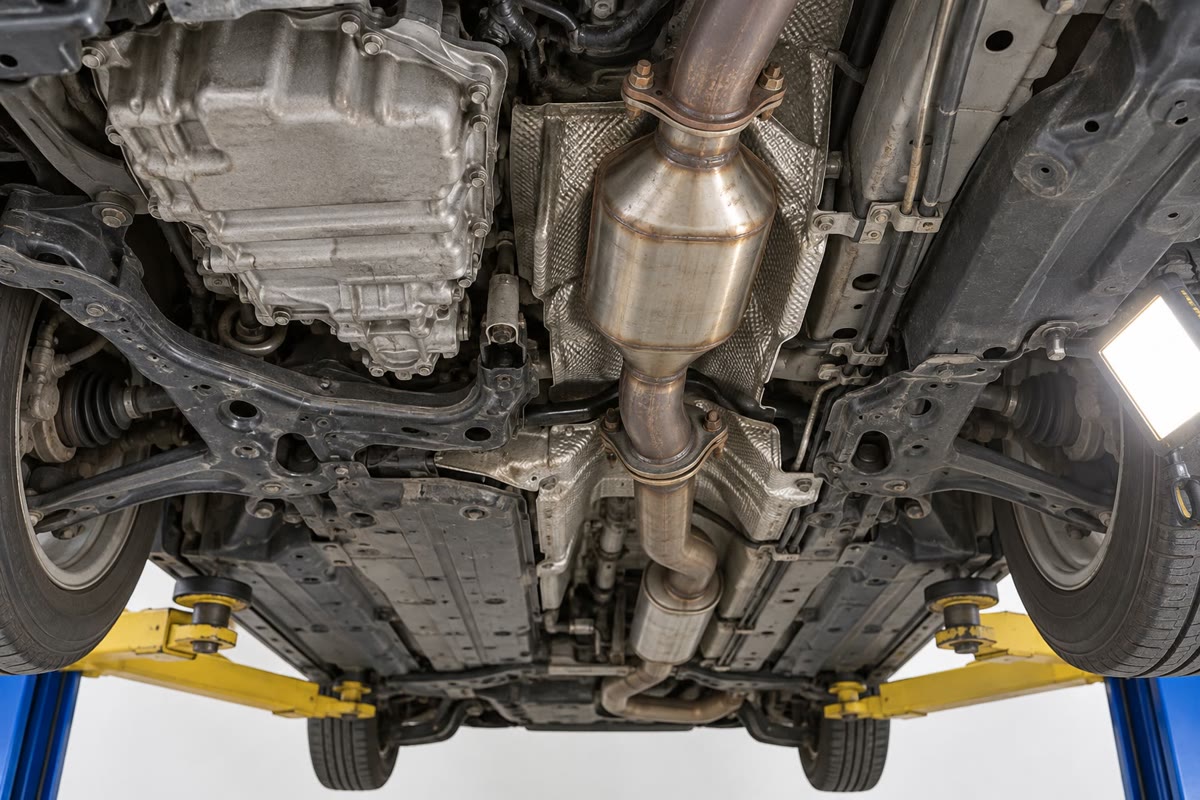
A catalyst is a species that increases the rate of a reaction without appearing in its overall equation: consumed in one step of the mechanism, it is regenerated in a later one. In homogeneous catalysis the catalyst is in the same phase as the reactants (dissolved acids, metal complexes, enzymes); in heterogeneous catalysis it is a separate phase, usually a solid on whose surface the reaction takes place (platinum, iron, zeolites).
Proposition 9.16 (What a catalyst changes)
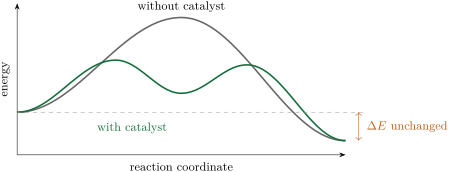
A catalyst provides a new mechanism of lower barrier. It speeds the forward and reverse reactions in the same ratio, and therefore leaves the equilibrium constant, the final state and the energy of reaction unchanged.
Proof. For an elementary step at equilibrium, forward and reverse rates are equal: , so . For any mechanism at equilibrium, each step is at equilibrium (otherwise some species would keep changing), and is the product of the ratios of the steps. A catalysed path reaches the same final state, of the same constant: whatever it multiplies by, it multiplies by the same factor. ∎
Definition 9.17 (Kinetic and thermodynamic control)
When a reactant can give two products by competing paths, the reaction is under kinetic control if the product proportions are fixed by the rates of formation (the product of lower barrier dominates), and under thermodynamic control if the paths are reversible and the system reaches equilibrium (the more stable product dominates).
Example 9.18 (Choosing the product)
A reactant gives B over a barrier of () and C over a barrier of (). At and short times, with equal pre-exponential factors, B forms times faster than C: kinetic control gives B. At high temperature and long times, B returns over its small reverse barrier, C does not, and the system ends as C: thermodynamic control.
History — Catalysis, 1835
In 1835 the Swedish chemist Jöns Jacob Berzelius gathered under one word a dozen puzzling observations — starch turned into sugar by acids, hydrogen peroxide decomposed by metals, alcohol oxidised on platinum — and called the hidden force at work “catalytic”. It took the kinetics of the end of the century, with Wilhelm Ostwald, to define a catalyst as a species that changes the rate of a reaction and not its equilibrium.
9.6 Exercises
Exercise 9.1 ★
Give the molecularity of each step and say which steps can be elementary: (a) ; (b) ; (c) ; (d) .
Solution
Solution of Exercise 9.1.
(a) Unimolecular: can be elementary. (b) Bimolecular: can be elementary. (c) Three molecules and four bonds rebuilt at once: not elementary. (d) Termolecular, carrying away the energy released: a rare but genuine elementary step.
Exercise 9.2 ★
Write the rate law of the elementary steps , and . Why can the rate law of an overall reaction not be written from its equation?
Solution
Solution of Exercise 9.2.
; ; . An overall equation is a balance sheet, not a description of how the molecules meet; its rate law must be measured, or derived from a mechanism.
Exercise 9.3 ★
On the two-step energy profile drawn in this chapter (intermediate at 30, transition states at 70 and 55, products at , in above the reactants), identify the intermediate, the transition states and the rate-determining step. Is the first step endothermic or exothermic?
Solution
Solution of Exercise 9.3.
The intermediate is the hollow at 30; the transition states are the maxima at 70 and 55. The highest transition state is the first: the first step is rate-determining. It is endothermic (from 0 up to 30).
Exercise 9.4 ★
A catalyst multiplies the forward rate constant of an elementary step by . By how much does it multiply the reverse rate constant? the equilibrium constant? the time needed to reach equilibrium?
Solution
Solution of Exercise 9.4.
By the same factor (Proposition 9.16); the equilibrium constant is unchanged; equilibrium is reached about times sooner.
Exercise 9.5 ★★
For with and , compute and the largest concentration of , in units of .
Solution
Solution of Exercise 9.5.
. Then .
Exercise 9.6 ★★
For , all steps of order 1, apply the steady-state approximation to and show that . Discuss the cases and .
Solution
Solution of Exercise 9.6.
gives and . If , : the first step is rate-determining. If , : a pre-equilibrium followed by a slow step.
Exercise 9.7 ★★
Iodide ions catalyse the decomposition of hydrogen peroxide: (slow), then (fast). Write the overall equation, identify the catalyst and the intermediate, and give the rate law.
Solution
Solution of Exercise 9.7.
Sum: . Catalyst: (consumed, then regenerated); intermediate: . The slow first step fixes the rate: .
Exercise 9.8 ★★
A step forms a carbocation from a neutral molecule, a strongly uphill process. Using the Hammond postulate, explain why a substituent that stabilises the carbocation also speeds the step.
Solution
Solution of Exercise 9.8.
The step is strongly uphill: by the Hammond postulate its transition state resembles the carbocation. A substituent that lowers the energy of the carbocation lowers that of the transition state almost as much, so the barrier falls and the step is faster.
Exercise 9.9 ★★
In Example 9.18, compute the ratio of the rate constants of formation of B and C at and at . Comment.
Solution
Solution of Exercise 9.9.
: at , at . Heating reduces the kinetic preference for B and, by making the formation of B reversible, lets the system reach the more stable C.
Exercise 9.10 ★★★
A gas decomposes after being activated by collision with any molecule : (, ), then (). With the steady-state approximation for , find , and show that the reaction is of order 1 at high pressure and of order 2 at low pressure.
Solution
Solution of Exercise 9.10.
, so . At high pressure (), : order 1. At low pressure, : order 2, activation by collision becomes the slow step.
Exercise 9.11 ★★★
Prove the formula for of Theorem 9.10 and treat the special case , for which .
Solution
Solution of Exercise 9.11.
The proof is that of the theorem. For : , so and , maximal at .
Exercise 9.12 ★★★
The overall reaction has the experimental rate law . Propose a mechanism with a fast pre-equilibrium that explains it.
Solution
Solution of Exercise 9.12.
(fast, constant ), then (slow, ). The sum is the overall reaction; and : the by-product, released in the pre-equilibrium, slows the reaction.
9.7 Problem: Why Nitrogen Monoxide Oxidises Faster in the Cold
Problem 9.1
Weekend problem — the third-order oxidation of nitrogen monoxide, a pre-equilibrium through the dimer , the steady-state treatment, and a negative apparent activation energy
For , initial-rate measurements at give (rates in ):
| experiment | (mol/L) | (mol/L) | |
|---|---|---|---|
| 1 | |||
| 2 | |||
| 3 |
The rate constant found at is ten times smaller than at . Take . The proposed mechanism is
Part I — The observed law.
- Find the partial orders with respect to and .
- Write the rate law and compute at , with its unit.
- Could the reaction be a single termolecular step? Give an argument.
- Compute the apparent activation energy from the two temperatures.
- Why is a negative activation energy impossible for an elementary step?
- Write the rates of disappearance of and in terms of .
Part II — The pre-equilibrium.
- Check that the two steps add up to the overall reaction. Name the intermediate.
- Give the molecularity of each step.
- Write the rate of the slow step.
- Express with the pre-equilibrium approximation.
- Deduce the rate law and compare with experiment.
- Express the observed constant with , and .
Part III — The steady state.
- Write for the full mechanism.
- Apply the steady-state approximation and express .
- Deduce the rate law .
- In which limit does it reduce to the result of Part II?
- What would the orders become in the opposite limit?
- Which limit do the measurements of Part I support?
Part IV — The apparent activation energy. Each step follows the Arrhenius law, with activation energies , and .
- Write in terms of the logarithms of , and .
- Deduce .
- Interpret: why can a combination of elementary steps have a negative apparent activation energy?
- Sketch the energy profile: where is the second transition state, relative to the reactants ?
- By what factor would the rate change between 300 and with this value?
- Compute the apparent activation energy from the step values, and compare with Part I.
Solution
Solution of Problem 9.1.
1. Doubling multiplies by 4: order 2; doubling multiplies it by 2: order 1. 2. ; . 3. A simultaneous collision of three molecules is rare, and a single step could not get slower on heating (question 5). 4. . 5. An elementary step proceeds through collisions that cross a barrier; the fraction of them able to do so, with , can only grow with temperature. 6. , . 7. plus gives ; the intermediate is . 8. Both bimolecular (and the reverse of the first unimolecular). 9. . 10. with . 11. : the observed law. 12. . 13. . 14. Setting it to zero: . 15. gives the stated law. 16. : the dimer falls apart far more often than it meets dioxygen, so the first step stays at equilibrium. 17. If , : order 2 in and 0 in . 18. The measured order 1 in : the first limit. 19. . 20. Differentiating with respect to and using : . 21. Heating speeds the slow step a little ( small) but shifts the pre-equilibrium strongly back towards ( large): fewer dimers, and the net rate falls. 22. The dimer lies below the reactants and the second transition state above the dimer: below the reactants. The highest point of the path is the first transition state, only up. 23. : ten times slower at . 24. , the value measured in Part I: the mechanism explains both the rate law and its strange temperature dependence.