 Coach
CoachAn electron-donor site of a molecule or an ion is a place rich in electrons, able to give a pair to form a new bond: a lone pair, a double bond, an atom carrying a negative charge or a partial charge . An electron-acceptor site is a place poor in electrons, able to receive a pair: an atom carrying a positive charge or a partial charge .
Examples
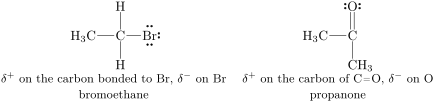
Example 40.2 (Sites in two molecules)
In bromoethane, , bromine is more electronegative than carbon: the carbon bonded to it carries (acceptor site), the bromine and three lone pairs. In propanone, the oxygen of the group carries and two lone pairs (donor sites), its carbon (acceptor site). The hydroxide ion , with its negative charge and three lone pairs, is a strong donor.