School Chemistry — Grades 1 to 12 · Grades 1–12
40Reaction Mechanisms: Curly Arrows
A balanced equation is like the first and last photographs of a film: it shows the reactants before and the products after, and nothing in between. Yet molecules do not simply swap atoms. Bonds break and form one at a time, as pairs of electrons move from one place to another, through short-lived species that never appear in the equation. Chemists draw these movements with curved arrows. With a few rules, these arrows explain why a reaction happens where it does, and predict reactions never seen before.
You already know
Electronegativity, polar bonds and partial charges (Chapter 30). Lewis structures: bonding pairs and lone pairs (Chapter 24). Functional groups and families (Chapter 33).
40.1 Electron-rich and electron-poor sites
Definition 40.1 (Electron-donor and electron-acceptor sites)
An electron-donor site of a molecule or an ion is a place rich in electrons, able to give a pair to form a new bond: a lone pair, a double bond, an atom carrying a negative charge or a partial charge . An electron-acceptor site is a place poor in electrons, able to receive a pair: an atom carrying a positive charge or a partial charge .
Example 40.2 (Sites in two molecules)
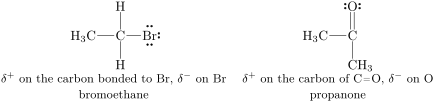
In bromoethane, , bromine is more electronegative than carbon: the carbon bonded to it carries (acceptor site), the bromine and three lone pairs. In propanone, the oxygen of the group carries and two lone pairs (donor sites), its carbon (acceptor site). The hydroxide ion , with its negative charge and three lone pairs, is a strong donor.
40.2 Curly arrows
Definition 40.3 (Curly arrow)
A curly arrow shows the movement of a pair of electrons during a step of a reaction. It starts from the pair that moves, a lone pair or a bond, and ends where the pair goes: on an atom, where it forms a new bond, or on an atom that takes the pair of a bond that breaks.
Method 40.4 (Drawing curly arrows)
- Find the donor site and the acceptor site.
- Draw an arrow from the donor pair (a lone pair or a bond) to the acceptor atom: a new bond forms there.
- If the acceptor atom would then have too many electrons (more than an octet, or more than two for hydrogen), draw a second arrow breaking one of its bonds, the pair going to the more electronegative atom.
- Check the charges after the step: the atom that gave a lone pair becomes more positive by one, the atom that received a pair as a lone pair more negative by one; the total charge does not change.
Proposition 40.5 (Charge is conserved in each step)
The total electric charge of the species is the same before and after each step of a mechanism.
Proof. A curly arrow only moves electrons that are already there; no electron is created or destroyed, and the nuclei do not change. ∎
Example 40.6 (A first arrow)
A hydrogen ion meets a hydroxide ion . A lone pair of the oxygen forms a bond with the hydrogen ion, which has no electrons: . One arrow, from the lone pair of the oxygen to the ; the charges and become 0 in the water molecule.

40.3 Elementary steps and intermediates
Definition 40.7 (Mechanism, elementary step, intermediate)
The reaction mechanism of a reaction is the series of steps by which the reactants become the products. Each elementary step is a single event in which a few pairs of electrons move at once. A species formed in one step and used up in a later one is a reaction intermediate: it does not appear in the overall equation.
Example 40.8 (A carbocation intermediate)
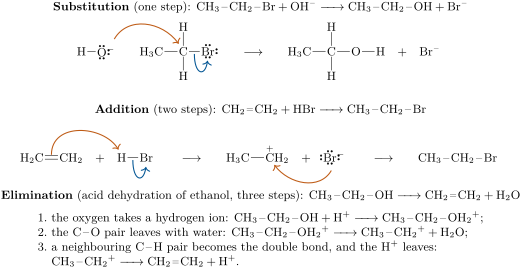
When hydrogen bromide adds to ethene, the reaction takes two steps. In the first, the double bond of ethene gives a pair to the hydrogen of , and the pair goes to bromine, which leaves as ; the carbon that lost its share of the double bond is left with only six electrons and a positive charge: a carbocation, . In the second step, a lone pair of forms a bond with that carbon. The carbocation is an intermediate.
40.4 Three categories of reaction
Definition 40.9 (Substitution, addition, elimination)
In a substitution, an atom or group of a molecule is replaced by another. In an addition, two molecules join into one, a multiple bond becoming a single one. In an elimination, a small molecule (often water) is removed from a molecule, a single bond becoming a multiple one.
Remark 40.10 (Changing the skeleton or the group)
Some reactions change only the functional group and keep the carbon skeleton: the substitution of bromoethane turns a halogenoalkane into an alcohol, two carbons before, two after. Others build or cut the skeleton: making a new carbon–carbon bond lengthens a chain, the key step in making a large molecule from small ones. Planning a synthesis means choosing reactions of both kinds, in the right order.
40.5 Exercises
Exercise 40.1 ★
In each species, name a donor site and, if there is one, an acceptor site: ; ; ; ; .
Solution
Solution of Exercise 40.1.
: donor (lone pairs, negative charge); no acceptor site. : acceptor (no electrons at all). : donor (the double bond). : donor (lone pairs of ), acceptor (the carbon, ). : donor (lone pairs of ); its hydrogen atoms, , are weak acceptor sites.
Exercise 40.2 ★
Substitution, addition or elimination? (a) ; (b) ; (c) ; (d) .
Exercise 40.3 ★
Where does a curly arrow start, and where does it end? What does a curly arrow from a lone pair of an oxygen atom to a carbon atom mean?
Exercise 40.4 ★
In the reaction , which species gives the pair? Draw the arrow. What is the charge of the product?
Exercise 40.5 ★
What is a reaction intermediate? Name the intermediate of the addition of to ethene.
Solution
Solution of Exercise 40.5.
A species formed in one step and used up in a later one; it is not in the overall equation. Here the carbocation .
Exercise 40.6 ★★
Draw the curly arrows of the substitution (one step), and check the charges.
Solution
Solution of Exercise 40.6.
One arrow from a lone pair of the oxygen of to the carbon; one arrow from the bond to the bromine. Charges: on the left (); on the right, methanol is neutral and carries : the total is on both sides.
Exercise 40.7 ★★
In the first step of the addition of to ethene, why does the pair go to bromine rather than to hydrogen? What charge does each product of the step carry?
Solution
Solution of Exercise 40.7.
Bromine is more electronegative than hydrogen: it takes the pair and leaves as (); the hydrogen bonds to a carbon, and the other carbon is left with a positive charge: ().
Exercise 40.8 ★★
In the dehydration of ethanol, write the three steps and say, for each, which species is the donor and which the acceptor. Why is the hydrogen ion not written in the overall equation?
Solution
Solution of Exercise 40.8.
1. : donor, a lone pair of the oxygen; acceptor, . 2. : the pair goes to the positive oxygen (acceptor), which leaves with it as water. 3. : the pair of a bond (donor) moves to the positive carbon (acceptor) to form the double bond, and leaves. The hydrogen ion used in step 1 is given back in step 3: it appears on both sides and cancels.
Exercise 40.9 ★★
The step follows the addition of a hydrogen ion to ethene in water. Draw the arrow. What is formed after a further loss of ? Write the overall equation and give its category.
Exercise 40.10 ★★
Read the mechanism of the substitution of bromoethane: how many pairs move? Which bond forms, which breaks? Is there an intermediate?
Solution
Solution of Exercise 40.10.
Two pairs move, in one step: the bond forms, the bond breaks. No intermediate.
Exercise 40.11 ★★
Chloromethane reacts with the hydroxide ion more slowly than bromomethane. Using electronegativities (C 2.55, Cl 3.16, Br 2.96), explain which carbon is the more . Does that explain the speeds? (Think also of how easily the leaving ion takes the pair.)
Solution
Solution of Exercise 40.11.
Chlorine is more electronegative ( against ): the carbon of chloromethane is the more , which alone would make it react faster. It does not: the speed also depends on how easily the halogen leaves with the pair, and the larger bromine leaves more easily.
Exercise 40.12 ★★★
Hydrogen chloride adds to propene, . In the first step the hydrogen ion can bond to either carbon of the double bond, giving two possible carbocations. Draw both, the two possible products, and name them. (Which one forms most is studied in the Year 1 volume.)
Solution
Solution of Exercise 40.12.
If the hydrogen bonds to carbon 1: , which gives 2-chloropropane . If it bonds to carbon 2: , which gives 1-chloropropane .
Exercise 40.13 ★★★
A student draws the first step of the substitution of bromoethane with an arrow from the bromine atom to the oxygen of . Explain the two mistakes.
Solution
Solution of Exercise 40.13.
The arrow goes the wrong way: it must start from the donor, a lone pair of , and end on the acceptor carbon. And the new bond is between oxygen and carbon, not oxygen and bromine: bromine leaves, taking the pair of the bond.
Exercise 40.14 ★★★
In the formation of an ester from a carboxylic acid and an alcohol, the oxygen of the alcohol attacks the carbon of the group. Using partial charges, explain why that carbon is an acceptor site and that oxygen a donor site. Which small molecule is lost overall, and what category is the whole reaction?
Solution
Solution of Exercise 40.14.
The carbon of the group of an acid is bonded to two electronegative oxygen atoms: strongly , an acceptor. The oxygen of the alcohol carries and two lone pairs: a donor. Water is lost overall; the of the acid is replaced by the of the alcohol: a substitution.
Exercise 40.15 ★★★
Ethene reacts with bromine , a non-polar molecule. As a molecule approaches the double bond, the electrons of are pushed away from the near bromine atom. Explain why this creates an acceptor site, and propose the first step of the mechanism.
Solution
Solution of Exercise 40.15.
Pushed away by the electrons of the double bond, the pair of the bond moves towards the far bromine: the near bromine becomes , an acceptor site. First step: an arrow from the double bond to the near bromine, and one from the bond to the far bromine, which leaves as ; a positive charge is left on the other carbon of the former double bond.
40.6 Problem: Making Bromoethane
Problem 40.1
Weekend problem — from ten grams of ethene: how much bromoethane?
Bromoethane, a starting material for many syntheses, is made by adding hydrogen bromide to ethene: . A chemist uses of ethene and an excess of hydrogen bromide; the yield is .
Part I — The sites.
- Draw the Lewis structures of ethene and of hydrogen bromide.
- Where is the donor site of ethene? Why?
- Compute the difference of electronegativity of the bond (H 2.20, Br 2.96). Which atom carries ?
- Which atom of is the acceptor site?
Part II — The mechanism.
- Draw the first step with its two curly arrows.
- Give the two species formed and their charges.
- Check the conservation of charge in the first step.
- Draw the second step with its curly arrow.
- How many electrons surround the positive carbon of the intermediate? Why is it so reactive?
Part III — What kind of reaction?
- What is the intermediate of the mechanism?
- Why does it not appear in the overall equation?
- To which category does the reaction belong?
- Does the reaction change the carbon skeleton, or only the functional group?
Part IV — How much product?
- Compute the molar masses of ethene and of bromoethane.
- Compute the amount of ethene.
- Fill the progress table. Which reactant is limiting?
- Compute the maximum mass of bromoethane.
- Compute the mass obtained with a yield of .
- State the final answer: what mass of bromoethane does the chemist obtain?
Solution
Solution of Problem 40.1.
1. Ethene: , a double bond and four . Hydrogen bromide: with three lone pairs on bromine.
2. The double bond: its second pair is a region rich in electrons.
3. : carries .
4. The hydrogen atom.
5. An arrow from the double bond to the hydrogen of ; an arrow from the bond to the bromine.
6. The carbocation () and ().
7. Before: ; after: .
8. An arrow from a lone pair of to the positive carbon.
9. Six (three bonds): one pair short of an octet, so it accepts a pair from any donor nearby.
10. The carbocation .
11. It is formed in the first step and used up in the second.
12. An addition.
13. Only the group: the chain of two carbons is kept, and the double bond becomes a single bond carrying and .
14. ; .
15. .
16. Ethene: ; : in excess; bromoethane: . Ethene is limiting: .
17. .
18. .
19. About of bromoethane.