All books

Professional

Apps About Coach Log in Start reading

Chemistry · Glossary

What is Epoxide?

Also known as: epoxidation · peroxy acid

Definition 21.6 University Chemistry — Year 2 · Chapter 21 — Oxidation and Reduction of Alkenes

An epoxide (oxirane) is a cyclic ether with a three-membered ring of two carbons and one oxygen. An epoxidation converts an alkene into an epoxide, usually with a peroxy acid RCOX3H\ce{RCO3H}, which transfers one oxygen atom to the double bond.

Epoxidation by a peroxy acid (Ar: for example a 3-chlorophenyl group). The terminal oxygen of the peroxy acid is transferred to the double bond in one step, both C–O bonds forming on the same face.
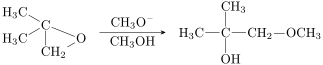
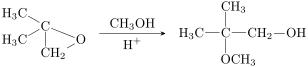
Opening of 2,2-dimethyloxirane by methanol. Top, with methoxide: attack at the CH2, the less hindered carbon. Bottom, in acid: attack at the more substituted carbon, which carries most of the positive charge of the protonated epoxide. Opening of 2,2-dimethyloxirane by methanol. Top, with methoxide: attack at the CH2, the less hindered carbon. Bottom, in acid: attack at the more substituted carbon, which carries most of the positive charge of the protonated epoxide.
Opening of 2,2-dimethyloxirane by methanol. Top, with methoxide: attack at the CHX2\ce{CH2}, the less hindered carbon. Bottom, in acid: attack at the more substituted carbon, which carries most of the positive charge of the protonated epoxide.
Read in context →