University Chemistry — Year 2 · Bachelor Year 2
21Oxidation and Reduction of Alkenes
Two-part epoxy glue comes in two tubes: one holds molecules ending in epoxide rings, three-membered rings of two carbons and an oxygen; the other an amine. Mixed, the strained rings open one after another and the paste sets into a hard network. Alkenes are the raw material of such rings, of alcohols placed where Markovnikov’s rule would never put them, of diols with a chosen geometry, and of the small fragments that once told chemists where a double bond lay in a molecule. This chapter adds to the electrophilic additions of the Year 1 volume the reactions that reduce or oxidise the double bond, and the stereochemistry each one imposes.
You already know
The Year 1 volume: electrophilic additions, Markovnikov’s rule, halonium ions, syn and anti additions, hydration of alkenes, oxidation levels of carbon, hydride donors, chemoselectivity, meso compounds and racemic mixtures, stereospecific reactions. Chapter 20: the hydrogenation cycle of Wilkinson’s catalyst.
21.1 Catalytic hydrogenation
Definition 21.1 (Catalytic hydrogenation)
A catalytic hydrogenation adds dihydrogen across a multiple bond in the presence of a catalyst: a finely divided metal (palladium on carbon, platinum, nickel) in heterogeneous catalysis, or a soluble complex such as Wilkinson’s in homogeneous catalysis.
On a metal surface, dihydrogen and the alkene are both held, the bond is broken into surface hydrogen atoms, and these are transferred one after the other to the carbon atoms of the alkene, which lies flat on the metal.
Proposition 21.2 (Syn addition)
Catalytic hydrogenation delivers both hydrogen atoms to the same face of the double bond. An alkyne hydrogenated over a poisoned palladium catalyst stops at the alkene, which is the (Z) isomer.
Argument. The alkene is bound to the catalyst by one face, and both hydrogens come from the catalyst, on that face: syn addition. With an alkyne, the two hydrogens added to the triple bond are on the same side, cis to each other: the (Z)-alkene. A partly deactivated catalyst (palladium on calcium carbonate with a lead salt and quinoline) binds the alkyne much more strongly than the alkene formed, which leaves the surface before a second addition. ∎
21.2 Hydroboration–oxidation
Definition 21.3 (Hydroboration)
A hydroboration adds a B–H bond of a borane across a bond; followed by oxidation with alkaline hydrogen peroxide, it converts the alkene into an alcohol whose hydroxyl group sits on the less substituted carbon: an anti-Markovnikov orientation.

Proposition 21.4 (Orientation of hydroboration)
Boron adds to the less substituted carbon of the double bond, and hydrogen to the more substituted one; the addition is syn.
Argument. Boron, with an empty p orbital, is the electrophile: in the four-centre transition state (the two carbons, boron and hydrogen), the bond to boron forms a little ahead of the C–H bond, and a partial positive charge develops on the other carbon, better carried by the more substituted one; the bulky boron group also prefers the less hindered end. Both new bonds form on one face, in a concerted step: syn. ∎
Proposition 21.5 (Oxidation with retention)
The oxidation of an alkylborane by alkaline hydrogen peroxide replaces each C–B bond by a C–OH bond with retention of configuration at carbon.
Argument. The hydroperoxide anion adds to boron; an alkyl group then migrates from boron to the adjacent oxygen, with its pair of electrons, as hydroxide leaves; the carbon keeps its bonds on the same side throughout. Hydrolysis of the B–O bond frees the alcohol. ∎
21.3 Epoxides
Definition 21.6 (Epoxide)
An epoxide (oxirane) is a cyclic ether with a three-membered ring of two carbons and one oxygen. An epoxidation converts an alkene into an epoxide, usually with a peroxy acid , which transfers one oxygen atom to the double bond.

Proposition 21.7 (Stereospecific epoxidation)
Epoxidation by a peroxy acid is stereospecific: a (Z)-alkene gives the cis epoxide, an (E)-alkene the trans epoxide.
Proof. The oxygen is transferred in one concerted step to one face of the double bond, which does not rotate meanwhile: the relative positions of the substituents are kept. ∎
Proposition 21.8 (Opening of epoxides)
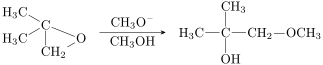
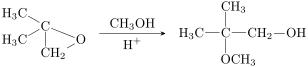
A nucleophile opens an epoxide by attack at one carbon from the face opposite to the oxygen (anti opening, with inversion at that carbon). Under basic conditions, it attacks the less hindered carbon; under acidic conditions, the more substituted one.
Argument. The ring strain makes the C–O bonds easy to break. With a strong nucleophile and no acid, the opening is a bimolecular substitution, and the least hindered carbon is reached most easily. In acid the oxygen is protonated; the C–O bond to the more substituted carbon stretches most, that carbon carrying the larger partial positive charge, and even a weak nucleophile (water, an alcohol) attacks there — still from the back, so still anti. ∎
21.4 Dihydroxylation
Definition 21.9 (Dihydroxylation)
A dihydroxylation converts an alkene into a 1,2-diol by adding one group to each carbon of the double bond.
Osmium tetroxide, in catalytic amount with a reoxidant, and cold dilute permanganate add both oxygens through a cyclic ester, on one face: a syn dihydroxylation. Epoxidation followed by opening with water in acid gives the anti diol.
Proposition 21.10 (Syn and anti diols)
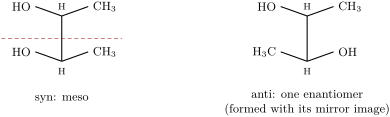
From (Z)-but-2-ene, syn dihydroxylation gives meso-butane-2,3-diol and the epoxide route gives the racemic (2R,3R) and (2S,3S) diols; from (E)-but-2-ene, the results are exchanged.
Proof. In (Z)-but-2-ene the two methyls are on the same side. Adding two on one face gives a diol in which, written in the eclipsed conformation of the former double bond, the two are on one side and the two methyls on the other: a mirror plane passes between C2 and C3, the meso compound. The epoxide route puts the two on opposite faces (anti): the mirror plane is lost, and the attack at either carbon of the achiral epoxide, equally likely, gives the two enantiomers in equal amounts. For the (E)-alkene each step changes the relation of the methyls, which exchanges the outcomes. ∎
21.5 Oxidative cleavage
Definition 21.11 (Oxidative cleavage)
An oxidative cleavage breaks both bonds of a double bond and turns each carbon into a carbonyl or carboxyl group. In an ozonolysis, the alkene reacts with ozone and the intermediate ozonide is decomposed in a second step, the work-up.
Proposition 21.12 (Products of ozonolysis)
Ozonolysis splits each bond into two groups. With a reducing work-up (zinc and acid, or dimethyl sulfide), a carbon bearing a hydrogen gives an aldehyde; with an oxidising work-up (hydrogen peroxide), it gives a carboxylic acid. A carbon bearing two carbon groups gives a ketone in both cases.
Argument. Ozone adds to the double bond, the intermediate rearranges and the C–C bond breaks, giving an ozonide in which each former alkene carbon is bound to two oxygens. The work-up reduces it to two carbonyl compounds, or oxidises the aldehydes further. The intermediate steps are admitted. ∎

Method 21.13 (Locating a double bond)
- List the carbonyl fragments of the ozonolysis and count their carbons; they must add up to the alkene’s.
- Each carbon was a doubly bonded carbon: join the fragments by replacing two by one .
- For a ring, one molecule with two carbonyl groups comes out; join its two ends.
- Check with the formula and the degree of unsaturation.
Hot concentrated permanganate cleaves double bonds as well, giving acids and ketones; sodium periodate cleaves 1,2-diols into two carbonyl compounds, a gentler route through the diol.
Method 21.14 (Choosing a reagent for an alkene)
| target | reagent | stereochemistry, orientation |
|---|---|---|
| alkane | , Pd/C | syn |
| Markovnikov alcohol | , acid | via a carbocation |
| anti-Markovnikov alcohol | , then , | syn |
| epoxide | peroxy acid | stereospecific |
| syn diol | (cat.) or cold | syn |
| anti diol | peroxy acid, then , acid | anti |
| two carbonyls | , then /acid | cleavage |
Safety


Osmium tetroxide is volatile and very toxic (it damages the eyes); it is used in catalytic amount in solution, in a fume hood. Peroxy acids and hydrogen peroxide are oxidisers that can decompose violently when heated or concentrated; borane solutions are flammable; ozone is toxic and generated in a hood.
21.6 Exercises
Exercise 21.1 ★
Give the product of 1-methylcyclohexene with: /Pd; /; then /; a peroxy acid; (cat.); then /.
Solution
Solution of Exercise 21.1.
Methylcyclohexane; 1-methylcyclohexan-1-ol; trans-2-methylcyclohexan-1-ol (syn addition of H and B, so the and the new H on the same side, the methyl trans to the ); 1-methylcyclohexene oxide; cis-1-methylcyclohexane-1,2-diol; 6-oxoheptanal .
Exercise 21.2 ★
Which alcohol does hydroboration–oxidation give from 2-methylpropene? And acid-catalysed hydration?
Solution
Solution of Exercise 21.2.
Hydroboration–oxidation: 2-methylpropan-1-ol. Acid-catalysed hydration: 2-methylpropan-2-ol.
Exercise 21.3 ★
Draw the epoxide formed from (E)-but-2-ene. Is it chiral?
Solution
Solution of Exercise 21.3.
trans-2,3-Dimethyloxirane, the two methyls on opposite sides of the ring. It is chiral (no mirror plane) and is formed as a racemic mixture.
Exercise 21.4 ★
Give the products of the ozonolysis of hex-3-ene with a reducing work-up, then with an oxidising work-up.
Solution
Solution of Exercise 21.4.
Reducing work-up: two molecules of propanal. Oxidising work-up: two molecules of propanoic acid.
Exercise 21.5 ★★
Give the diols formed from (Z)-but-2-ene (a) with ; (b) with a peroxy acid then aqueous acid. Which one is optically inactive because it is meso, and which because it is racemic?
Solution
Solution of Exercise 21.5.
(a) meso-butane-2,3-diol, inactive because it is achiral. (b) the (2R,3R) and (2S,3S) diols in equal amounts, inactive because racemic.
Exercise 21.6 ★★
2,2-Dimethyloxirane is opened by water in acid and by hydroxide. Do the two routes give the same product? Explain.
Solution
Solution of Exercise 21.6.
In acid water attacks the tertiary carbon, in base hydroxide attacks the ; in both cases an ends on each carbon: the same 2-methylpropane-1,2-diol. With methanol the two routes give different ethers (as in the chapter).
Exercise 21.7 ★★
How would you prepare (Z)-hex-3-ene from hex-3-yne?
Solution
Solution of Exercise 21.7.
Hydrogenation with one equivalent of over a poisoned palladium catalyst (Lindlar): syn addition to the triple bond stops at the (Z)-alkene.
Exercise 21.8 ★★
An alkene gives, by ozonolysis with a reducing work-up, propanone and butanal. Give its structure.
Solution
Solution of Exercise 21.8.
Propanone (3 C) and butanal (4 C) join at their carbonyl carbons: , 2-methylhex-2-ene.
Exercise 21.9 ★★
Propose a synthesis of hexan-1-ol from hex-1-ene, and say why acid-catalysed hydration would fail.
Solution
Solution of Exercise 21.9.
(or a bulky borane), then and : hexan-1-ol. Acid-catalysed hydration goes through the secondary carbocation and gives hexan-2-ol (Markovnikov), with rearranged by-products.
Exercise 21.10 ★★★
Limonene has a trisubstituted ring double bond and a disubstituted exocyclic one (). Which reacts first with one equivalent of a peroxy acid, and which with one equivalent of a bulky borane? Explain.
Solution
Solution of Exercise 21.10.
The peroxy acid, an electrophile, reacts faster with the more substituted, more electron-rich ring double bond. The bulky borane reacts with the less hindered terminal .
Exercise 21.11 ★★★
Prepare trans-cyclohexane-1,2-diol from cyclohexene, and cis-cyclohexane-1,2-diol.
Solution
Solution of Exercise 21.11.
trans: peroxy acid, then water in acid (anti opening). cis: catalytic with a reoxidant, or cold dilute permanganate (syn).
Exercise 21.12 ★★★
A compound absorbs one equivalent of . Its ozonolysis with a reducing work-up gives a single product, hexanedial . Identify it.
Solution
Solution of Exercise 21.12.
has two degrees of unsaturation; one equivalent of means one , so one ring. A single six-carbon dialdehyde comes from a ring opened at its double bond: cyclohexene.
21.7 Problem: Identifying a Terpene
Problem 21.1
Weekend problem — the formula and unsaturation of limonene, its hydrogenation, the fragments of its ozonolysis, and the selective reactions of its two double bonds
Limonene, the scent of orange peel, has the formula . It is 1-methyl-4-(prop-1-en-2-yl)cyclohex-1-ene: a ring double bond bearing a methyl, and an exocyclic group on the opposite carbon of the ring. ; molar masses (): C 12.011, H 1.008.
Part I — Formula and hydrogenation.
- Compute the molar mass of limonene.
- Compute its degree of unsaturation.
- How many rings and how many double bonds does it have?
- Write its hydrogenation over palladium, product included.
- Compute the amount of dihydrogen absorbed by of limonene.
- Compute its volume at and .
- Is the product chiral?
Part II — Ozonolysis.
- Which fragments does ozonolysis with a reducing work-up give? (Count the carbons.)
- Why does the ring double bond give one molecule and not two?
- Which fragment is lost as a gas or volatile liquid?
- How would the products differ with an oxidising work-up?
- Show how the fragments locate the two double bonds.
- How many stereocentres does limonene have, and does the ozonolysis keep it?
Part III — Hydroboration.
- With one equivalent of a bulky borane, which double bond reacts? Why?
- Draw the product after oxidation.
- Is the new alcohol primary, secondary or tertiary?
- Why is the orientation called anti-Markovnikov?
- How many stereoisomers can form at the new stereocentre?
- Which reagent would instead put the on the more substituted carbon of the same double bond?
Part IV — Epoxidation.
- With one equivalent of a peroxy acid, which double bond reacts? Why?
- Draw the epoxide.
- Open it with water in acid: at which carbon does water attack?
- Draw the diol and give the relative orientation of its two .
- How would you obtain the other diastereomer of this diol?
- State the volume of dihydrogen absorbed by of limonene at and .
Solution
Solution of Problem 21.1.
1. . 2. . 3. One ring and two double bonds. 4. , 1-isopropyl-4-methylcyclohexane. 5. of limonene, of . 6. , . 7. No: the ring carbons 1 and 4 each carry two identical ring paths; the cis and trans isomers are achiral. 8. Methanal (1 C) from the end, and a single compound, 3-acetyl-6-oxoheptanal . 9. Its two carbons belong to the same ring: breaking the double bond opens the ring without separating anything. 10. Methanal (a gas). 11. The aldehyde groups become carboxylic acids (methanal goes on to ); the ketones are unchanged. 12. The ketone and aldehyde of the chain were joined in the ring; the second ketone () and methanal were the two ends of the side chain’s double bond. 13. One (C4 of the ring); it is untouched by ozonolysis and survives as a stereocentre of the product. 14. The exocyclic , less hindered than the trisubstituted ring double bond. 15. 2-(4-methylcyclohex-3-en-1-yl)propan-1-ol: at the former terminal carbon. 16. Primary. 17. The goes to the less substituted carbon, opposite to the orientation predicted by Markovnikov’s rule for hydration. 18. Two configurations at the new centre, giving two diastereomers (with the existing centre). 19. Acid-catalysed hydration (or another Markovnikov hydration): the tertiary alcohol, -terpineol. 20. The ring double bond: trisubstituted, more electron-rich. 21. 1,2-Epoxy-1-methyl-4-(prop-1-en-2-yl)cyclohexane, the oxygen bridging C1 and C2. 22. At C1, the more substituted carbon (bearing the methyl). 23. 1-Methyl-4-(prop-1-en-2-yl)cyclohexane-1,2-diol, the two trans (anti opening). 24. Syn dihydroxylation of the ring double bond (catalytic ), which gives the cis diol — if the reagent can be made to react with that double bond selectively. 25. of limonene absorbs of dihydrogen.