All books

Professional

Apps About Coach Log in Start reading

Chemistry · Glossary

What is Limiting reactant, maximum extent, total reaction?

Also known as: total reaction · limiting reactant · maximum extent

Definition 27.5 School Chemistry — Grades 1 to 12 · Chapter 27 — The Reaction-Progress Table

A reaction is a total reaction if it stops only when one of its reactants is used up. That reactant is the limiting reactant; the other reactants are in excess. The extent at which the limiting reactant runs out is the maximum extent xmax⁡x_{\max}; the final state of a total reaction is the state at x=xmax⁡x = x_{\max}.

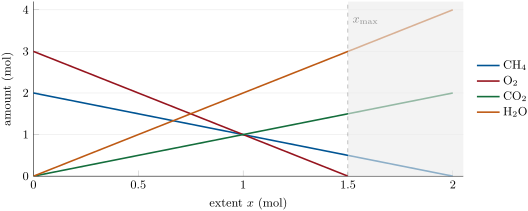
Amounts against the extent for the methane example. Dioxygen (red) reaches zero first, at x = 1.5\, mol: the reaction stops there, and the shaded part is never reached.
Amounts against the extent for the methane example. Dioxygen (red) reaches zero first, at x=1.5 molx = 1.5\,\mathrm{mol}: the reaction stops there, and the shaded part is never reached.

Examples

Example 27.7 (Back to the methane)

Methane would run out at x=2.0/1=2.0 molx = 2.0/1 = 2.0\,\mathrm{mol}, dioxygen at x=3.0/2=1.5 molx = 3.0/2 = 1.5\,\mathrm{mol}. The smaller is 1.5 mol1.5\,\mathrm{mol}: dioxygen is the limiting reactant and xmax⁡=1.5 molx_{\max} = 1.5\,\mathrm{mol}. The final state holds 0.5 mol0.5\,\mathrm{mol} of methane left over, no dioxygen, 1.5 mol1.5\,\mathrm{mol} of carbon dioxide and 3.0 mol3.0\,\mathrm{mol} of water.

Read in context →