School Chemistry — Grades 1 to 12 · Grades 1–12
27The Reaction-Progress Table
In a car crash, a cushion bursts out of the steering wheel and fills with gas in a fraction of a second, before the driver’s head moves forward. The gas is made by a chemical reaction: a small charge of solid, sodium azide in the classic design, decomposes into sodium and nitrogen. The engineer must put in enough solid to fill the cushion, but not so much that it bursts, and no reactant may be left over to harm the passengers. How much solid gives how much gas? A balanced equation gives the proportions; this chapter turns them into a bookkeeping tool that follows every reactant and product from the start of a reaction to its end.
You already know
A balanced equation keeps the number of atoms of each element, and the charge, the same on both sides; its coefficients give the proportions in which the species react (Chapter 13). The amount of a species is for a mass, for a gas (with at and normal atmospheric pressure) (Chapter 25), and for a solute (Chapter 26).

27.1 Describing a chemical system
Definition 27.1 (Chemical system, initial and final states)
A chemical system is the collection of chemical species present in a given place (a flask, a cushion, a cell), each with its amount and its physical state. The system before the reaction starts is the initial state; the system once the reaction has stopped is the final state.
Example 27.2 (Methane burning in a closed vessel)
A closed vessel contains of methane and of dioxygen; a spark sets off the combustion . In the initial state the system holds of , of and no products. What is in the final state? The rest of the chapter answers.
27.2 The extent of reaction and the progress table
Definition 27.3 (Extent of reaction, progress table)
The extent of reaction , in moles, counts how many times the reaction, as written in the balanced equation, has taken place: when the extent is , a species of coefficient has been used up (reactant) or formed (product) in the amount . The progress table gives, under the equation, the amount of every species in the initial state, at an extent , and in the final state.
Method 27.4 (Filling a progress table)
- Write the balanced equation in the first row.
- Initial state (): write the initial amount of each species under it.
- Intermediate state (extent ): each reactant of coefficient becomes , each product .
- Final state: find (next section) and put it into the expressions of the intermediate row.
| equation | |||||
|---|---|---|---|---|---|
| state | extent () | amounts () | |||
| initial | |||||
| intermediate | |||||
| final | |||||
27.3 The limiting reactant and the final state
Definition 27.5 (Limiting reactant, maximum extent, total reaction)
A reaction is a total reaction if it stops only when one of its reactants is used up. That reactant is the limiting reactant; the other reactants are in excess. The extent at which the limiting reactant runs out is the maximum extent ; the final state of a total reaction is the state at .
Method 27.6 (Finding the limiting reactant)
- For each reactant, solve : the reactant would run out at .
- The smallest of these values is ; the reactant that gives it is the limiting reactant.
- Put into the intermediate row to get the final state; check that no amount is negative.
Example 27.7 (Back to the methane)
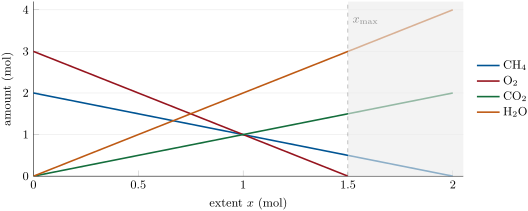
Methane would run out at , dioxygen at . The smaller is : dioxygen is the limiting reactant and . The final state holds of methane left over, no dioxygen, of carbon dioxide and of water.
Remark 27.8 (Not all reactions are total)
Many reactions stop before any reactant is used up: they reach a state in which reactants and products coexist. Their final state is not , and a later chapter learns to find it. In this chapter, every reaction is total.
27.4 The stoichiometric mixture
Definition 27.9 (Stoichiometric mixture)
A mixture of reactants is a stoichiometric mixture when the initial amounts are in the proportions of the coefficients of the balanced equation.
Proposition 27.10 (All reactants run out together)
For a reaction products, the mixture is stoichiometric if and only if
and then, for a total reaction, both reactants are used up in the final state.
Proof. would run out at , at . The two values are equal exactly when the proportions are those of the equation, and then the extent empties both at once. ∎
Example 27.11 (Burning methane cleanly)
For , of methane need of dioxygen: . With only of dioxygen the mixture of the first example was short of oxygen; in a real flame, that shortage is what makes the poisonous carbon monoxide (Chapter 14).
27.5 Gases and solutions in the table
Method 27.12 (Amounts for the initial state)
Before filling a table, convert every quantity given into an amount: for a solid or a liquid weighed; for a gas; for a dissolved species. At the end, convert back the amounts of the final state into whatever is asked: mass, gas volume or concentration.
Example 27.13 (Magnesium in hydrochloric acid)
Hydrochloric acid contains hydrogen ions , which attack magnesium: . A ribbon of of magnesium is dropped into of acid with . Initial amounts: and . Magnesium would run out at , the hydrogen ions at : magnesium is limiting and . The reaction gives of dihydrogen, that is at , and leaves of hydrogen ions in excess.
In the lab — Balloons on flasks
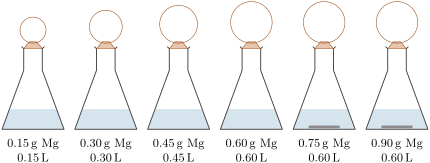
The teacher pours of the same hydrochloric acid into each of six conical flasks, and places in six balloons increasing masses of magnesium powder: 0.15, 0.30, 0.45, 0.60, 0.75 and . Each balloon is stretched over the neck of its flask, then lifted so that the powder falls into the acid. Fizzing, the balloons swell. When all has stopped, the balloons are larger and larger from the first flask to the fourth; the fourth, fifth and sixth are the same size, and in the last two some grey powder is left at the bottom of the flask.
Remark 27.14 (Reading the plateau)
In the first flasks magnesium is the limiting reactant, and doubling it doubles the gas. From a certain mass on, the hydrogen ions run out first: adding magnesium changes nothing but the leftover powder. The change happens exactly at the stoichiometric mixture, , that is of magnesium.
Safety


Magnesium powder is flammable; hydrochloric acid burns the skin and the eyes and its fumes irritate the airways; dihydrogen burns in air. A demonstration by the teacher, with goggles, away from any flame.
27.6 Exercises
Exercise 27.1 ★
Fill the progress table of for an initial mixture of of dihydrogen and of dioxygen, assuming the reaction is total. Give , the limiting reactant and the final state.
Solution
Solution of Exercise 27.1.
: ; : ; : . Dihydrogen runs out at , dioxygen at : , dihydrogen is limiting. Final state: , , .
Exercise 27.2 ★
Carbon burns in dioxygen: . Starting from of carbon and of dioxygen, find , the limiting reactant and the final state.
Solution
Solution of Exercise 27.2.
Carbon would run out at , dioxygen at : , dioxygen is limiting. Final state: of carbon, no dioxygen, of carbon dioxide.
Exercise 27.3 ★
Iron and sulfur react when heated: . Starting from of iron and of sulfur, describe the final state.
Solution
Solution of Exercise 27.3.
(sulfur limiting). Final state: of iron, no sulfur, of iron sulfide.
Exercise 27.4 ★
Assume the reaction is total. Starting from of dinitrogen and of dihydrogen, find and the final state.
Solution
Solution of Exercise 27.4.
Dinitrogen runs out at , dihydrogen at : . Final state: , no , .
Exercise 27.5 ★
For , which of these mixtures is stoichiometric? (a) and ; (b) and ; (c) and .
Solution
Solution of Exercise 27.5.
(b): . In (a) carbon monoxide is limiting, in (c) too.
Exercise 27.6 ★★
What mass of dioxygen is needed to burn of methane completely ()? What mass of water is formed?
Solution
Solution of Exercise 27.6.
, so for a stoichiometric mixture. Dioxygen: , that is . Water: .
Exercise 27.7 ★★
A camping stove burns of propane: . What volume of carbon dioxide, at , does it release?
Solution
Solution of Exercise 27.7.
; carbon dioxide ; , about .
Exercise 27.8 ★★
Using the figure of the amounts against the extent for the methane example, read the amounts of the four species at . Why does the line of dioxygen stop at ?
Solution
Solution of Exercise 27.8.
At : , , , . The dioxygen is used up at : the reaction stops there, so larger extents are never reached.
Exercise 27.9 ★★
of zinc powder are added to of blue copper sulfate solution at . The reaction is . Find the limiting reactant, the mass of copper formed and the mass of zinc left. Is the solution still blue at the end?
Exercise 27.10 ★★
of magnesium are added to of hydrochloric acid with (). Which reactant is limiting? What volume of dihydrogen is collected at ?
Solution
Solution of Exercise 27.10.
, which would run out at ; , which would run out at . The acid is limiting: , so of dihydrogen, .
Exercise 27.11 ★★
In exercise 3, by what percentage is the reactant in excess above the amount that would have made a stoichiometric mixture?
Solution
Solution of Exercise 27.11.
A stoichiometric mixture with of sulfur needs of iron; there is more, that is in excess.
Exercise 27.12 ★★★
A student wants of a stoichiometric mixture of iron and sulfur for . What masses of iron and of sulfur must be weighed?
Solution
Solution of Exercise 27.12.
Equal amounts: , with . So and .
Exercise 27.13 ★★★
of limestone are strongly heated and decompose totally: . The quicklime obtained is then put into of water: .
- Fill the progress table of the first reaction; what volume of carbon dioxide is released at ?
- Fill the table of the second reaction. Which reactant is limiting? What mass of slaked lime is formed?
Exercise 27.14 ★★★
In the balloon experiment of the lab box, compute the volume of dihydrogen in each balloon. Explain why it stops growing after the fourth flask, and plot (by hand) the volume of gas against the mass of magnesium.
Solution
Solution of Exercise 27.14.
in each flask; it would run out at . Magnesium: 0.15, 0.30, 0.45, 0.60, 0.75, give 0.0062, 0.0123, 0.0185, 0.0247, 0.0309, . In the first four flasks magnesium is limiting and the dihydrogen is : 0.15, 0.30, 0.45 and . In the last two the acid is limiting: . The plot is a straight line through the origin up to about of magnesium, then a horizontal plateau at .
Exercise 27.15 ★★★
of ethanol burn in a closed vessel containing of dioxygen at : . Find the limiting reactant, the mass of ethanol left unburnt and the volume of carbon dioxide formed.
Solution
Solution of Exercise 27.15.
(would run out at ); (would run out at ). Dioxygen is limiting, . Ethanol left: , that is . Carbon dioxide: , that is .
27.7 Problem: The Airbag
Problem 27.1
Weekend problem — what mass of sodium azide must be packed into a steering wheel to fill a 60-litre airbag?
In the classic airbag design, an electric spark sets off the decomposition of solid sodium azide:
The sodium metal formed is dangerous: it reacts violently with water, and with the moisture of the skin and the eyes. The charge therefore also contains potassium nitrate, which turns the sodium into harmless oxides and gives a little more nitrogen:
Both reactions are total. The airbag must be filled with of nitrogen; take the gas at , where .
Part I — The reactions.
- Check that the first equation is balanced, element by element.
- Check that the second equation is balanced.
- Which earlier chapter showed that sodium reacts violently with water? Why must no sodium remain after the crash?
- Compute the molar masses of sodium azide and of potassium nitrate .
Part II — The decomposition.
- Fill the progress table of the first reaction for an initial amount of of sodium azide.
- Find . Which is the limiting reactant?
- Give the amounts of sodium and of nitrogen in the final state.
- What volume of nitrogen does of sodium azide give at ?
Part III — Removing the sodium.
- Fill the progress table of the second reaction, starting from the sodium found in question 7 and an amount of potassium nitrate.
- What amount, and what mass, of potassium nitrate makes a stoichiometric mixture with this sodium?
- Give the final state of the second reaction for this mixture.
- If only of potassium nitrate were put in, which reactant would be limiting, and what would be left? Why would that be dangerous?
Part IV — The 60-litre bag.
- From questions 7 and 11, what amount of nitrogen does the whole charge give per mole of sodium azide?
- What amount of nitrogen fills the bag?
- Deduce the amount of sodium azide needed.
- Compute its mass.
- Compute the mass of potassium nitrate to add.
- Without the second reaction, what mass of sodium azide would have been needed? How much does the second reaction save?
- Sodium azide is fatal if swallowed. Why does it matter that the first reaction is total, and how does the progress table show that none is left?
- State the final answer: what mass of sodium azide fills a airbag?
Solution
Solution of Problem 27.1.
1. Left: 2 Na, 6 N. Right: 2 Na, N. Balanced.
2. Left: 10 Na, 2 K, 2 N, 6 O. Right: K: 2; Na: ; O: ; N: 2. Balanced.
3. The periodic-table chapter (Chapter 20): sodium reacts violently with water, giving a corrosive solution and dihydrogen. After the crash the bag is in contact with the skin, the eyes and the moist air of breath.
4. ; .
5. : ; : ; : .
6. at ; sodium azide, the only reactant, is limiting.
7. : ; : .
8. .
9. : ; : ; : ; : ; : .
10. , so , that is .
11. : no sodium, no potassium nitrate, , , .
12. Sodium would run out at , potassium nitrate at : the nitrate is limiting, , and of sodium metal would be left in the bag, ready to react with moisture.
13. of nitrogen per mole of sodium azide.
14. .
15. of sodium azide.
16. .
17. , that is of potassium nitrate.
18. , that is : the second reaction saves about of sodium azide.
19. A total reaction stops only when its limiting reactant is used up; here sodium azide is the only reactant, so in the final state its amount is . Nothing toxic is left in the bag.
20. About of sodium azide fill a airbag.