
All books

Professional

Apps About Coach Log in Start reading

Chemistry · Glossary

What is Molecular solid?

Definition 30.14 School Chemistry — Grades 1 to 12 · Chapter 30 — Electronegativity, Polarity and Intermolecular Forces

A molecular solid is a solid made of molecules held to one another by van der Waals interactions and, where possible, hydrogen bonds. Ice, solid iodine and sugar are molecular solids.
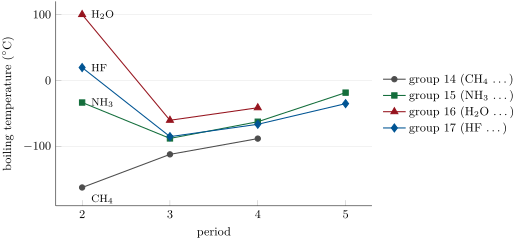
Boiling temperatures of the compounds of hydrogen with the elements of groups 14 to 17. In each group they rise with the size of the molecule, except for the first member of groups 15, 16 and 17, far too high: ammonia, water and hydrogen fluoride form hydrogen bonds. (No value is plotted where the sources used give none.)

Examples

Example 30.16 (Three solids)

Sodium chloride, an ionic solid, melts at 801 ∘C801\,{}^{\circ}\mathrm{C}; ice, held by hydrogen bonds, at 0 ∘C0\,{}^{\circ}\mathrm{C}; solid methane, held only by van der Waals interactions between small molecules, far below −150 ∘C-150\,{}^{\circ}\mathrm{C}.

Read in context →