School Chemistry — Grades 1 to 12 · Grades 1–12
30Electronegativity, Polarity and Intermolecular Forces
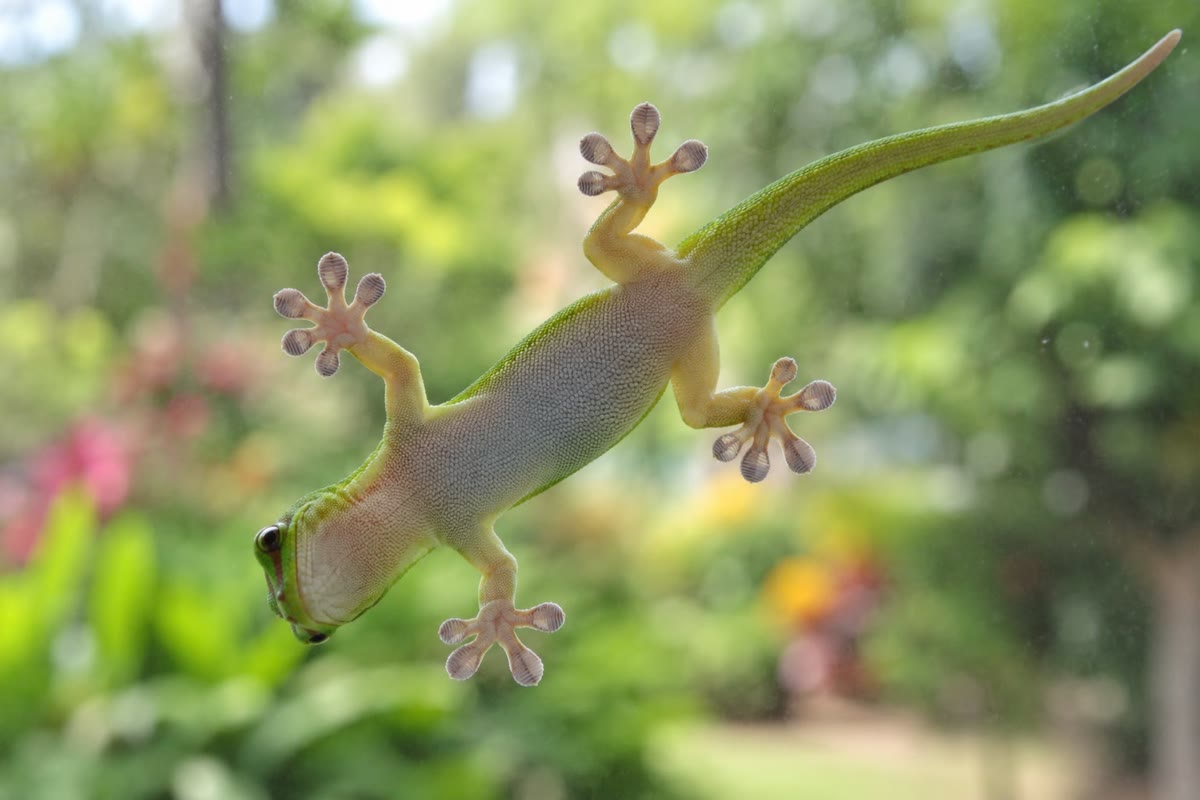
A gecko runs up a window pane and hangs from the glass by a single toe, with no glue and no suction cup. A water molecule, , is lighter than a molecule of hydrogen sulfide, , yet water boils at while hydrogen sulfide is a gas down to . Both stories are about the same thing: the forces that hold molecules to one another, and to other things. They are far weaker than the covalent bonds inside a molecule, but they decide whether a substance is a gas, a liquid or a solid at room temperature, and whether a gecko falls.
You already know
A covalent bond is a pair of electrons shared by two atoms; Lewis structures show bonding pairs and lone pairs, and the pairs around a central atom decide the shape of a molecule (Chapter 24). Ions carry a charge; in an ionic solid, positive and negative ions attract one another (Chapter 17).
30.1 Electronegativity
Definition 30.1 (Electronegativity)
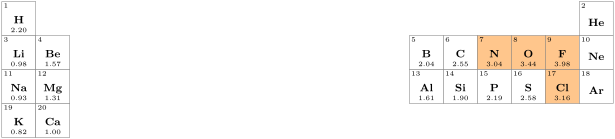
The electronegativity of an element measures how strongly its atoms, in a molecule, attract the electrons of the bonds they share. It is a number without unit; on the usual scale it runs from about 0.8 to about 4.
Proposition 30.2 (Trends in the table)
Electronegativity increases from left to right along a period and decreases from top to bottom in a group. Fluorine (3.98) is the most electronegative element; the alkali metals are the least (lithium 0.98, potassium 0.82).
Proof. Read on the table: along period 2, ; down group 17, fluorine is above chlorine ; down group 1, , , , . (Why it is so is explained in the Year 1 volume.) ∎
History — Pauling’s scale, 1932
The chemist Linus Pauling built the first electronegativity scale in 1932, from the energies of bonds between different atoms. He gave fluorine the largest value, and the scale used in this chapter is still called after him.
30.2 Polar bonds and polar molecules
Definition 30.3 (Polar bond, partial charge)
A covalent bond between two atoms of different electronegativities is a polar bond: the shared pair sits closer to the more electronegative atom. That atom carries a small negative partial charge, written , and the other atom an equal positive partial charge, .
Proposition 30.4 (When is a bond polar?)
A bond between two identical atoms is not polar. Between different atoms, the larger the difference of electronegativities, the more polar the bond; as a rule of thumb, a difference below about 0.4 (such as , ) is treated as non-polar. When the difference is very large (such as Na and Cl, ), the electrons are not shared but transferred: the compound is ionic.
Proof. Admitted: it follows from the definition of electronegativity, the thresholds being conventions. ∎
Definition 30.5 (Polar and non-polar molecules)
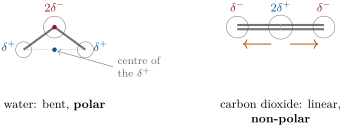
A molecule is a polar molecule if the centre of its positive partial charges and the centre of its negative partial charges do not coincide; if they coincide, it is a non-polar molecule.
Method 30.6 (Is a molecule polar?)
- Draw the Lewis structure and find the shape of the molecule.
- Mark the polar bonds with and .
- If there is no polar bond, the molecule is non-polar. Otherwise, look at the shape: if the polar bonds are arranged symmetrically around the centre, their effects cancel and the molecule is non-polar; if not, it is polar.
Example 30.7 (Four molecules)
Hydrogen chloride has one polar bond and is polar, chlorine . Ammonia , a pyramid of three polar bonds, is polar, nitrogen . Methane has only nearly non-polar bonds: non-polar. Tetrachloromethane has four polar bonds, but at the corners of a regular tetrahedron: their effects cancel and the molecule is non-polar.
30.3 Van der Waals interactions
Definition 30.8 (Van der Waals interaction)
A van der Waals interaction is a weak attraction between neighbouring molecules, which exists between all molecules, polar or not: the electrons of each molecule are constantly moving, and the momentary uneven charges of one molecule attract those of its neighbours. Between polar molecules, the permanent partial charges add a further attraction.
Proposition 30.9 (Bigger molecules attract more)
Van der Waals interactions grow with the size of the molecules, that is, with the number of their electrons; between similar molecules, the larger ones have the higher melting and boiling temperatures.
Proof. Admitted: a larger electron cloud is more easily deformed, so its momentary charges are larger, and it has more contact with its neighbours. ∎
Example 30.10 (The halogens)
The molecules , , , are all non-polar and larger and larger. Their boiling temperatures rise with them: , , and . At room temperature, fluorine and chlorine are gases, bromine a liquid, iodine a solid.
Remark 30.11 (The gecko)
A single van der Waals interaction is tiny, but they add up. The toe pads of a gecko are covered with a dense carpet of microscopic hairs, each split into still finer tips, which come close enough to the glass for van der Waals interactions to act over a very large total area.
30.4 Hydrogen bonds
Definition 30.12 (Hydrogen bond)
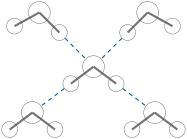
A hydrogen bond is an attraction between a hydrogen atom bonded to a very electronegative atom (nitrogen, oxygen or fluorine), which carries a marked , and a lone pair of another nitrogen, oxygen or fluorine atom, often on a neighbouring molecule. It is drawn as a dashed line, and the three atoms involved are nearly in a straight line.
Example 30.13 (Ethanol and propane)
Ethanol, (), and propane, (), have molecules of nearly the same size. Yet ethanol boils at and propane at . Ethanol molecules, with their group, form hydrogen bonds with one another; propane molecules cannot.
30.5 The cohesion of solids and liquids
Definition 30.14 (Molecular solid)
A molecular solid is a solid made of molecules held to one another by van der Waals interactions and, where possible, hydrogen bonds. Ice, solid iodine and sugar are molecular solids.
Proposition 30.15 (Cohesion and change of state)
The stronger the attractions between the particles of a substance, the higher its melting and boiling temperatures. In increasing order of strength: van der Waals interactions, hydrogen bonds, and the attraction between the ions of an ionic solid.
Proof. Admitted: melting and boiling pull particles apart against these attractions, which needs more energy, so a higher temperature, when they are stronger. ∎
Example 30.16 (Three solids)
Sodium chloride, an ionic solid, melts at ; ice, held by hydrogen bonds, at ; solid methane, held only by van der Waals interactions between small molecules, far below .
Remark 30.17 (Ice and snow)
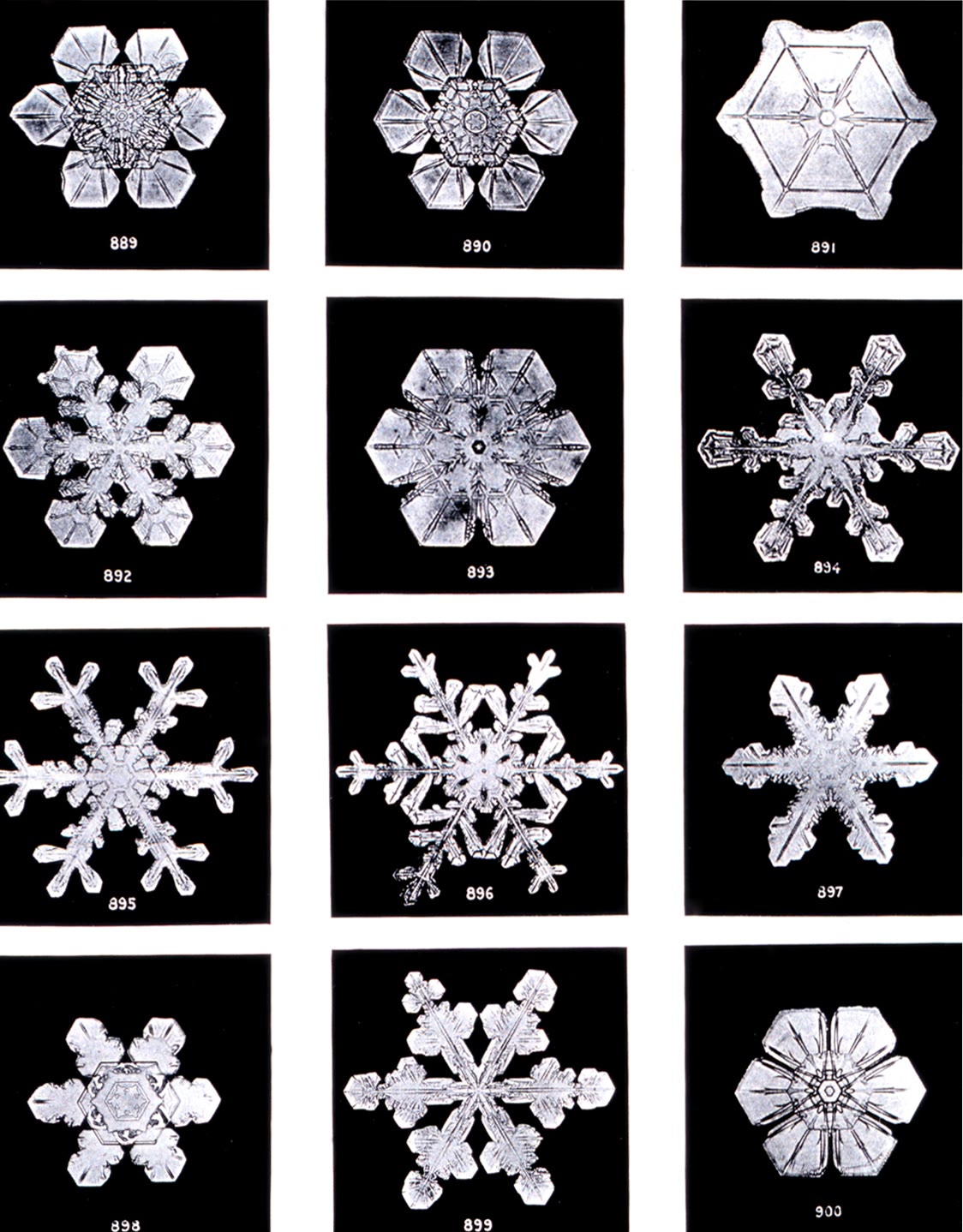
In ice, every water molecule is hydrogen-bonded to four neighbours, in an open network of hexagonal rings. That network leaves more empty space than liquid water, where the bonds constantly break and re-form: ice is less dense than water and floats. The six-fold symmetry of snow crystals reflects the hexagonal rings of the network.
30.6 Exercises
Exercise 30.1 ★
In the bonds , and , which atom carries the partial charge ? Use the table of electronegativities.
Solution
Solution of Exercise 30.1.
: chlorine (3.16 against 2.20). : oxygen (3.44). : oxygen (3.44 against 2.55).
Exercise 30.2 ★
Which of these bonds are polar: , , , , , ? Give the difference of electronegativities for each.
Solution
Solution of Exercise 30.2.
: 0, not polar. : 0.35, treated as non-polar. : 1.24, polar. : 0.84, polar. : 0, not polar. : 0.61, polar.
Exercise 30.3 ★
Which element is the more electronegative in each pair: nitrogen or phosphorus; oxygen or sulfur; carbon or nitrogen; sodium or magnesium? Which trend of the table does each pair illustrate?
Solution
Solution of Exercise 30.3.
Nitrogen (3.04 > 2.19) and oxygen (3.44 > 2.58): electronegativity decreases down a group. Nitrogen (3.04 > 2.55) and magnesium (1.31 > 0.93): it increases from left to right along a period.
Exercise 30.4 ★
Which of , , and can form hydrogen bonds between their own molecules? Explain.
Solution
Solution of Exercise 30.4.
Ammonia and water: each has hydrogen atoms bonded to nitrogen or oxygen, and lone pairs on that atom. Methane has no hydrogen on N, O or F; hydrogen chloride has hydrogen bonded to chlorine, which is not one of the three atoms of the definition.
Exercise 30.5 ★
Are there any attractions between the non-polar molecules of methane? Why is methane nevertheless a gas at room temperature?
Solution
Solution of Exercise 30.5.
Yes: van der Waals interactions exist between all molecules. But methane molecules are small (10 electrons), so these interactions are very weak and break at very low temperature: methane boils near .
Exercise 30.6 ★★
Say whether each molecule is polar: dichloromethane (tetrahedral), tetrachloromethane , ammonia , carbon dioxide , boron trifluoride (a flat triangle with boron at the centre).
Solution
Solution of Exercise 30.6.
: polar (two polar bonds and two nearly non-polar bonds: no symmetry cancels them). : non-polar (four identical bonds at the corners of a tetrahedron). : polar (pyramid). : non-polar (linear, opposite bonds). : non-polar (three identical polar bonds at in a plane cancel).
Exercise 30.7 ★★
In methanol, , which hydrogen atom can be given in a hydrogen bond? Which atom can receive one? Can methanol and water molecules form hydrogen bonds with each other? Draw one.
Solution
Solution of Exercise 30.7.
The hydrogen of the group can be given (not those of , bonded to carbon); the oxygen atom, with its two lone pairs, can receive. Yes: the of methanol can bond to the oxygen of a water molecule, and an of water to the oxygen of methanol, for example .
Exercise 30.8 ★★
Explain why the boiling temperatures rise in the order < < .
Solution
Solution of Exercise 30.8.
The three molecules are non-polar and of the same shape, but larger and larger (10, 18 and 36 electrons): their van der Waals interactions grow, and so do their boiling temperatures.
Exercise 30.9 ★★
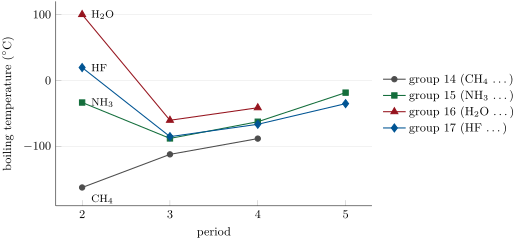
On the chart of the boiling temperatures of the hydrides, which group shows no unusual value for its first member? Why?
Solution
Solution of Exercise 30.9.
Group 14: methane has no hydrogen bonded to N, O or F and forms no hydrogen bonds, so it follows the trend of its group.
Exercise 30.10 ★★
The bonds , , are less and less polar (the electronegativities of chlorine, bromine and iodine are 3.16, 2.96 and 2.66), yet the boiling temperatures rise: , , . Which interaction wins, and why?
Solution
Solution of Exercise 30.10.
The van der Waals interactions: the molecules grow from to , and the increase of these interactions with size outweighs the decrease of the attraction between the partial charges.
Exercise 30.11 ★★
At room temperature chlorine is a gas and iodine a solid, though both are made of non-polar molecules . Explain.
Solution
Solution of Exercise 30.11.
An iodine molecule is much larger than a chlorine molecule (106 electrons against 34): its van der Waals interactions are much stronger, strong enough to hold the molecules in a solid at room temperature.
Exercise 30.12 ★★★
Ethanol , methoxymethane and propane have nearly the same molar mass. They boil at , and . Which of them are polar? Which form hydrogen bonds between their own molecules? Explain the order.
Solution
Solution of Exercise 30.12.
Propane is non-polar: van der Waals interactions only. Methoxymethane is polar (two polar bonds in a bent ) but has no hydrogen on its oxygen: no hydrogen bonds between its molecules. Ethanol is polar and its groups form hydrogen bonds. The stronger the attractions, the higher the boiling temperature: propane < methoxymethane < ethanol.
Exercise 30.13 ★★★
In ice each water molecule is hydrogen-bonded to four neighbours, in an open network; in liquid water the network keeps breaking and partly collapses. Explain why ice floats on water. Why is this important for the fish of a frozen lake?
Solution
Solution of Exercise 30.13.
The open network of ice takes more room than the same molecules in the liquid, so ice is less dense than liquid water and floats. A lake freezes from the top: the layer of ice insulates the water underneath, which stays liquid, and the fish survive.
Exercise 30.14 ★★★
Sort in increasing order of melting temperature, and justify by the attractions between the particles: potassium chloride , ice , solid methane .
Solution
Solution of Exercise 30.14.
Solid methane (van der Waals interactions between small molecules) < ice (hydrogen bonds) < potassium chloride (attraction between ions).
Exercise 30.15 ★★★
Fluorine is more electronegative than oxygen, so an bond is more polar than an bond. Yet water boils at and hydrogen fluoride at . Count the hydrogen atoms each molecule can give and the lone pairs it can receive with, and explain.
Solution
Solution of Exercise 30.15.
A water molecule has two hydrogen atoms to give and two lone pairs to receive with: every molecule can take part in four hydrogen bonds, two given and two received, which builds a complete network. A molecule of hydrogen fluoride has three lone pairs but only one hydrogen atom: it gives a single hydrogen bond, so on average only one bond per molecule can form (zig-zag chains). Water has about twice as many hydrogen bonds per molecule, and boils higher.
30.7 Problem: Why Does Water Boil at ?
Problem 30.1
Weekend problem — without hydrogen bonds, at what temperature would water boil?
Oxygen, sulfur and selenium are in the same group of the table, and all three form a compound with hydrogen: , , . In each group of hydrides, boiling temperatures usually rise with the size of the molecule. Water breaks the rule. By how much?
Part I — Three molecules.
- Draw the Lewis structures of , and . Why are they alike?
- Compute their molar masses.
- Compute the differences of electronegativity of the bonds , and (oxygen 3.44, sulfur 2.58, selenium 2.55, hydrogen 2.20). Which bonds are clearly polar?
- What is the shape of the three molecules? Are they polar?
- Count the electrons of each molecule. Which has the strongest van der Waals interactions?
Part II — Hydrogen bonds.
- Which of the three compounds forms hydrogen bonds between its molecules? Why not the others?
- How many hydrogen bonds can one water molecule take part in at most? Draw them.
- Which interactions hold the molecules of hydrogen sulfide together in the liquid?
Part III — The trend.
- Hydrogen sulfide boils at and hydrogen selenide at . Express the first in degrees Celsius ().
- By how much does the boiling temperature rise from period 3 () to period 4 ()?
- Why does it rise?
- Assuming the same rise from period 2 to period 3, at what temperature would a “normal” boil?
- Test the method on group 14: boils at and at . Predict the boiling temperature of and compare with the real one, . Is the extrapolation exact?
- Do the same for group 17 ( , ) and compare with , .
Part IV — The gap.
- Water really boils at . How large is the gap between the real and the extrapolated values?
- Same for ammonia, using and ; ammonia really boils at .
- Rank water, hydrogen fluoride and ammonia by the size of their gap, and explain the ranking by counting hydrogen bonds.
- Without hydrogen bonds, would water be a solid, a liquid or a gas at room temperature? What would that mean for the Earth?
- Why is the answer of question 12 only an estimate?
- State the final answer: at about what temperature would water boil without hydrogen bonds?
Solution
Solution of Problem 30.1.
1. , , , each central atom with two lone pairs: O, S and Se have six valence electrons, being in the same group.
2. , , .
3. ; ; . Only the bond is clearly polar.
4. Bent (four groups, two of them lone pairs). Water is polar; hydrogen sulfide and hydrogen selenide only very slightly.
5. 10, 18 and 36 electrons: hydrogen selenide has the strongest van der Waals interactions.
6. Only water: its hydrogen atoms are bonded to oxygen, one of the three very electronegative atoms; sulfur and selenium are not electronegative enough to give their hydrogen atoms a marked .
7. Four: two through its own hydrogen atoms, two received by its two lone pairs.
8. Van der Waals interactions (including a weak attraction between the small partial charges).
9. and .
10. .
11. The molecule is larger, so its van der Waals interactions are stronger.
12. .
13. Rise ; prediction for methane , against in reality: the extrapolation is about too high. It is not exact; the real trend is not a straight line.
14. Rise ; prediction for hydrogen fluoride , against : a gap of about .
15. , about .
16. Rise ; prediction ; gap .
17. Water () > hydrogen fluoride () > ammonia (). Water gives two hydrogen atoms and receives with two lone pairs: four hydrogen bonds per molecule, all used. Hydrogen fluoride has one hydrogen to give, and ammonia only one lone pair to receive with: on average fewer bonds per molecule, and nitrogen, less electronegative, makes weaker ones.
18. A gas: it would boil near . The Earth would have no liquid water, no oceans, no rain, and none of the life that depends on them.
19. It extrapolates a straight line drawn through only two points, and the test on group 14 shows such an extrapolation can be off by some .
20. Without hydrogen bonds water would boil at about , some below its real boiling point.