
全部书籍

专业

应用 关于 Coach 登录 开始阅读

书籍暂未推出简体中文版——当前显示英文版。

Chemistry · 术语表

什么是 Molecular solid?

Definition 30.14 School Chemistry — Grades 1 to 12 · 第 30 章 — Electronegativity, Polarity and Intermolecular Forces

A molecular solid is a solid made of molecules held to one another by van der Waals interactions and, where possible, hydrogen bonds. Ice, solid iodine and sugar are molecular solids.
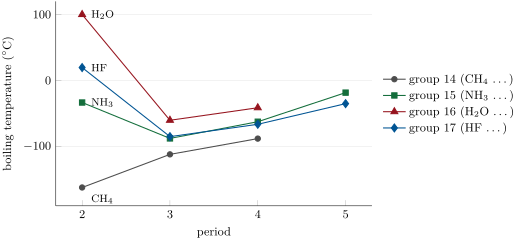
Boiling temperatures of the compounds of hydrogen with the elements of groups 14 to 17. In each group they rise with the size of the molecule, except for the first member of groups 15, 16 and 17, far too high: ammonia, water and hydrogen fluoride form hydrogen bonds. (No value is plotted where the sources used give none.)

示例

Example 30.16 (Three solids)

Sodium chloride, an ionic solid, melts at 801 ∘C801\,{}^{\circ}\mathrm{C}; ice, held by hydrogen bonds, at 0 ∘C0\,{}^{\circ}\mathrm{C}; solid methane, held only by van der Waals interactions between small molecules, far below −150 ∘C-150\,{}^{\circ}\mathrm{C}.

在原文中阅读 →