All books

Professional

Apps About Coach Log in Start reading

Chemistry · Glossary

What is Hydrogen bond?

Definition 30.12 School Chemistry — Grades 1 to 12 · Chapter 30 — Electronegativity, Polarity and Intermolecular Forces

A hydrogen bond is an attraction between a hydrogen atom bonded to a very electronegative atom (nitrogen, oxygen or fluorine), which carries a marked δ+\delta^+, and a lone pair of another nitrogen, oxygen or fluorine atom, often on a neighbouring molecule. It is drawn as a dashed line, and the three atoms involved are nearly in a straight line.
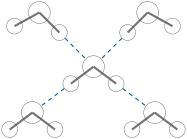
Hydrogen bonds (dashed) around a water molecule in liquid water: its two hydrogen atoms bond to the oxygen atoms of two neighbours, and the two lone pairs of its oxygen atom receive the hydrogen atoms of two others.

Examples

Example 30.13 (Ethanol and propane)

Ethanol, CHX3−CHX2−OH\ce{CH3-CH2-OH} (46.0 g/mol46.0\,\mathrm{g}/\mathrm{mol}), and propane, CHX3−CHX2−CHX3\ce{CH3-CH2-CH3} (44.0 g/mol44.0\,\mathrm{g}/\mathrm{mol}), have molecules of nearly the same size. Yet ethanol boils at 78 ∘C78\,{}^{\circ}\mathrm{C} and propane at −42 ∘C-42\,{}^{\circ}\mathrm{C}. Ethanol molecules, with their O−H\ce{O-H} group, form hydrogen bonds with one another; propane molecules cannot.

Example 30.16 (Three solids)

Sodium chloride, an ionic solid, melts at 801 ∘C801\,{}^{\circ}\mathrm{C}; ice, held by hydrogen bonds, at 0 ∘C0\,{}^{\circ}\mathrm{C}; solid methane, held only by van der Waals interactions between small molecules, far below −150 ∘C-150\,{}^{\circ}\mathrm{C}.

Read in context →
Definition 4.4 University Chemistry — Year 1 · Chapter 4 — Intermolecular Forces and Solvents

A hydrogen bond is an attraction X−H⋯Y\ce{X-H}\cdots\ce{Y} between a hydrogen atom bonded to a small, very electronegative atom X (N\ce{N}, O\ce{O} or F\ce{F}) and a lone pair of another electronegative atom Y. The molecule that carries X−H\ce{X-H} is the hydrogen-bond donor, the one that carries Y the acceptor. Its energy, 10 to 40 kJ/mol40\,\mathrm{kJ}/\mathrm{mol}, lies between van der Waals interactions and covalent bonds; the three atoms X\ce{X}, H\ce{H}, Y\ce{Y} are nearly aligned.

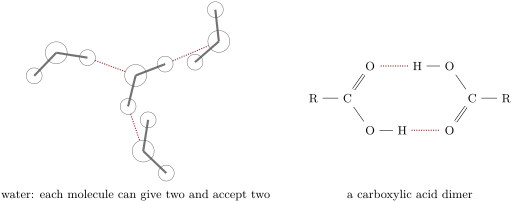
Hydrogen bonds (red dotted). In liquid water each molecule takes part in up to four of them; carboxylic acids pair up in cyclic dimers held by two hydrogen bonds.
Boiling points of the hydrides of group 14 (grey squares), 15 (blue), 16 (red) and 17 (green). Water would boil near -79\, C if it followed its heavier analogues (dashed); its hydrogen bonds raise it by about 180\, C.
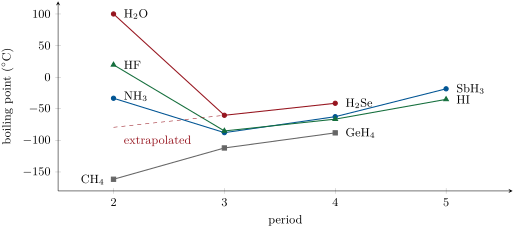
Boiling points of the hydrides of group 14 (grey squares), 15 (blue), 16 (red) and 17 (green). Water would boil near −79 ∘C-79\,{}^{\circ}\mathrm{C} if it followed its heavier analogues (dashed); its hydrogen bonds raise it by about 180 ∘C180\,{}^{\circ}\mathrm{C}.
Read in context →