All books

Professional

Apps About Coach Log in Start reading

Chemistry · Glossary

What is π-excessive and π-deficient heterocycles?

Also known as: π-excessive heterocycle · π-deficient heterocycle

Definition 29.3 University Chemistry — Year 3 · Chapter 29 — Heterocyclic Chemistry

A π\pi-excessive heterocycle, such as pyrrole, furan or thiophene, has six π\pi electrons on five atoms and a higher π\pi electron density on its carbons than benzene; a π\pi-deficient heterocycle, such as pyridine, has an electronegative ring atom that draws π\pi density away from the carbons.

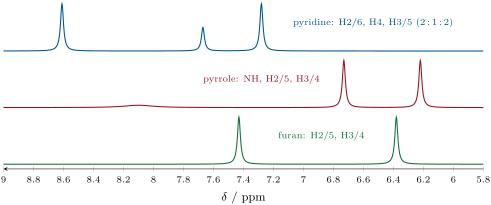
Proton NMR of pyridine, pyrrole and furan in deuterochloroform, synthesised from measured shifts as single lines (couplings omitted), with areas equal to the numbers of protons. The π-deficient pyridine has its H2/6 and H4 signals well downfield of benzene’s; the π-excessive pyrrole and furan have most of theirs upfield of it; the protons next to the heteroatom are always the most deshielded.
Proton NMR of pyridine, pyrrole and furan in deuterochloroform, synthesised from measured shifts as single lines (couplings omitted), with areas equal to the numbers of protons. The π\pi-deficient pyridine has its H2/6 and H4 signals well downfield of benzene’s; the π\pi-excessive pyrrole and furan have most of theirs upfield of it; the protons next to the heteroatom are always the most deshielded.
Read in context →