University Chemistry — Year 3 · Bachelor Year 3
29Heterocyclic Chemistry
A cup of coffee holds caffeine, built of two fused rings that contain four nitrogen atoms, and its aroma comes from dozens of furans, pyrroles, pyrazines and thiophenes formed in roasting. Most drugs on a pharmacy shelf contain at least one ring with a nitrogen, oxygen or sulfur atom in it, and so do the bases of DNA, haem and chlorophyll, and many vitamins. This chapter explains how a heteroatom in an aromatic ring changes its electrons: it can make the ring poorer or richer than benzene, and that decides where and how it reacts. It ends with three classical ways of building such rings.
You already know
The Year 2 volume treated aromaticity and Hückel’s rule, arenes and electrophilic aromatic substitution through the Wheland intermediate, activating and directing groups, amines and their basicity, imines, enamines, tautomers and the nucleobases; the Year 1 volume , nucleophiles, electrophiles and leaving groups. Chapter 26 gave the [3,3] sigmatropic rearrangement.
29.1 Aromatic heterocycles
Definition 29.1 (Heterocycles)
A heterocycle is a ring compound with at least one atom other than carbon in the ring; a heteroaromatic compound is an aromatic one, such as pyridine, pyrrole, furan or thiophene.
Proposition 29.2 (Six electrons)
Pyridine, pyrrole, furan, thiophene and imidazole each have six electrons in a planar, cyclic, conjugated ring, and are aromatic by Hückel’s rule.
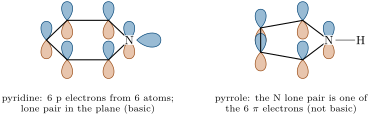
Proof. Pyridine: five carbons and the nitrogen each give one p electron; the nitrogen lone pair is in an orbital in the ring plane, outside the system: . Pyrrole: four carbons give one each and the nitrogen, bonded to H in the plane, puts its lone pair in its p orbital: . Furan and thiophene: as pyrrole, the heteroatom giving one of its two lone pairs (the other lies in the plane). Imidazole: the N–H nitrogen gives two, the pyridine-like nitrogen one, the three carbons three: 6. Six is with . ∎
Definition 29.3 (-excessive and -deficient heterocycles)
A -excessive heterocycle, such as pyrrole, furan or thiophene, has six electrons on five atoms and a higher electron density on its carbons than benzene; a -deficient heterocycle, such as pyridine, has an electronegative ring atom that draws density away from the carbons.
Proposition 29.4 (Basicity)
Pyridine is a moderate base and pyrrole almost none; pyrrole, when it is protonated in strong acid, takes the proton on carbon, not nitrogen.
Argued. Pyridine’s lone pair is outside the system: protonating it costs no aromaticity, and pyridinium has ; it is less basic than piperidine (pyridinium’s nitrogen is , with more s character, and holds its pair more tightly: piperidinium 11.1). Protonating pyrrole’s nitrogen would take its lone pair out of the sextet and destroy the aromaticity; only very strong acids protonate pyrrole at all, at C2, where the cation keeps some delocalisation ( about ). Imidazole has both kinds of nitrogen: it is protonated on the pyridine-like one, and its cation, symmetrical, is stabilised by resonance ( 7.0), the reason histidine works as an acid and a base in enzymes. 4-(Dimethylamino)pyridine is more basic still ( 9.6): the amino group pushes its lone pair into the ring and onto the ring nitrogen. ∎
The dipole moments tell the same story: pyridine () has its negative end on nitrogen, while in pyrrole () the donation of the lone pair to the ring puts the negative end on the ring and the positive end on nitrogen. In furan () and thiophene () the two effects, withdrawal and donation, nearly cancel.
29.2 Pyridine
Pyridine resists electrophilic substitution: the electrophile meets a ring poorer in electrons than benzene, and, in the acid usually present, a pyridinium ion whose positive charge repels it. Nitration needs very forcing conditions and gives the 3-isomer in poor yield.
Proposition 29.5 (Electrophilic substitution at C3)
Electrophilic attack on pyridine occurs at C3: attack at C2 or C4 gives a Wheland intermediate one of whose resonance structures puts the positive charge on nitrogen with only six electrons around it.
Proof. In the cation from attack at C2 (or C4) the positive charge is spread over C3, C5 and N1 (or C3, C5 and N1): a resonance structure with an electron-deficient, six-electron nitrogen, very unfavourable for an electronegative atom. Attack at C3 spreads the charge over C2, C4 and C6 only. All three cations are less stable than benzene’s, but C3 attack is the least bad. ∎
Definition 29.6 (Pyridine N-oxide)
A pyridine N-oxide, made by oxidising pyridine with a peroxy acid, has an group whose oxygen gives electrons back to C2 and C4; it undergoes electrophilic substitution at C4, and the oxygen is then removed.
Definition 29.7 (Nucleophilic aromatic substitution)
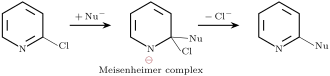
Nucleophilic aromatic substitution () replaces a leaving group on an electron-poor aromatic ring by a nucleophile, through addition followed by elimination. The anionic addition intermediate is a Meisenheimer complex.
Proposition 29.8 ( at C2 and C4)
Halopyridines undergo readily at C2 and C4 and only sluggishly at C3, because addition at C2 or C4 places the negative charge on the nitrogen.
Proof. Addition at C2 makes C2 and leaves four electrons plus the incoming pair spread over N1, C3 and C5 (or for C4: C3, C5 and N1): one resonance structure has the negative charge on the electronegative nitrogen. Addition at C3 spreads it over C2, C4 and C6 only, all carbons. ∎
Proposition 29.9 (Addition–elimination)
For an reaction whose addition step is rate-determining, , and fluoride is the best halide leaving group.
Argued. The rate is that of the bimolecular addition. The carbon–halogen bond is not broken in that step; what matters is how much the halogen lowers the energy of the anionic transition state by withdrawing electrons, and fluorine, the most electronegative, does so most: the order F Cl Br I, opposite to that of . ∎
Definition 29.10 (Chichibabin reaction)
The Chichibabin reaction is the amination of pyridine at C2 by sodium amide: the amide ion adds to C2, and a hydride ion is lost, as dihydrogen after reaction with the product.
Pyridine and DMAP also serve as bases and as nucleophilic catalysts: in acylations with acid anhydrides, DMAP attacks the anhydride first, giving an acylpyridinium ion that transfers its acyl group to the alcohol much faster than the anhydride itself. Pyridines, bipyridines and phenanthrolines are among the commonest ligands of coordination chemistry.
29.3 Five-membered rings
Proposition 29.11 (Electrophilic substitution of pyrrole at C2)
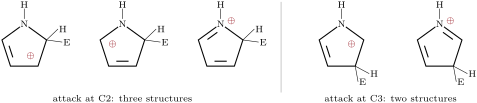
Pyrrole, furan and thiophene undergo electrophilic substitution mainly at C2, because the cation from attack at C2 has three resonance structures and that from attack at C3 only two.
Proof. After attack at C2, the positive charge can sit on C3, on C5, or on nitrogen, where it is shared through the lone pair and every atom keeps an octet (third structure). After attack at C3, it can sit on C2 or on nitrogen only: the charge is less delocalised (see the figure). ∎
Pyrrole is about as reactive as phenol or aniline: it is brominated, nitrated and acylated under mild conditions, polymerises in strong acid, and is formylated at C2 by the Vilsmeier reagent from dimethylformamide and phosphoryl chloride. Reactivities fall in the order pyrrole furan thiophene benzene, following the willingness of the heteroatom to share its lone pair. Furan, the least aromatic, also reacts as a diene in Diels–Alder reactions. Strong bases such as butyllithium deprotonate furan and thiophene at C2, next to the heteroatom, giving organolithium reagents.
Method 29.12 (Predicting the site of attack on a heterocycle)
- Classify the ring: -excessive (pyrrole-like heteroatom) or -deficient (pyridine-like nitrogen).
- Electrophiles: on a -excessive ring at C2 (C3 for indole, whose C2 attack would disrupt the benzene ring); on pyridine at C3, or at C4 through the N-oxide.
- Nucleophiles: on a -deficient ring at C2 or C4, especially with a leaving group there.
- Strong bases: at the C–H next to the heteroatom.
29.4 Fused and biological heterocycles
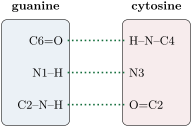
Indole, a benzene fused to a pyrrole, reacts with electrophiles at C3: there the intermediate keeps the benzene ring intact, with the charge on the nitrogen. Quinoline, a benzene fused to a pyridine, is substituted by electrophiles on its benzene ring and by nucleophiles at C2 and C4. The nucleobases are pyrimidines (cytosine, thymine, uracil) and purines (adenine, guanine), a pyrimidine fused to an imidazole. Their oxo and amino forms (lactam and amine tautomers) dominate over the hydroxy and imino forms, which fixes the pattern of hydrogen-bond donors and acceptors on each base, and so the base pairing.
29.5 Making rings
Definition 29.13 (Paal–Knorr synthesis)
The Paal–Knorr synthesis makes a furan (with acid), a pyrrole (with a primary amine or ammonia) or a thiophene (with a sulfur reagent) from a 1,4-dicarbonyl compound.
Definition 29.14 (Hantzsch pyridine synthesis)
The Hantzsch pyridine synthesis condenses an aldehyde, two equivalents of a -keto ester and ammonia into a 1,4-dihydropyridine, which can be oxidised to the pyridine.
Definition 29.15 (Fischer indole synthesis)
The Fischer indole synthesis heats the phenylhydrazone of an aldehyde or ketone with an acid catalyst: the hydrazone tautomerises to an ene-hydrazine, which undergoes a [3,3] sigmatropic rearrangement; cyclisation and loss of ammonia give the indole.
![The Fischer indole synthesis from acetone phenylhydrazone. Acid turns the hydrazone into its ene-hydrazine tautomer; the [3,3] rearrangement breaks the N–N bond and makes a C–C bond between the ring carbon ortho to nitrogen and the terminal CH2; the new amine attacks the imine, and loss of ammonia gives 2-methylindole.](/images/onecourse/chapters/chemistry-4/b3-heterocycles/fig-a129fbc767b0.svg)
![The Fischer indole synthesis from acetone phenylhydrazone. Acid turns the hydrazone into its ene-hydrazine tautomer; the [3,3] rearrangement breaks the N–N bond and makes a C–C bond between the ring carbon ortho to nitrogen and the terminal CH2; the new amine attacks the imine, and loss of ammonia gives 2-methylindole.](/images/onecourse/chapters/chemistry-4/b3-heterocycles/fig-04406a6cf107.svg)
Method 29.16 (Disconnecting a heterocycle)
- A 2,5-disubstituted pyrrole, furan or thiophene: disconnect both bonds to the heteroatom, back to a 1,4-diketone (Paal–Knorr).
- A symmetrical 1,4-dihydropyridine with esters at C3 and C5: back to one aldehyde, two -keto esters and ammonia (Hantzsch).
- A 2,3-disubstituted indole: back to phenylhydrazine and the ketone (Fischer).
- Check the availability of the pieces, then the regiochemistry when the ketone is unsymmetrical.
Definition 29.17 (Bioisostere)
A bioisostere is a group that replaces another in a drug molecule while keeping its biological activity, because it has a similar size, shape and pattern of hydrogen-bonding and charge, such as a tetrazole in place of a carboxylic acid, or a pyridine in place of a benzene ring.
In the lab — A Paal–Knorr pyrrole
Hexane-2,5-dione, aniline and a catalytic amount of 4-toluenesulfonic acid are heated under reflux in toluene in a flask fitted with a Dean–Stark trap: the water formed is carried over as an azeotrope and collects in the side arm, which drives the condensation to completion. When no more water separates, the solution is washed with aqueous sodium hydrogencarbonate, dried and evaporated, and the 2,5-dimethyl-1-phenylpyrrole is recrystallised.
Safety


Pyridine: highly flammable, harmful by all routes, with a strong smell; used in a fume hood. Phenylhydrazine: toxic by all routes, may cause cancer and genetic defects, damages the blood on repeated exposure, sensitising, very toxic to aquatic life; it is weighed in a fume hood with gloves, and its waste collected separately.
History — Two classical ring syntheses
Emil Fischer described his indole synthesis in 1883, in the same years as his work on the sugars and the purines; Arthur Hantzsch published his pyridine synthesis in 1881. Both remain in use: the Fischer synthesis for the triptan drugs against migraine, the Hantzsch synthesis for the dihydropyridine calcium-channel blockers that treat high blood pressure.
29.6 Exercises
Exercise 29.1 ★
Count the electrons of oxazole, thiazole, pyrimidine and purine, and say which lone pairs belong to the system.
Solution
Solution of Exercise 29.1.
Oxazole: O gives two (one lone pair in the system, one in the plane), N one, the three carbons three: 6. Thiazole: the same with S: 6. Pyrimidine: one from each of the six atoms, both nitrogen lone pairs in the plane: 6. Purine: nine atoms, the N–H nitrogen giving two and the others one each: 10, a Hückel number (, ).
Exercise 29.2 ★
Rank pyridine, pyrrole, imidazole, piperidine and DMAP by basicity, with their values.
Solution
Solution of Exercise 29.2.
Piperidine (11.1) DMAP (9.6) imidazole (7.0) pyridine (5.2) pyrrole (about , protonated on carbon).
Exercise 29.3 ★
Give the main product of monobromination of pyrrole, of furan and of indole.
Solution
Solution of Exercise 29.3.
2-Bromopyrrole (pyrrole is so reactive that it is easily polybrominated); 2-bromofuran; 3-bromoindole.
Exercise 29.4 ★
Give the products of the Paal–Knorr reaction of hexane-2,5-dione with acid alone, with methylamine, and with phosphorus pentasulfide.
Solution
Solution of Exercise 29.4.
2,5-Dimethylfuran; 1,2,5-trimethylpyrrole; 2,5-dimethylthiophene.
Exercise 29.5 ★★
2-Chloropyridine reacts with sodium methoxide in methanol at ; 3-chloropyridine hardly does. Explain, and give the product.
Solution
Solution of Exercise 29.5.
2-Methoxypyridine. Addition of methoxide at C2 puts the negative charge of the Meisenheimer complex on nitrogen; at C3 it can only be spread over carbons, so the intermediate, and the transition state before it, are much higher in energy.
Exercise 29.6 ★★
Give the product of the Chichibabin reaction of pyridine and draw the addition intermediate.
Solution
Solution of Exercise 29.6.
2-Aminopyridine (as its sodium salt, then protonated on work-up). The amide ion adds at C2, giving an anionic -adduct with H and on C2 and the negative charge on the ring nitrogen; it loses hydride, which takes a proton from the amino group and leaves as .
Exercise 29.7 ★★
Pyridine N-oxide is nitrated at C4. Explain with resonance structures, and say how 4-nitropyridine is obtained.
Solution
Solution of Exercise 29.7.
The oxygen of the N-oxide gives a lone pair back into the ring: resonance structures carry negative charge at C2, C4 and C6. Electrophiles attack C4 (C2 is close to the positively charged nitrogen). The oxygen is then removed with phosphorus trichloride, giving 4-nitropyridine.
Exercise 29.8 ★★
2-Hydroxypyridine exists mainly as 2-pyridone in water. Draw both tautomers and explain why the pyridone is still aromatic.
Solution
Solution of Exercise 29.8.
2-Hydroxypyridine (an OH on C2) and 2-pyridone (N–H and C=O). The pyridone keeps six electrons in the ring: its zwitterionic resonance structure, with and an that shares its lone pair, is a pyridinium-olate; it is an amide whose nitrogen lone pair completes the sextet, and the strong C=O and N–H hydrogen bonds favour it in water.
Exercise 29.9 ★★
Give the components of a Hantzsch synthesis of the 1,4-dihydropyridine with methyl esters at C3 and C5, methyl groups at C2 and C6 and a 2-nitrophenyl group at C4.
Solution
Solution of Exercise 29.9.
2-Nitrobenzaldehyde, two equivalents of methyl acetoacetate, and ammonia: the calcium-channel blocker nifedipine.
Exercise 29.10 ★★★
Butanone gives two different indoles in the Fischer synthesis with phenylhydrazine. Give both, and say how the acid strength changes their ratio.
Solution
Solution of Exercise 29.10.
The ene-hydrazine towards the group (internal, more substituted) gives 2,3-dimethylindole; that towards the methyl group (terminal) gives 2-ethylindole. Weak acids give mainly the first, through the more stable ene-hydrazine; stronger acids raise the proportion of 2-ethylindole.
Exercise 29.11 ★★★
Explain why 4-fluoronitrobenzene and 2-fluoropyridine react faster with nucleophiles than the corresponding chlorides, unlike substrates.
Solution
Solution of Exercise 29.11.
In the rate-determining step is the addition, which does not break the C–X bond; the more electronegative fluorine stabilises the anionic transition state and the Meisenheimer complex more. In the C–X bond breaks in the transition state, and the weak C–I bond leaves fastest.
Exercise 29.12 ★★★
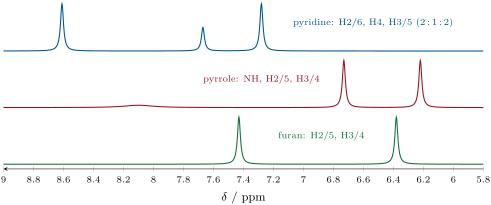
Using the synthetic spectra of the chapter, explain how you would tell pyridine, pyrrole and furan apart by their proton NMR, and predict the spectrum of thiophene (shifts and ).
Solution
Solution of Exercise 29.12.
Pyridine: three signals in the ratio 2 : 1 : 2, the first near . Pyrrole: two equal signals at 6.7 and and a broad N–H near . Furan: two equal signals at 7.4 and , with no N–H. Thiophene: two equal signals at 7.33 and , close together, between those of furan.
29.7 Problem: Building an Indole
Problem 29.1
Weekend problem — building an indole: the phenylhydrazone of acetone, the ene-hydrazine and its [3,3] rearrangement, the loss of ammonia, and the choice between two indoles with butanone
Data of the problem: 10.0 g of phenylhydrazine reacts with excess acetone, and the hydrazone is heated with zinc chloride.
Part I — The hydrazone.
- Write the formation of acetone phenylhydrazone.
- Why is it an imine-type condensation, and why is a trace of acid useful?
- Which nitrogen of phenylhydrazine attacks the carbonyl group, and why?
- Compute the molar mass of phenylhydrazine and the amount used.
- Compute the theoretical mass of hydrazone.
Part II — The ene-hydrazine and the [3,3] step.
- Draw the ene-hydrazine tautomer.
- Which six atoms form the cyclic transition state of the [3,3] rearrangement?
- Which bond breaks and which forms?
- How many electrons take part, and is the step thermally allowed?
- What does the zinc chloride do?
- Why does the aromaticity of the benzene ring have to be restored afterwards?
Part III — Closing the ring.
- Which amine attacks which carbon to close the five-membered ring?
- What small molecule leaves, and what drives the last step?
- Write the overall equation, hydrazone to 2-methylindole.
- Compute the molar mass of 2-methylindole.
- Compute the theoretical mass of 2-methylindole.
- Where would 2-methylindole be substituted by an electrophile, and why?
Part IV — Butanone.
- Draw the two ene-hydrazines of butanone phenylhydrazone.
- Give the two indoles they lead to.
- Which ene-hydrazine is more substituted, and which forms under strong acid?
- Which indole dominates with a weak acid, and why?
- Why can acetaldehyde phenylhydrazone not give indole itself well?
- What does the regiochemistry problem mean for the synthesis of a drug?
- State the result: the theoretical mass of 2-methylindole from 10.0 g of phenylhydrazine.
Solution
Solution of Problem 29.1.
1. .
2. The amine nitrogen adds to the carbonyl carbon, then water is lost, as in imine formation; acid activates the carbonyl group and turns the OH of the adduct into a leaving group.
3. The terminal : the other nitrogen’s lone pair is conjugated with the phenyl ring and more hindered.
4. ; .
5. The hydrazone , : .
6. .
7. The ortho ring carbon, the ipso carbon, the two nitrogens, the hydrazone carbon and the terminal .
8. The N–N bond breaks; a C–C bond forms between the ortho carbon and the .
9. Six electrons, all components suprafacial: thermally allowed.
10. As a Lewis acid it catalyses the tautomerisation, binds a nitrogen and weakens the N–N bond, and helps ammonia leave.
11. The ortho carbon has become , with a hydrogen: loss of that proton restores the benzene ring, a strong driving force.
12. The aniline formed attacks the imine carbon, closing the five-membered ring (a 2-aminoindoline).
13. Ammonia; the formation of the aromatic pyrrole ring of indole drives it.
14. .
15. .
16. .
17. At C3, the most nucleophilic position of indole, free here; attack there keeps the benzene ring intact in the intermediate.
18. (terminal) and (internal).
19. 2-Ethylindole and 2,3-dimethylindole.
20. The internal one is more substituted; strong acids raise the share of the terminal one.
21. 2,3-Dimethylindole, through the more stable, more substituted ene-hydrazine.
22. Acetaldehyde condenses with itself and the ene-hydrazine route gives poor yields; indole is made instead from the hydrazone of pyruvic acid, giving indole-2-carboxylic acid, which is decarboxylated.
23. A mixture of regioisomers must be separated, which costs yield; a symmetrical ketone or a route that fixes the regiochemistry is preferred.
24. 10.0 g of phenylhydrazine can give at most of 2-methylindole.