
All books

Professional

Apps About Coach Log in Start reading

Chemistry · Glossary

What is Polar and non-polar molecules?

Also known as: polar molecule · non-polar molecule

Definition 30.5 School Chemistry — Grades 1 to 12 · Chapter 30 — Electronegativity, Polarity and Intermolecular Forces

A molecule is a polar molecule if the centre of its positive partial charges and the centre of its negative partial charges do not coincide; if they coincide, it is a non-polar molecule.
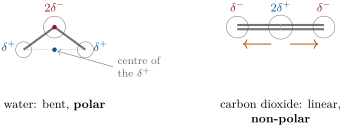
In water, the bent shape puts the centre of the positive partial charges (between the hydrogen atoms) below the oxygen atom: the molecule is polar. In carbon dioxide the two polar bonds pull in opposite directions (arrows) and cancel: the centres of charge coincide on the carbon atom.

Examples

Example 30.7 (Four molecules)

Hydrogen chloride HCl\ce{HCl} has one polar bond and is polar, chlorine δ−\delta^-. Ammonia NHX3\ce{NH3}, a pyramid of three polar N−H\ce{N-H} bonds, is polar, nitrogen δ−\delta^-. Methane CHX4\ce{CH4} has only nearly non-polar C−H\ce{C-H} bonds: non-polar. Tetrachloromethane CClX4\ce{CCl4} has four polar C−Cl\ce{C-Cl} bonds, but at the corners of a regular tetrahedron: their effects cancel and the molecule is non-polar.

Read in context →