All books

Professional

Apps About Coach Log in Start reading

Chemistry · Glossary

What is Rate of disappearance, rate of appearance?

Also known as: rate of disappearance · rate of appearance

Definition 41.5 School Chemistry — Grades 1 to 12 · Chapter 41 — Reaction Rates

In a solution of constant volume, the rate of disappearance of a reactant A at time tt is

vA(t)=−d[A]dt,v_A(t) = -\frac{d[\ce{A}]}{dt},

and the rate of appearance of a product P is vP(t)=d[P]dtv_P(t) = \dfrac{d[\ce{P}]}{dt}. Both are positive, in mol L−1 min−1\mathrm{mol}\,\mathrm{L}^{-1}\,\mathrm{min}^{-1} (or per second).

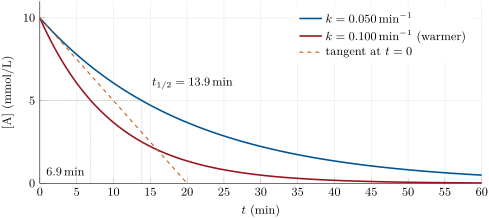
The concentration of a reactant A against time, for the same first-order reaction at two temperatures. The tangent at t = 0 (dashed) gives the initial rate; the dotted lines mark the half-lives.
The concentration of a reactant A against time, for the same first-order reaction at two temperatures. The tangent at t=0t = 0 (dashed) gives the initial rate; the dotted lines mark the half-lives.

Examples

Example 41.7 (The initial rate)

On the blue curve, the tangent at t=0t = 0 goes from 10.0 mmol/L10.0\,\mathrm{mmol}/\mathrm{L} at t=0t = 0 to 00 at t=20 mint = 20\,\mathrm{min}: its slope is −10.0/20=−0.50 mmol L−1 min−1-10.0/20 = -0.50\,\mathrm{mmol}\,\mathrm{L}^{-1}\,\mathrm{min}^{-1}, so the initial rate of disappearance is 0.50 mmol L−1 min−10.50\,\mathrm{mmol}\,\mathrm{L}^{-1}\,\mathrm{min}^{-1}. Later the curve flattens and the rate falls: the reaction slows down as A is used up.

Read in context →