School Chemistry — Grades 1 to 12 · Grades 1–12
41Reaction Rates
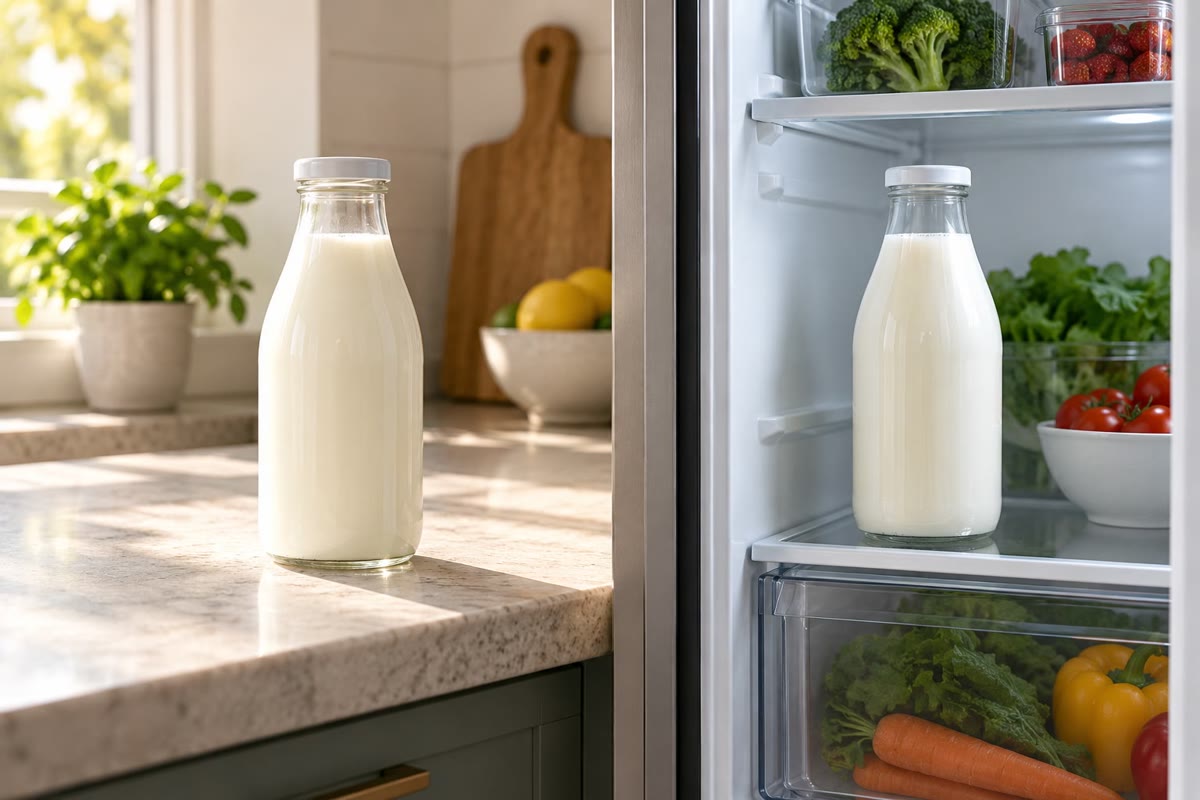
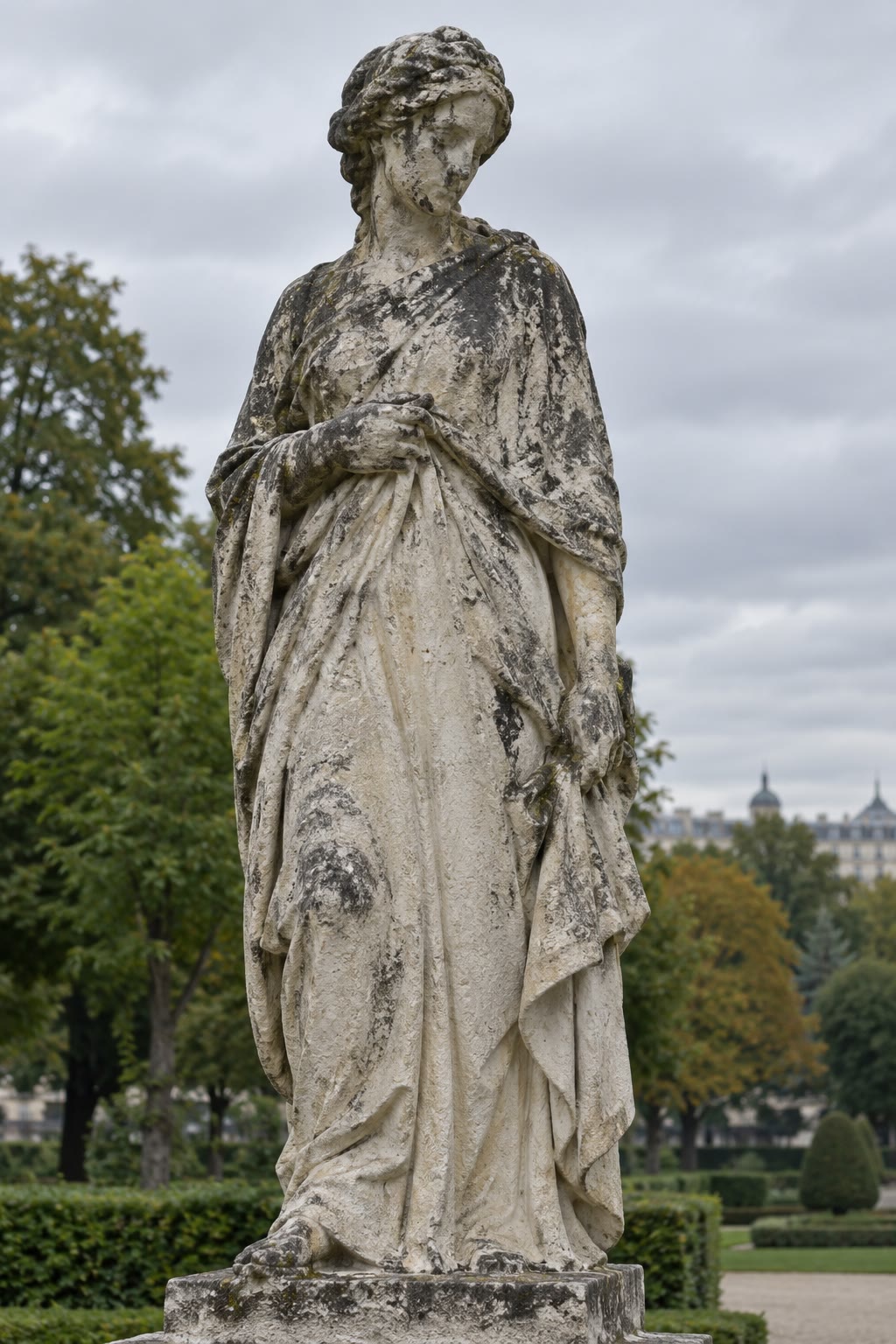
A bottle of milk left on the kitchen counter turns sour in a couple of days; in the fridge, it keeps for more than a week. A firework burns in a fraction of a second, while a limestone statue in a city park weathers over centuries. Balanced equations and progress tables say what a reaction gives and how much; they say nothing about how fast. This chapter measures the speed of reactions, finds what controls it, and describes the simplest way a reaction can slow down as it goes.
You already know
The concentration of a solution (Chapter 26) and the extent of a reaction (Chapter 27). The absorbance of a dilute solution is proportional to the concentration of the coloured species (Chapter 29). A titration measures the amount of a species (Chapter 36).
41.1 Following a reaction in time
Some reactions are over as soon as the reactants meet: the precipitation of silver chloride, the reaction of an acid with a base. Others take minutes, hours or years. To study a slow reaction, chemists measure the concentration of a reactant or a product at regular times. They can
- take small samples, stop the reaction in each, and titrate them;
- measure the absorbance of the solution, when a reactant or a product is coloured;
- measure the pressure or the volume of a gas given off, or the conductivity of a solution whose ions change.
Definition 41.1 (Quenching)
Quenching a sample is stopping, or very greatly slowing, the reaction in it at the moment it is taken, usually by cooling it suddenly and diluting it, so that its composition can be measured at leisure.
In the lab — Quenching a sample
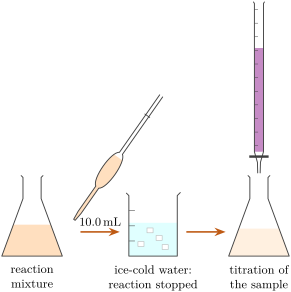
Every five minutes, of the reaction mixture are taken with a pipette and poured into a beaker holding about of ice-cold water. Diluted five times and cooled close to , the reaction becomes so slow that it can be considered stopped; the sample is then titrated. The time of the sample is the time it was poured into the ice water, not the time of the titration.
41.2 Kinetic factors
Definition 41.2 (Kinetic factor)
A kinetic factor is a quantity that changes the speed of a reaction without changing what the reaction gives: the temperature, the concentrations of the reactants, the area of contact between reactants in different phases, and the presence of a catalyst (next chapter).
Proposition 41.3 (Hotter, more concentrated, finer: faster)
In general a reaction is faster when the temperature is higher, when the reactants are more concentrated, and, for a solid reactant, when it is more finely divided.
Proof. Admitted, with a picture: reacting particles must meet, and meet hard enough. Concentrating them makes meetings more frequent; dividing a solid offers more surface to meet; heating makes them move faster, so that they meet more often and, above all, more of the meetings are energetic enough to break bonds. ∎
Example 41.4 (Three everyday cases)
Food keeps longer in the fridge and much longer in the freezer: the reactions that spoil it slow down in the cold. Fine flour dust in the air of a mill can explode, while a sack of flour only smoulders: same reaction, enormous contact area. A tablet that fizzes in water dissolves faster if it is crushed first.
41.3 Rates of disappearance and of appearance
Definition 41.5 (Rate of disappearance, rate of appearance)
In a solution of constant volume, the rate of disappearance of a reactant A at time is
and the rate of appearance of a product P is . Both are positive, in (or per second).
Method 41.6 (Reading a rate from a tangent)
- On the curve of against , draw the tangent at the chosen time.
- Read two points far apart on the tangent and compute its slope, .
- The rate of disappearance is the opposite of this slope (for a product, the slope itself).
Example 41.7 (The initial rate)
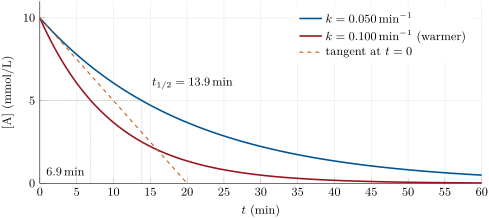
On the blue curve, the tangent at goes from at to at : its slope is , so the initial rate of disappearance is . Later the curve flattens and the rate falls: the reaction slows down as A is used up.
41.4 First-order reactions
Definition 41.8 (First-order reaction, rate constant)
A reaction is a first-order reaction with respect to A if its rate of disappearance is proportional to the concentration of A at every moment:
The positive constant , in or , is the rate constant; it depends on the temperature.
Proposition 41.9 (Exponential decay)
For a first-order reaction with initial concentration ,
Proof. The function has derivative , so it satisfies the rate equation, and . That it is the only such function is admitted here (it is proved in mathematics, for equations ). ∎
Method 41.10 (Testing for first order)
- From the measurements, compute (or for an absorbance proportional to ) at each time.
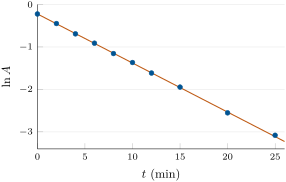
- Plot against : since , the points lie on a straight line if and only if the reaction is first order.
- The slope of the line is .
41.5 Half-life
Definition 41.11 (Half-life)
The half-life of a reaction is the time it takes for the concentration of the limiting reactant to fall to half of its initial value.
Proposition 41.12 (Half-life of a first-order reaction)
For a first-order reaction,
whatever the initial concentration; after half-lives, the concentration is divided by .
Proof. gives , so . Each further half-life multiplies the concentration by again. ∎
Example 41.13 (Reading the half-lives)
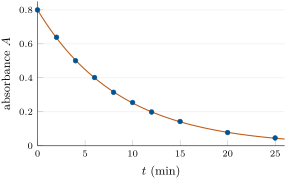
For , : the concentration falls from 10.0 to 5.0, then 2.5, then at 13.9, 27.7 and . The warmer run, with twice as large, has half the half-life, , as the figure shows.
Remark 41.14 (Half-lives elsewhere)
The same word is used in physics for radioactive nuclei, whose number falls in the same exponential way: a radioactive decay behaves like a first-order reaction. The physics book treats it.
41.6 Exercises
Exercise 41.1 ★
Name the kinetic factor at work in each case: a fridge keeps food; powdered sugar dissolves faster than a lump; a more concentrated acid attacks zinc faster; a cut apple browns faster in summer.
Solution
Solution of Exercise 41.1.
Temperature; contact area; concentration; temperature.
Exercise 41.2 ★
Read on the figure of against time the half-life of each run. What is on the blue curve after two half-lives?
Solution
Solution of Exercise 41.2.
(blue) and (red). After two half-lives, .
Exercise 41.3 ★
A tangent to the curve of a product drawn at passes through and . What is the rate of appearance of the product at ?
Exercise 41.4 ★
Why is a sample poured into ice-cold water before being titrated? Why must the time of the sample be noted when it is poured, not when it is titrated?
Exercise 41.5 ★
A first-order reaction has a half-life of . What fraction of the reactant remains after ? After ?
Solution
Solution of Exercise 41.5.
is 3 half-lives: remains. is 6 half-lives: , about .
Exercise 41.6 ★★
Concentrations of a reactant, in : 8.00 at , 5.66 at , 4.00 at , 2.83 at , 2.00 at . Compute at each time and show that the reaction is first order. Find and the half-life.
Solution
Solution of Exercise 41.6.
: 2.079, 1.733, 1.386, 1.040, 0.693. It falls by 0.346 every : a straight line, first order. and (as seen directly: 8.00, 4.00, 2.00 every ).
Exercise 41.7 ★★
A first-order reaction has . Compute .
Solution
Solution of Exercise 41.7.
.
Exercise 41.8 ★★
For and , compute after 10, 30 and .
Solution
Solution of Exercise 41.8.
; ; .
Exercise 41.9 ★★
On the figure of against time, estimate the slope of the blue curve at (draw a tangent), and compare it with at that time.
Solution
Solution of Exercise 41.9.
At , ; the tangent’s slope is close to , and : half the initial value.
Exercise 41.10 ★★
Iodine , brown, is formed slowly in a colourless solution. The absorbance rises from 0 towards 0.60. Explain why the absorbance can be used to follow , and how the rate of appearance at a given time is read on the curve of against .
Solution
Solution of Exercise 41.10.
Iodine is the only coloured species: by the Beer–Lambert law . The rate of appearance is the slope of the tangent to the curve , that is the slope of the tangent to divided by .
Exercise 41.11 ★★
Two runs of the same reaction start at and . If the reaction is first order, compare their initial rates and their half-lives.
Solution
Solution of Exercise 41.11.
The initial rate is twice as large for the second run; the half-lives are equal, , independent of .
Exercise 41.12 ★★★
How many half-lives does it take for a first-order reaction to reach of its reactant? ? Give the general formula for the time to fall to a fraction .
Solution
Solution of Exercise 41.12.
. In half-lives: . For , ; for , .
Exercise 41.13 ★★★
A reaction has at and at . How long does it take to use up of the reactant at each temperature? A common rule of thumb says the rate doubles every : does this reaction follow it?
Solution
Solution of Exercise 41.13.
used, : , that is at and at . The rate constant doubles over : the rule holds here.
Exercise 41.14 ★★★
A sample is quenched by pouring into of ice water. Give two reasons why the reaction becomes much slower. If the reaction is first order in each of two reactants, by what factor does dilution alone divide the rate?
Solution
Solution of Exercise 41.14.
The temperature drops close to , and the concentrations are divided by 10. With a rate proportional to the product of two concentrations, dilution alone divides it by .
Exercise 41.15 ★★★
Show, by differentiating, that the rate of disappearance of a first-order reaction is itself an exponential function of time, . What is the initial rate? After how long is the rate half the initial rate?
Solution
Solution of Exercise 41.15.
. Initial rate ; the rate is halved when , that is after one half-life.
41.7 Problem: The Fading Dye
Problem 41.1
Weekend problem — crystal violet bleached by hydroxide ions: how long until the colour is almost gone?
The violet dye crystal violet reacts with hydroxide ions to give a colourless product. In a large excess of hydroxide, the rate depends only on the concentration of the dye. The absorbance of the solution is recorded at the wavelength where the dye absorbs most:
| () | 0 | 2 | 4 | 6 | 8 | 10 | 12 | 15 | 20 | 25 |
| 0.800 | 0.639 | 0.501 | 0.402 | 0.315 | 0.255 | 0.199 | 0.143 | 0.078 | 0.046 |
Part I — Absorbance and concentration.
- Why is the absorbance proportional to the concentration of the dye? What condition must the solution meet?
- Why is the product, colourless, not seen at this wavelength?
- Why is hydroxide used in large excess?
- What would be read on the spectrophotometer at the end of the reaction?
Part II — Is it first order?
- Read the half-life directly in the table.
- Check that it is the same from to min.
- Compute for each time.
- Plot against (or use the figure of the chapter). What do you observe? Conclude.
- Compute the slope from the points at 0 and .
Part III — The rate constant.
- Deduce .
- Compute the half-life from , and compare with question 5.
- Compute the initial rate of disappearance of the dye, expressed as a rate of decrease of the absorbance.
- What would the half-life be if the initial absorbance were 0.400?
Part IV — Prediction.
- Predict the absorbance at .
- At what time does the absorbance fall to 0.008, of its start?
- How many half-lives is that?
- The eye no longer sees the colour below about . When does the solution look colourless?
- The experiment is repeated warmer and the half-life becomes . When is reached?
- State the final answer: how many half-lives does the colour take to fall to of its start, and how many minutes is that here?
Solution
Solution of Problem 41.1.
1. By the Beer–Lambert law, the dye being the only species absorbing at this wavelength; the solution must be dilute enough ( below about 1).
2. It absorbs no visible light: it adds nothing to .
3. So that its concentration hardly changes: the rate then depends on the dye alone.
4. (the blank).
5. falls from 0.800 to 0.402 in : about .
6. From 0.402 at to 0.199 at : halved again in .
7. , , , , , , , , , .
8. The points lie on a straight line: the reaction is first order in the dye.
9. .
10. .
11. , as read in the table.
12. in absorbance units per minute.
13. The same, : a first-order half-life does not depend on the starting value.
14. .
15. .
16. half-lives.
17. .
18. Still 6.6 half-lives, now .
19. About 6.6 half-lives, that is about here.