All books

Professional

Apps About Coach Log in Start reading

Chemistry · Glossary

What is Reversibility?

Also known as: electrochemically reversible system · quasi-reversible system · electrochemically irreversible system

Definition 15.14 University Chemistry — Year 3 · Chapter 15 — Electrode Kinetics and Electroanalysis

With the dimensionless rate parameter Λ=k∘/DnFv/RT\Lambda = k^\circ/\sqrt{DnFv/RT}, comparing the electron-transfer rate with the rate of diffusion imposed by the scan, a couple is electrochemically reversible if Λ>15\Lambda > 15 (its surface concentrations obey the Nernst equation at all times), quasi-reversible if 15>Λ>10−2(1+α)15 > \Lambda > 10^{-2(1 + \alpha)}, and electrochemically irreversible below.
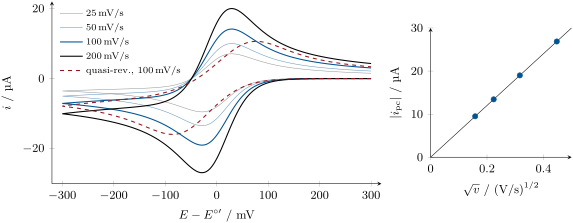
Cyclic voltammograms simulated by finite differences for a reduction (model: 1.0\, mM, D = 1.0 × 10⁻⁵\, cm2\, s-1, 3\, mm disk, n = 1; anodic current positive). Reversible waves at four scan rates: the peaks stay 57.7\, mV apart, centred on E, and the peak current grows as √ v (right, the line is the Randles–Ševčík equation). Dashed: a quasi-reversible couple (k = 2 × 10⁻³\, cm\, s-1) at 100\, mV/ s, with peaks 162\, mV apart and lower.
Cyclic voltammograms simulated by finite differences for a reduction (model: 1.0 mM1.0\,\mathrm{mM}, D=1.0×10⁻⁵ cm2 s−1D = 1.0 \times 10^{-5}\,\mathrm{cm}^{2}\,\mathrm{s}^{-1}, 3 mm3\,\mathrm{mm} disk, n=1n = 1; anodic current positive). Reversible waves at four scan rates: the peaks stay 57.7 mV57.7\,\mathrm{mV} apart, centred on E∘′E^{\circ\prime}, and the peak current grows as v\sqrt v (right, the line is the Randles–Ševčík equation). Dashed: a quasi-reversible couple (k∘=2×10⁻³ cm s−1k^\circ = 2 \times 10^{-3}\,\mathrm{cm}\,\mathrm{s}^{-1}) at 100 mV/s100\,\mathrm{mV}/\mathrm{s}, with peaks 162 mV162\,\mathrm{mV} apart and lower.
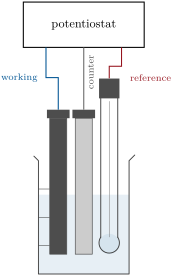
A three-electrode cell. The potentiostat controls the potential of the working electrode against the reference electrode, which carries no current, and drives the current through the counter electrode.
Read in context →