
সব বই

পেশাদার

1 Markets I: The Ecosystem and Exchange-Traded Marketsবাজার অনলাইন 2 Markets II: Rates, FX and Creditবাজার অনলাইন 3 Markets III: Commodities, Energy and Cryptoবাজার অনলাইন 4 Quantitative Methodsপদ্ধতি অনলাইন 5 Derivatives and Volatilityডেরিভেটিভস অনলাইন 6 Rates, Credit, XVA and Riskসুদহার, ঋণ ও ঝুঁকি অনলাইন 7 Research Craft: Predictors, Backtests, Measurement, Portfoliosগবেষণা অনলাইন 8 Strategies I: Equities and Futuresকৌশল অনলাইন 9 Strategies II: Volatility, Relative Value, Macro and the Bank Desksকৌশল অনলাইন 10 Microstructure and Executionএক্সিকিউশন অনলাইন 11 Market Making and High-Frequency Tradingমার্কেট মেকিং অনলাইন 12 Machine Learning for Marketsমেশিন লার্নিং অনলাইন 13 Low-Latency Softwareপ্রযুক্তি অনলাইন 14 Networks, Hardware and Trading Infrastructureপ্রযুক্তি অনলাইন 15 Research, Data and Risk Platformsপ্রযুক্তি অনলাইন 16 The Desk and the Firmপ্রতিষ্ঠান অনলাইন 17 The Industry: Firms, Roles and Careersক্যারিয়ার অনলাইন 18 Interviews I: Maths, Probability and Speedক্যারিয়ার অনলাইন 19 Interviews II: Markets, Trading Games and the Final Roundক্যারিয়ার অনলাইন 20 Interviews III: Codeক্যারিয়ার অনলাইন
অ্যাপ পরিচিতি Coach সাইন ইন পড়া শুরু করো

বইগুলো এখনো বাংলা ভাষায় পাওয়া যায় না — ইংরেজি সংস্করণ দেখানো হচ্ছে।

Chemistry · পরিভাষা

Solubility product কী?

Definition 11.1 University Chemistry — Year 1 · অধ্যায় 11 — Precipitation and Solubility

The solubility product KsK_s of an ionic solid MaXb\mathrm{M}_a\mathrm{X}_b is the equilibrium constant of its dissolution into its ions,

MaXb(s)⇌a Mm++b Xx−,Ks=[Mm+]eq a [Xx−]eq b,pKs=−log⁡Ks,\mathrm{M}_a\mathrm{X}_b\mathrm{(s)} \rightleftharpoons a\,\mathrm{M}^{m+} + b\,\mathrm{X}^{x-}, \qquad K_s = [\mathrm{M}^{m+}]_{\mathrm{eq}}^{\,a}\,[\mathrm{X}^{x-}]_{\mathrm{eq}}^{\,b}, \qquad \mathrm{p}K_s = -\log K_s ,

the activity of the solid being 1. Like every equilibrium constant it depends on temperature only.
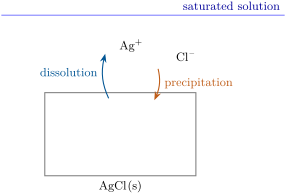
A crystal of silver chloride in its saturated solution. Ions leave the surface (dissolution) and others are captured (precipitation) at the same rate, so that [ Ag+][ Cl-] stays equal to K_s. Silver ions are drawn smaller than chloride ions, as they are.
A crystal of silver chloride in its saturated solution. Ions leave the surface (dissolution) and others are captured (precipitation) at the same rate, so that [AgX+][ClX−][\ce{Ag+}][\ce{Cl-}] stays equal to KsK_s. Silver ions are drawn smaller than chloride ions, as they are.
solidpKs\mathrm{p}K_ssolidpKs\mathrm{p}K_s
AgCl\ce{AgCl}9.75Ca(OH)X2\ce{Ca(OH)2}5.33
AgBr\ce{AgBr}12.27Mg(OH)X2\ce{Mg(OH)2}11.25
AgI\ce{AgI}16.07Fe(OH)X2\ce{Fe(OH)2}16.31
AgX2CrOX4\ce{Ag2CrO4}11.95Zn(OH)X2\ce{Zn(OH)2}16.38
BaSOX4\ce{BaSO4}9.97Fe(OH)X3\ce{Fe(OH)3}38.55
CaCOX3\ce{CaCO3} (calcite)8.30Al(OH)X3\ce{Al(OH)3} (gibbsite)34.75
CaFX2\ce{CaF2}9.84
Solubility products at 25 ∘C25\,{}^{\circ}\mathrm{C}, computed from the standard Gibbs energies of formation of the solids and of the aqueous ions. Formation constants used in this chapter (Section 11.5): log⁡β4=14.45\log\beta_4 = 14.45 for Zn(OH)X4X2−\ce{Zn(OH)4^2-}, 33.52 for Al(OH)X4X−\ce{Al(OH)4-}, and log⁡β1=11.82\log\beta_1 = 11.82 for FeOHX2+\ce{FeOH^2+}.

উদাহরণ

Example 11.6 (Silver chloride and silver chromate)

Silver chloride: s=10−9.75/2=1.3×10−5 mol/Ls = 10^{-9.75/2} = 1.3 \times 10^{-5}\,\mathrm{mol}/\mathrm{L}, or 1.9 mg/L1.9\,\mathrm{mg}/\mathrm{L} with M=143.4 g/molM = 143.4\,\mathrm{g}/\mathrm{mol}. Silver chromate AgX2CrOX4\ce{Ag2CrO4} (pKs=11.95\mathrm{p}K_s = 11.95): s=(10−11.95/4)1/3=6.6×10−5 mol/Ls = (10^{-11.95}/4)^{1/3} = 6.6 \times 10^{-5}\,\mathrm{mol}/\mathrm{L}. The chromate has the smaller KsK_s and yet is five times more soluble. Solubility products can be compared directly only between solids of the same formula type.

প্রসঙ্গসহ পড়ো →