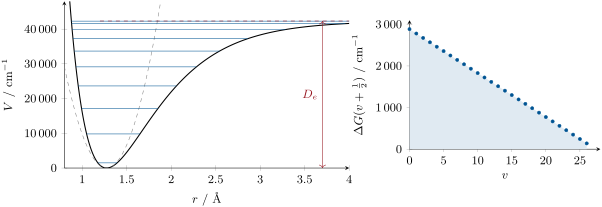
The spectroscopic dissociation energy of a molecule is the depth of its potential, De, measured from the minimum, or D0=De−G(0), measured from the lowest level — per molecule at 0K, unlike the bond dissociation enthalpy of the Year 2 volume, a molar enthalpy at 298K.
Examples
Example 6.14 (Hydrogen chloride)
For HX35X2235Cl, ω~e=2990.95cm−1 and ω~exe=52.82cm−1: the fundamental is at ω~e−2ω~exe=2885.3cm−1 and the first overtone at 2ω~e−6ω~exe=5665.0cm−1, slightly less than twice the fundamental. The Morse model predicts De=42342cm−1 and D0=40860cm−1; the true D0, from the enthalpies of formation of H, Cl and HCl at 0K, is 35760cm−1 (4.43eV). The real potential flattens out faster than a Morse curve fitted at the bottom: Birge–Sponer extrapolations from the lowest levels overestimate dissociation energies.
 Coach
Coach