All books

Professional

Apps About Coach Log in Start reading

Chemistry · Glossary

What is Vibronic transition, progression, Franck–Condon factor?

Also known as: vibronic transition · vibronic progression · Franck--Condon factor

Definition 7.8 University Chemistry — Year 3 · Chapter 7 — Electronic Spectroscopy and Photophysics

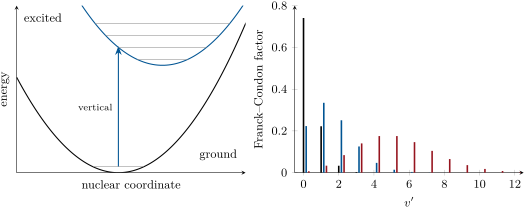
A vibronic transition changes the electronic and vibrational states together; the lines v′←0v' \leftarrow 0 for v′=0,1,2,…v' = 0, 1, 2, \dots form a vibronic progression; the Franck–Condon factor of a vibronic line is ∣⟨χv′∣χv′′⟩∣2|\langle\chi_{v'}|\chi_{v''}\rangle|^2.

Left: a vertical transition from the lowest level of the ground state lands where the excited curve, displaced to longer bond length, is high above its minimum (drawn for S = 1.5). Right: Franck–Condon factors of the progression for S = 0.3 (black), 1.5 (blue) and 5 (red); each set adds up to 1.
Left: a vertical transition from the lowest level of the ground state lands where the excited curve, displaced to longer bond length, is high above its minimum (drawn for S=1.5S = 1.5). Right: Franck–Condon factors of the progression for S=0.3S = 0.3 (black), 1.5 (blue) and 5 (red); each set adds up to 1.

Examples

Example 7.10 (Iodine)

Iodine vapour is violet because its B←\leftarrowX band absorbs yellow-green light. The bond lengthens from 266.6 pm266.6\,\mathrm{pm} in the ground state to 302.5 pm302.5\,\mathrm{pm} in the B state. In the displaced-oscillator model with the B-state frequency (125.7 cm−1125.7\,\mathrm{cm}^{-1}), ΔR=35.8 pm\Delta R = 35.8\,\mathrm{pm} gives S≈15S \approx 15: the absorption is a long progression whose strongest lines end on high vibrational levels of the B state, and whose continuation runs into the dissociation continuum.

Read in context →