全部书籍

专业

应用 关于 Coach 登录 开始阅读

书籍暂未推出简体中文版——当前显示英文版。

Earth and Space Sciences · 术语表

什么是 Budyko–Sellers model?

又称: Budyko--Sellers model

Definition 22.5 University Earth and Space Sciences — Year 3 · 第 22 章 — Climate Models

A Budyko–Sellers model is an energy-balance model in which the annual mean temperature T(x)T(x) depends on x=sin⁡φx = \sin\varphi, φ\varphi the latitude, the hemispheres being symmetric. At each latitude

C ∂T∂t=Qs(x)(1−α(x))−(A+BT)−D(x),C\,\frac{\partial T}{\partial t} = Qs(x)\big(1 - \alpha(x)\big) - (A + BT) - D(x) ,

where s(x)s(x) is the annual insolation of the latitude divided by its global mean, D(x)D(x) the divergence of the poleward heat transport, and the albedo takes its ice value poleward of the ice line xsx_s, where TT falls below a critical temperature TcT_c. Budyko wrote D=β(T−Tˉ)D = \beta(T - \bar T), a relaxation towards the global mean Tˉ\bar T; in the diffusive form, D=−D ∂x[(1−x2) ∂xT]D = -\mathcal D\,\partial_x\big[(1 - x^2)\,\partial_xT\big].

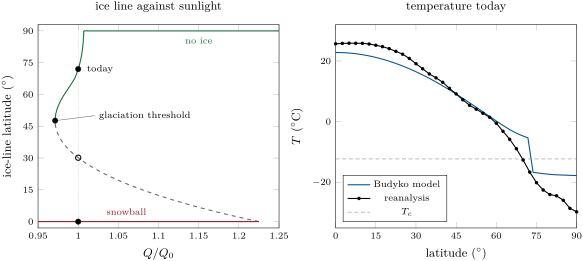
Budyko’s latitudinal model with the OLR law of the reanalysis and the insolation of each latitude. Left, the sunlight Q/Q_0 needed to hold the ice line at each latitude: stable branch solid, unstable dashed. Today, Q/Q_0 = 1, three states coexist: the ice line at 72 (stable), at 30 (unstable) and the snowball. The stable branch ends at its minimum, 47.7 and 0.9713: with less sunlight there, the ice runs to the equator. Right, the model’s temperature today against the annual zonal mean of the NCEP–NCAR Reanalysis 1, 1991–2020, averaged over the two hemispheres; the ice line is where the model’s curve, with the albedo of the edge, reaches T_c.
Budyko’s latitudinal model with the OLR law of the reanalysis and the insolation of each latitude. Left, the sunlight Q/Q0Q/Q_0 needed to hold the ice line at each latitude: stable branch solid, unstable dashed. Today, Q/Q0=1Q/Q_0 = 1, three states coexist: the ice line at 72∘72{}^{\circ} (stable), at 30∘30{}^{\circ} (unstable) and the snowball. The stable branch ends at its minimum, 47.7∘47.7{}^{\circ} and 0.97130.9713: with less sunlight there, the ice runs to the equator. Right, the model’s temperature today against the annual zonal mean of the NCEP–NCAR Reanalysis 1, 1991–2020, averaged over the two hemispheres; the ice line is where the model’s curve, with the albedo of the edge, reaches TcT_c.
在原文中阅读 →