সব বই

পেশাদার

1 Markets I: The Ecosystem and Exchange-Traded Marketsবাজার অনলাইন 2 Markets II: Rates, FX and Creditবাজার অনলাইন 3 Markets III: Commodities, Energy and Cryptoবাজার অনলাইন 4 Quantitative Methodsপদ্ধতি অনলাইন 5 Derivatives and Volatilityডেরিভেটিভস অনলাইন 6 Rates, Credit, XVA and Riskসুদহার, ঋণ ও ঝুঁকি অনলাইন 7 Research Craft: Predictors, Backtests, Measurement, Portfoliosগবেষণা অনলাইন 8 Strategies I: Equities and Futuresকৌশল অনলাইন 9 Strategies II: Volatility, Relative Value, Macro and the Bank Desksকৌশল অনলাইন 10 Microstructure and Executionএক্সিকিউশন অনলাইন 11 Market Making and High-Frequency Tradingমার্কেট মেকিং অনলাইন 12 Machine Learning for Marketsমেশিন লার্নিং অনলাইন 13 Low-Latency Softwareপ্রযুক্তি অনলাইন 14 Networks, Hardware and Trading Infrastructureপ্রযুক্তি অনলাইন 15 Research, Data and Risk Platformsপ্রযুক্তি অনলাইন 16 The Desk and the Firmপ্রতিষ্ঠান অনলাইন 17 The Industry: Firms, Roles and Careersক্যারিয়ার অনলাইন 18 Interviews I: Maths, Probability and Speedক্যারিয়ার অনলাইন 19 Interviews II: Markets, Trading Games and the Final Roundক্যারিয়ার অনলাইন 20 Interviews III: Codeক্যারিয়ার অনলাইন
অ্যাপ পরিচিতি Coach সাইন ইন পড়া শুরু করো

বইগুলো এখনো বাংলা ভাষায় পাওয়া যায় না — ইংরেজি সংস্করণ দেখানো হচ্ছে।

Earth and Space Sciences · পরিভাষা

Insolation কী?

Definition 3.3 High School Earth and Space Sciences · অধ্যায় 3 — The Earth’s Energy Budget

The insolation of a place is the power of sunlight received by a horizontal square metre at the top of the atmosphere above it. Averaged over the twenty-four hours of a day, it is the daily-mean insolation; averaged over a year, the annual-mean insolation; both are measured in W/m2\mathrm{W}/\mathrm{m}^{2}.

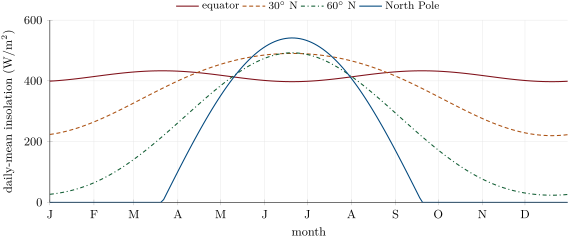
Daily-mean insolation at the top of the atmosphere through the year at four latitudes of the Northern Hemisphere (computed for a circular orbit, from the solar constant and the tilt of the axis). The pole receives nothing for half the year and more than any other place around the June solstice.

উদাহরণ

Example 3.4 (The pole in June)

At the June solstice the Sun stands 23.44∘23.44{}^{\circ} above the horizon of the North Pole all day long. The daily-mean insolation there is 1361×sin⁡23.44∘≈541 W/m21361 \times \sin 23.44^\circ \approx 541\,\mathrm{W}/\mathrm{m}^{2}; over twenty-four hours this is 541×24≈13 000 Wh541 \times 24 \approx 13\,000\,\mathrm{Wh}, 13.0 kWh13.0\,\mathrm{kWh} per square metre. On the same day the equator receives a daily mean of 397 W/m2397\,\mathrm{W}/\mathrm{m}^{2}, or 9.5 kWh9.5\,\mathrm{kWh} per square metre: the Sun rises higher there at noon, but it is down for twelve hours.

প্রসঙ্গসহ পড়ো →
Definition 1.18 University Earth and Space Sciences — Year 1 · অধ্যায় 1 — Spherical Astronomy

The insolation at a place and an instant is the power of sunlight received per unit area of a horizontal surface at the top of the atmosphere. With S0S_0 the solar irradiance at the mean distance aa of the Sun, rr the actual distance and θz\theta_z the Sun’s zenith distance,

I=S0(ar)2cos⁡θz=S0(ar)2sin⁡h⊙(h⊙>0),I=0 at night.I = S_0\left(\frac{a}{r}\right)^{2}\cos\theta_z = S_0\left(\frac{a}{r}\right)^{2}\sin h_\odot \quad (h_\odot > 0), \qquad I = 0 \text{ at night}.
প্রসঙ্গসহ পড়ো →