书籍暂未推出简体中文版——当前显示英文版。
High School Earth and Space Sciences · 10–12 年级
3The Earth’s Energy Budget
On the longest day of the year the Sun never sets at the North Pole. It circles the sky all day at the same height, about above the horizon, and the top of the atmosphere above the pole receives in one day more sunlight per square metre than anywhere else on the Earth — , against above the equator. Yet the sea around the pole stays covered with ice through the summer. Over a whole year, on the other hand, the equator receives two and a half times as much sunlight as the pole, and the tropics stay warm all year round. This chapter follows the energy of sunlight: how much arrives, where and when; how much is reflected straight back to space; how the rest is shared between the air and the ground, carried from the tropics towards the poles, and finally sent back to space as infrared light — and what tiny part of it ends up stored by living things.
You already know
The seasons come from the tilt of the Earth’s axis, from the perpendicular to the plane of its orbit: in June the Northern Hemisphere leans towards the Sun, which climbs higher in its sky and stays up longer (the physics books, and Book 1). The irradiance at the Earth’s distance, , the Bond albedo of a planet and its equilibrium temperature were met in Chapter 2. Greenhouse gases absorb part of the infrared emitted by the surface (the chemistry books). Warm air rises and cold air sinks, which sets the air turning in convection cells and drives the global winds (Book 1, grade 8). Plants, algae and some bacteria make sugars from carbon dioxide and water with the energy of light: photosynthesis (the biology books).
3.1 Sunlight received
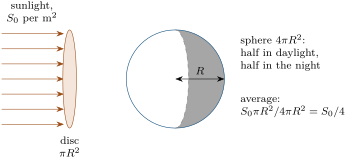
Seen from the Sun, the Earth is a disc. Every second, it intercepts the sunlight falling on a disc of radius , its own radius; but that light is shared among all the points of a sphere, half of which are in the night.
Proposition 3.1 (A quarter of the solar constant)
Averaged over the whole surface of the Earth and over day and night, the power of sunlight arriving at the top of the atmosphere is
Proof. The Earth intercepts the sunlight crossing a disc of area perpendicular to the rays, that is a power . Spread over the area of the sphere, , this gives per square metre. ∎
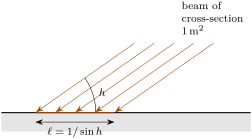
The average hides great differences from place to place. A beam of sunlight that strikes the ground at a slant spreads over a larger area than a beam striking it straight on.
Proposition 3.2 (Sunlight on a horizontal surface)
When the Sun is at a height above the horizon, a horizontal square metre at the top of the atmosphere receives the power .
Proof. Take a beam of sunlight of cross-section , square, carrying . On the ground its trace is a rectangle with one side of and the other of length along the slope of the rays. In the right triangle formed by that side, the ray and the beam’s cross-section, the angle at the ground is and . The beam’s power is spread over square metres: per square metre. ∎
The height of the Sun changes through the day, and the length of the day changes with the seasons; both count in the energy a place receives.
Definition 3.3 (Insolation)
The insolation of a place is the power of sunlight received by a horizontal square metre at the top of the atmosphere above it. Averaged over the twenty-four hours of a day, it is the daily-mean insolation; averaged over a year, the annual-mean insolation; both are measured in .
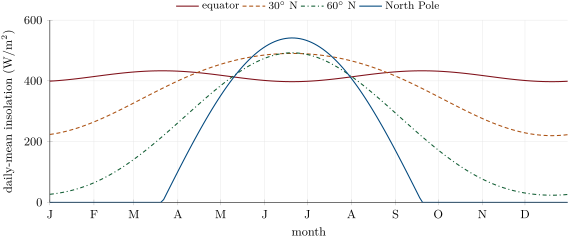
Working out the daily mean needs the Sun’s height at every moment of the day, which uses mathematics beyond this book; the computer that drew the curves below did it. Two cases are simple. On the equator at an equinox, the Sun rises due east, passes overhead at noon and sets due west after twelve hours; averaged over twenty-four hours this gives (admitted). At the North Pole the Sun simply circles the sky at a constant height, which the next example uses.
Example 3.4 (The pole in June)
At the June solstice the Sun stands above the horizon of the North Pole all day long. The daily-mean insolation there is ; over twenty-four hours this is , per square metre. On the same day the equator receives a daily mean of , or per square metre: the Sun rises higher there at noon, but it is down for twelve hours.
Remark 3.5 (Reading the curves)
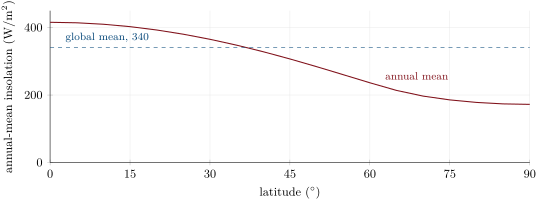
The equator’s insolation hardly changes: two shallow maxima at the equinoxes, when the Sun passes overhead at noon. The farther north, the larger the swing between summer and winter. Poleward of the Sun stays below the horizon on the December solstice: the polar night. From about 10 May to the end of July the North Pole and the latitude N both receive more than the equator.
Over a whole year the picture changes: the annual-mean insolation, plotted in the section on surplus and deficit below, falls from at the equator to at the poles. The summer abundance of the polar regions does not make up for their long night and their low Sun.
Remark 3.6 (The distance to the Sun does not make the seasons)
The Earth’s orbit is not quite a circle: its distance to the Sun varies between and million kilometres, by about , so the sunlight varies by about . The Earth is closest to the Sun in early January, in the middle of the northern winter. The curves above neglect this small change; the seasons come from the tilt of the axis, and they are opposite in the two hemispheres.
3.2 Albedo
Part of the sunlight reaching the Earth never warms anything: clouds, the air, snow and the sea send it back to space.
Definition 3.7 (Albedo)
The albedo of a surface is the fraction of the sunlight falling on it that it reflects, a number between 0 (all the light absorbed) and 1 (all of it reflected). The Bond albedo of Chapter 2 is the albedo of a planet taken as a whole.
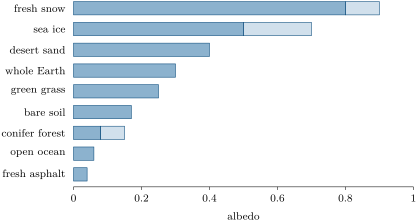
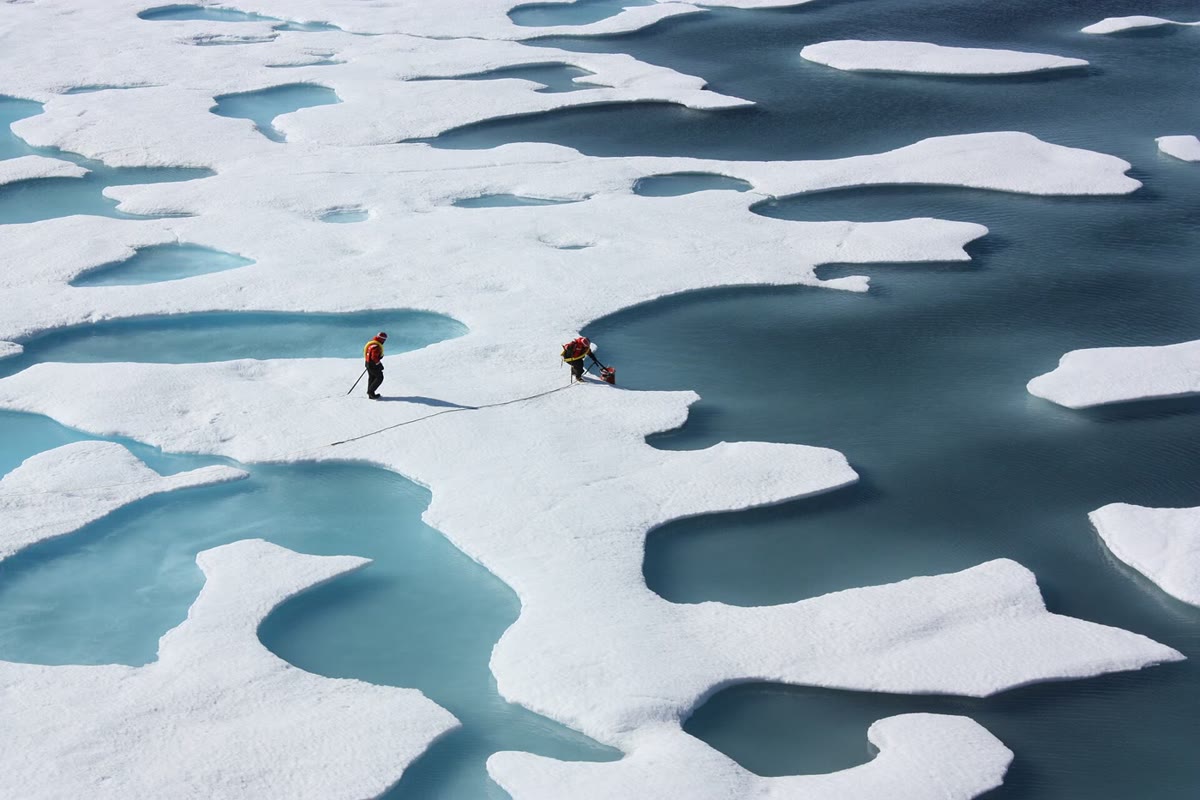
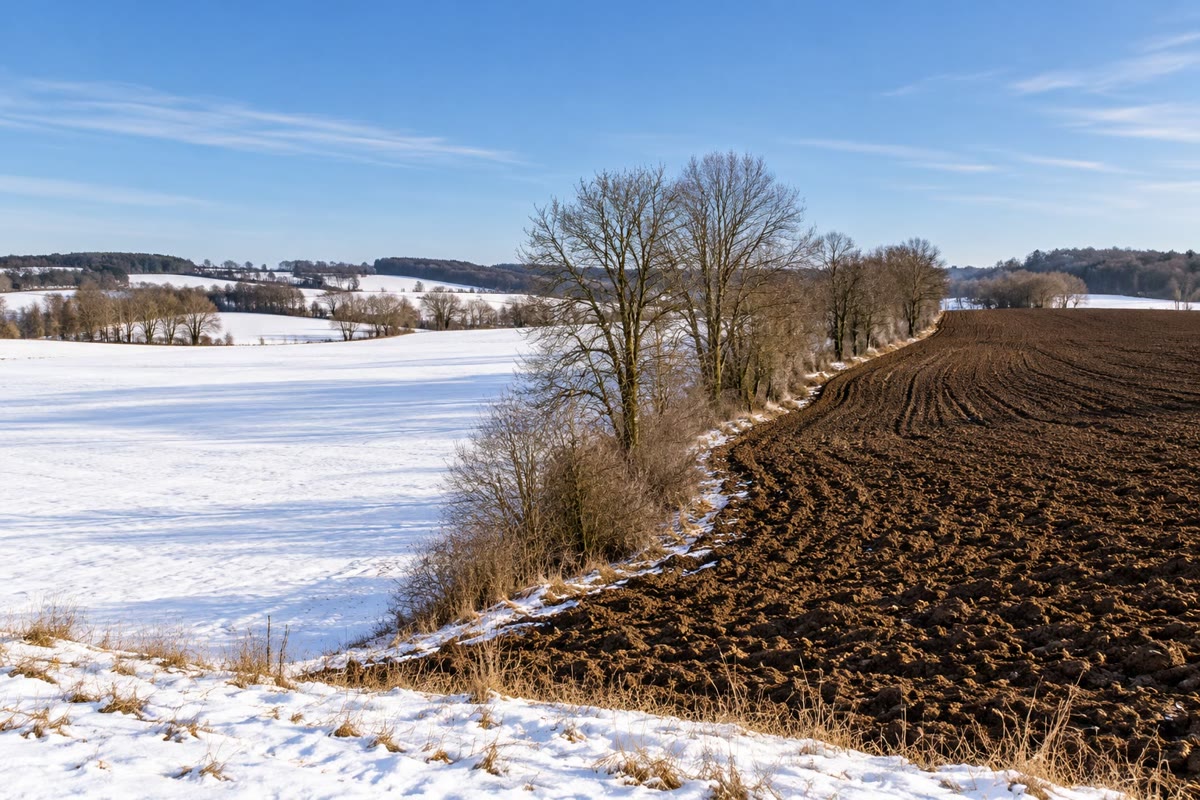
Fresh snow returns most of the light it receives, the open ocean almost none. This is why the sea ice of the opening photograph keeps its cold through the polar summer: the snow on top of it reflects up to nine-tenths of the sunlight, while the dark water between the floes absorbs about 94 per cent of it. When the ice melts, dark water replaces it and absorbs more sunlight, which melts more ice: a reinforcing loop that Chapter 28 weighs among the feedbacks of the climate.
For the Earth as a whole, the satellites measure the sunlight reflected to space directly: on average of the that arrive, an albedo of . Clouds are the main reflector: the same measurements, with the clouds removed by calculation, give only reflected.
Example 3.8 (The sunlight the Earth absorbs)
With a Bond albedo of 0.294, each square metre absorbs on average . Over the whole sphere, of area , the Earth absorbs of sunlight: this power drives the winds, the ocean currents and the water cycle.
3.3 The global energy budget
Where do these go? Measurements from satellites, from instruments on the ground and from ships, combined with models of the atmosphere, now give a consistent answer, averaged over the globe and over several years. The scientific assessment of 2021 summarises it in the diagram below, and states that the global mean components are now known more accurately, at the top of the atmosphere and at the surface (high confidence).
Definition 3.9 (Energy budget)
The energy budget of a system — the whole Earth, its surface or its atmosphere — is the account of all the energy entering and leaving it, each flow given as an average power per square metre of the Earth’s surface. The budget is balanced when what enters equals what leaves; otherwise the system gains or loses energy and warms or cools.
The surface also loses energy without any radiation: water evaporates from the sea and from leaves, and the ground warms the air in contact with it.
Definition 3.10 (Latent heat; sensible heat)
The latent heat of a substance is the energy it absorbs when it changes state without changing temperature — melting, or evaporating — and gives back when it changes back. For water evaporating at it is about per kilogram. In the energy budget, the latent heat flux is the energy that evaporation takes from the surface and that the water vapour releases in the air where it condenses into clouds. The sensible heat flux is the energy that the surface passes to the air in contact with it, warming it, and that rising air carries upwards.
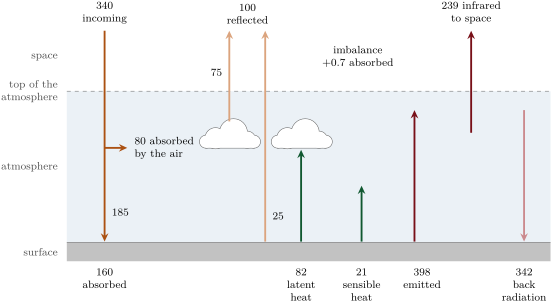
Method 3.11 (Reading an energy-budget diagram)
- Choose the system: the whole Earth (a line above the atmosphere), the surface, or the atmosphere (the layer between them).
- List the arrows that enter it and add them; list the arrows that leave it and add them.
- Compare the two sums. If they are equal within the rounding of the numbers, the system is in balance; the difference is what it gains (or loses) each second per square metre.
Proposition 3.12 (The budget balances)
Within the rounding of the figures, the budget in the diagram above is balanced for the Earth as a whole, for the surface and for the atmosphere, apart from a small surplus of about that the Earth absorbs and does not give back.
Proof. Whole Earth: in, 340; out, . Surface: in, ; out, . In both cases the surplus, about 1, is the imbalance of 0.7 rounded. Atmosphere: call the part of the surface’s infrared that escapes through the air to space. The air receives and emits downwards and upwards, in all: balanced, whatever . ∎
The diagram also shows the greenhouse effect at work. The surface receives from the air, as infrared, — more than twice the sunlight it absorbs, . This is why it can emit , the emission of a body at about , while the Earth sends only to space. The physics books build the model that connects these numbers to the temperature; this book uses the measured fluxes.
Example 3.13 (A metre of water a year)
The latent heat flux, , evaporates every second of water per square metre. Over a year, seconds, this makes about , a layer of water thick over the whole Earth. The air holds only a little water at a time, so practically all of it falls back as rain and snow: the latent heat flux and the yearly rainfall of the planet are two faces of the same water cycle.
Remark 3.14 (The imbalance)
The surplus of looks tiny next to the fluxes of hundreds of watts, but over the whole Earth it is , mostly stored in the ocean, which warms. It is not a natural constant: it has grown in recent decades, as Chapter 28 explains.
3.4 Surplus and deficit
The budget balances for the Earth as a whole, but not at each latitude.
The tropics absorb far more sunlight than the polar regions, and their low albedo widens the gap. The infrared they send to space is larger too, because they are warmer, but it varies much less with latitude. As a result, the regions around the equator absorb on average about more than they reflect and radiate, and the regions near the poles radiate about more than they absorb.
Definition 3.15 (Poleward heat transport)
The poleward heat transport is the flow of energy carried from the tropics towards the poles by the motions of the atmosphere and of the ocean. It is measured, across a circle of latitude, in petawatts ( = ).
Without it, the tropics would grow hotter and the poles colder until each latitude balanced its own budget. The atmosphere does most of the carrying: warm air moving poleward and cold air returning towards the equator, and water vapour that releases its latent heat far from where it evaporated. The ocean currents carry the rest. Estimates from measurements put the atmosphere’s poleward transport at a maximum of about near N, with similar values near S; the ocean carries more than the atmosphere only close to the equator, between and N, and at N, where the total transport is largest, the atmosphere carries of it. The total is largest there because is about where the surplus gives way to the deficit: equatorward, the transport keeps gathering the surplus of every latitude it crosses; poleward, each latitude draws on it.
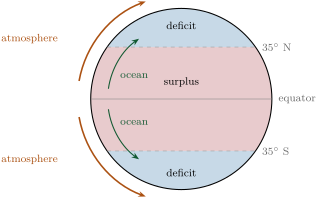
This transport is the engine of the weather. The convection cells and the global winds of Book 1, the storms of Chapter 5 and the great ocean currents of Chapter 6 all move heat from where the Sun gives too much to where it gives too little.
3.5 Where the energy goes
Almost all the energy of sunlight that the Earth absorbs ends up as heat: it warms the ground, the sea and the air, evaporates water, drives the winds and the currents, and leaves again as infrared light. A tiny part takes a different path: photosynthesis stores it in the chemical bonds of sugars, and from there in all the living matter of the planet.
Example 3.16 (The share of photosynthesis)
Plants on land and algae in the sea store, after their own needs, about billion tonnes of carbon in new living matter each year, roughly half on land and half in the ocean: ecologists call it the net primary production of the planet. Burning a mole of glucose, , which contains six moles of carbon, , releases : about per gram of carbon. The energy stored each year is , a power of . Compared with the of sunlight the Earth absorbs, this is about .
Remark 3.17 (A small share, a large role)
One thousandth of the absorbed sunlight feeds nearly all life on the Earth, and the remains of plants and algae buried over hundreds of millions of years make up coal, oil and natural gas (Chapter 18). The rest of the sunlight — more than 99.9 per cent — keeps the planet warm and its air, water and weather moving.
3.6 Exercises
Exercise 3.1 ★
Define the insolation of a place and the albedo of a surface. Which reflects the larger fraction of sunlight, fresh snow or the open ocean?
Solution
Solution of Exercise 3.1.
The insolation of a place is the power of sunlight received by a horizontal square metre at the top of the atmosphere above it (averaged over a day or a year). The albedo of a surface is the fraction of the sunlight falling on it that it reflects. Fresh snow (0.8 to 0.9) reflects far more than the open ocean (0.06).
Exercise 3.2 ★
Using the energy-budget diagram of this chapter, give as percentages of the arriving at the top of the atmosphere the share reflected to space, the share absorbed by the air and the share absorbed by the surface.
Solution
Solution of Exercise 3.2.
Reflected: ; absorbed by the air: ; absorbed by the surface: .
Exercise 3.3 ★
A summer sun delivers to the ground. How much power does a square metre absorb if it is covered with fresh asphalt (albedo 0.04), and with fresh snow (albedo 0.85)?
Solution
Solution of Exercise 3.3.
Asphalt: . Snow: , more than six times less.
Exercise 3.4 ★
Which carries more energy away from the Earth’s surface, evaporation or the warming of the air in contact with the ground? Describe in two sentences how the energy taken by evaporation from the sea reaches the air high above it.
Solution
Solution of Exercise 3.4.
Evaporation: , against for the warming of the air. The water that evaporates takes its latent heat from the sea; the vapour rises with the air, and where it condenses into cloud droplets, often kilometres higher, it gives that energy back to the air around it.
Exercise 3.5 ★
Explain why the daily-mean insolation is zero at the North Pole in December, and give the latitude beyond which this happens on the December solstice.
Solution
Solution of Exercise 3.5.
In December the Northern Hemisphere leans away from the Sun: at the pole the Sun stays below the horizon all day, so no sunlight arrives. On the December solstice this is so everywhere poleward of N.
Exercise 3.6 ★★
Using Proposition 3.2, compute the power received by a horizontal square metre at the top of the atmosphere when the Sun is , and above the horizon. At what height of the Sun does the square metre receive half of ?
Solution
Solution of Exercise 3.6.
; ; . Half of needs , that is .
Exercise 3.7 ★★
Following Method 3.11, check the budget of sunlight alone: of the that arrive, how much is reflected, absorbed by the air and absorbed by the surface? Do the three add up to 340? Check also that the sunlight reaching the surface, , is either reflected or absorbed there.
Solution
Solution of Exercise 3.7.
Reflected 100, absorbed by the air 80, absorbed by the surface 160: , all the sunlight is accounted for. At the surface, : what is not reflected is absorbed.
Exercise 3.8 ★★
With the Earth’s mean radius , compute the area of the disc that intercepts sunlight and the power it intercepts, then the area of the sphere. Deduce the average power per square metre of the sphere.
Solution
Solution of Exercise 3.8.
Disc: ; power: . Sphere: . Average: , a quarter of .
Exercise 3.9 ★★
The Earth’s surplus is over an area of . How much energy, in joules, does the Earth gain in a year of seconds?
Solution
Solution of Exercise 3.9.
in a year.
Exercise 3.10 ★★
With the clouds removed by calculation, the Earth would reflect instead of , and send of infrared to space instead of . By how much do the clouds change the sunlight absorbed, and the infrared lost? Do the clouds, on balance, warm or cool the Earth?
Solution
Solution of Exercise 3.10.
The clouds reflect more sunlight, which is therefore not absorbed. They hold back of infrared. On balance the Earth loses : the clouds, as a whole, cool it.
Exercise 3.11 ★★
Read the curves of daily-mean insolation in this chapter. In which months is the daily-mean insolation at the North Pole larger than at the equator? Why does the equator’s curve show two maxima and not one?
Solution
Solution of Exercise 3.11.
From about 10 May to the end of July, that is in May, June and July. On the equator the Sun passes overhead at noon at the two equinoxes, in March and September; at the solstices it passes away from the zenith, so the equator receives a little less in June and in December.
Exercise 3.12 ★★★
The latent heat of evaporation of water is and the latent heat flux . Compute the thickness of water, in millimetres, evaporated from the average square metre of the Earth each day, and in metres each year (one litre of water spread over a square metre makes a layer thick).
Solution
Solution of Exercise 3.12.
Each second: . Each day: , a layer of about . Each year: , about of water.
Exercise 3.13 ★★★
At the North Pole the Sun circles the sky at a height equal to its declination , so the daily-mean insolation there is . Find the declination for which the pole receives as much, on average over the day, as the equator at an equinox, . The declination obeys , where the angle grows steadily by in a year, from at the March equinox ( at the June solstice). For roughly how many days a year does the pole receive more than ?
Solution
Solution of Exercise 3.13.
gives , so . Then : or . Between the two, grows by , that is of a year, about days, from mid-May to late July.
Exercise 3.14 ★★★
Suppose that in summer an area of of sea ice (albedo 0.6) melts and is replaced by open ocean (albedo 0.06), under sunlight of on average at the surface. Compute the extra power absorbed. Compare it with the power stored by all the photosynthesis on the Earth, , and explain why this exchange of surfaces reinforces itself.
Solution
Solution of Exercise 3.14.
The ice absorbs of the sunlight, the ocean . Extra power: , more than all the photosynthesis of the planet. The extra energy warms the water, which melts more ice at the edges of the floes, which exposes more dark water: the change feeds itself.
Exercise 3.15 ★★★
The Earth’s distance to the Sun is million kilometres at its closest and million at its farthest, for a mean of million, where . Compute the solar irradiance at the two extremes. The difference is close to ; at N, the daily-mean insolation is about in June and in December. Explain why the distance cannot be the cause of the seasons.
Solution
Solution of Exercise 3.15.
Closest: ; farthest: ; about apart. At N the insolation is twenty times larger in June than in December: a change of a few per cent cannot cause it. Besides, the Earth is closest to the Sun in early January, during the northern winter, and the two hemispheres, at the same distance from the Sun, have opposite seasons: the tilt of the axis, not the distance, makes the seasons.
3.7 Problem: Following a Sunbeam
Problem 3.1
Weekend problem — from the sunlight that reaches the Earth to the share that life stores
Use , the Earth’s radius , , a year of seconds, the fluxes of the energy-budget diagram, a latent heat of evaporation of , a global net primary production of billion tonnes of carbon per year, and released by burning a mole of glucose ( of carbon).
Part I — The geometry of sunlight.
- Compute the area of the disc that intercepts sunlight, , in square metres.
- Compute the power of sunlight it intercepts.
- Compute the area of the Earth’s surface, .
- Deduce the average power arriving per square metre of the top of the atmosphere.
- At an equinox at noon, the Sun is overhead on the equator and above the horizon at N. What does a horizontal square metre receive at each place?
Part II — Albedo.
- From the reflected, compute the Earth’s albedo.
- Compute the power absorbed per square metre and by the whole Earth.
- Without clouds, would be reflected. What would the albedo be? By what factor do clouds raise it?
- Compute the equilibrium temperature corresponding to the absorbed power of question 7 (Chapter 2), and compare it with the surface’s .
Part III — The surface.
- Add the energy flows that enter the surface.
- Add those that leave it, and compare.
- How many times larger than the sunlight absorbed by the surface is the infrared it receives from the air? What does this show?
- Compute the mass of water evaporated from a square metre in a year, and the thickness of the layer it makes.
- Compute the total power of the imbalance, , over the whole Earth.
Part IV — The share of life.
- Compute the energy stored per gram of carbon fixed in glucose.
- Compute the energy stored in a year by the net primary production.
- Convert it into a power.
- Express it per square metre of the Earth’s surface.
- Compare it with the imbalance of question 14.
- What share of the sunlight absorbed by the Earth (question 7) does photosynthesis store?
Solution
Solution of Problem 3.1.
1. .
2. .
3. .
4. , that is .
5. Equator: ; N: .
6. .
7. ; over the Earth, .
8. . Clouds raise the albedo by a factor : they almost double it.
9. , about below the surface’s .
10. .
11. . The surface gains about : the imbalance of , rounded.
12. . The air sends the surface more than twice as much energy as infrared as the sunlight it absorbs: the greenhouse effect.
13. , a layer about thick.
14. .
15. per gram of carbon.
16. tonnes is g; .
17. .
18. .
19. : the Earth’s imbalance is almost three times the power that photosynthesis stores.
20. : photosynthesis stores about of the sunlight the Earth absorbs — one thousandth.