全部书籍

专业

应用 关于 Coach 登录 开始阅读

书籍暂未推出简体中文版——当前显示英文版。

Earth and Space Sciences · 术语表

什么是 Insolation?

Definition 3.3 High School Earth and Space Sciences · 第 3 章 — The Earth’s Energy Budget

The insolation of a place is the power of sunlight received by a horizontal square metre at the top of the atmosphere above it. Averaged over the twenty-four hours of a day, it is the daily-mean insolation; averaged over a year, the annual-mean insolation; both are measured in W/m2\mathrm{W}/\mathrm{m}^{2}.

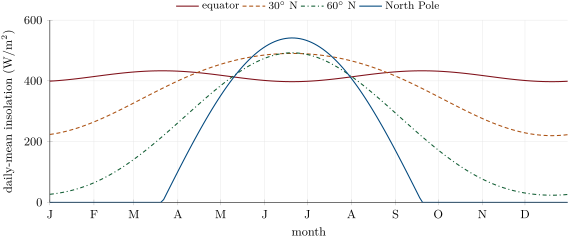
Daily-mean insolation at the top of the atmosphere through the year at four latitudes of the Northern Hemisphere (computed for a circular orbit, from the solar constant and the tilt of the axis). The pole receives nothing for half the year and more than any other place around the June solstice.

示例

Example 3.4 (The pole in June)

At the June solstice the Sun stands 23.44∘23.44{}^{\circ} above the horizon of the North Pole all day long. The daily-mean insolation there is 1361×sin⁡23.44∘≈541 W/m21361 \times \sin 23.44^\circ \approx 541\,\mathrm{W}/\mathrm{m}^{2}; over twenty-four hours this is 541×24≈13 000 Wh541 \times 24 \approx 13\,000\,\mathrm{Wh}, 13.0 kWh13.0\,\mathrm{kWh} per square metre. On the same day the equator receives a daily mean of 397 W/m2397\,\mathrm{W}/\mathrm{m}^{2}, or 9.5 kWh9.5\,\mathrm{kWh} per square metre: the Sun rises higher there at noon, but it is down for twelve hours.

在原文中阅读 →
Definition 1.18 University Earth and Space Sciences — Year 1 · 第 1 章 — Spherical Astronomy

The insolation at a place and an instant is the power of sunlight received per unit area of a horizontal surface at the top of the atmosphere. With S0S_0 the solar irradiance at the mean distance aa of the Sun, rr the actual distance and θz\theta_z the Sun’s zenith distance,

I=S0(ar)2cos⁡θz=S0(ar)2sin⁡h⊙(h⊙>0),I=0 at night.I = S_0\left(\frac{a}{r}\right)^{2}\cos\theta_z = S_0\left(\frac{a}{r}\right)^{2}\sin h_\odot \quad (h_\odot > 0), \qquad I = 0 \text{ at night}.
在原文中阅读 →