书籍暂未推出简体中文版——当前显示英文版。
University Earth and Space Sciences — Year 1 · 本科一年级
1Spherical Astronomy
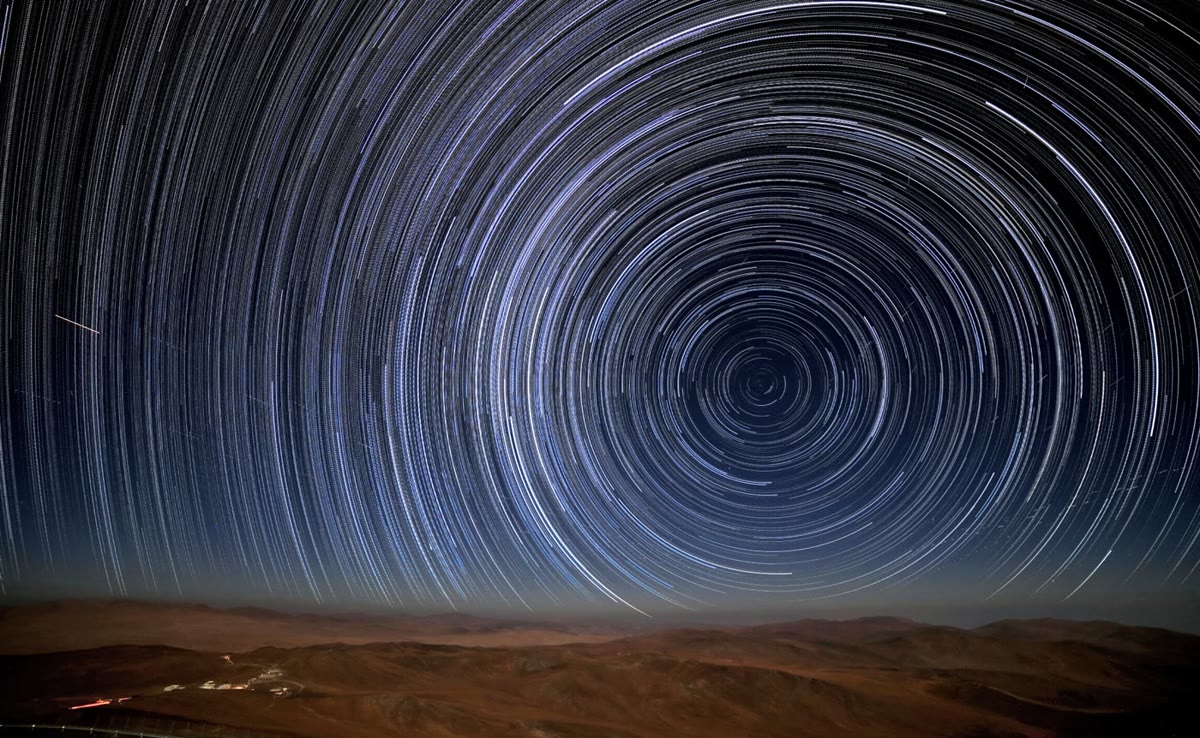
On a clear night far from any town, a long-exposure camera pointed at the sky records the stars as arcs of circles, all centred on one point that does not move. A star that rose in the east at nine o’clock tonight will rise at about five to nine tomorrow, and a little earlier every night after that. The Sun at noon stands higher in June than in December, and in the far north it does not set at all in midsummer. All of this is the rotation of the Earth and its orbit round the Sun, seen from the ground. To describe it, the astronomer and the geoscientist need coordinates on a sphere, the trigonometry of triangles drawn on a sphere, and clocks that keep step with the stars or with the Sun. This chapter builds these tools. They return in plate kinematics (Chapter 12), where plates turn on the sphere, and in the climate chapters (Chapter 27), where the sunlight a latitude receives drives the winds and the currents.
You already know
The Earth turns on its axis once a day and goes round the Sun once a year on an orbit that is very nearly a circle; its axis is tilted with respect to the orbit, which makes the seasons (the physics books, grades 6 and 12; Kepler’s laws are recalled from the physics books’ Year 1 volume). A point on the Earth is located by its latitude and longitude (Book 1, grade 6). A vector of length one is fixed by two angles, as in spherical coordinates; the dot product of two unit vectors is the cosine of the angle between them, and the triple product is unchanged by a cyclic permutation of the three vectors.
1.1 Triangles on a sphere
Definition 1.1 (Great circle, spherical triangle)
A great circle of a sphere is its intersection with a plane through its centre; any other plane section is a small circle. Through two points that are not diametrically opposite passes exactly one great circle, and the shorter of its two arcs is the shortest path on the sphere between the points. A spherical triangle is the figure formed by three points of the sphere, its vertices , , , joined by arcs of great circles of less than . Its sides , , (opposite , , ) are measured by the angles they subtend at the centre; its angles , , are the angles between the planes of the sides that meet at each vertex.
On the sphere of radius , a side of radians has the length . Every side and every angle lies between and .
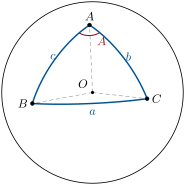
Theorem 1.2 (The cosine rule)
In a spherical triangle,
Proof. Work on the unit sphere and choose axes with at the pole: , and the plane containing : , since is at the angular distance from . The point is at the angular distance from , on a great circle through making the angle with the plane : . The side is the angle between and , so
∎
Theorem 1.3 (The sine rule)
In a spherical triangle,
Proof. With the vectors of the previous proof, , so the triple product is . The triple product is unchanged when , , are permuted cyclically; placing , then , at the pole gives in the same way and . The three expressions are equal; dividing by gives the rule. ∎
When the sides are small compared with the radius, and , and the two rules become the cosine and sine rules of plane triangles: on a small enough patch the sphere is flat. On a large triangle they do not: the angles of a spherical triangle add up to more than (Exercise 1.12).
Method 1.4 (Distance and heading on the sphere)
To find the shortest distance between two places of latitudes , and longitudes , , and the direction in which to set off:
- form the triangle with vertices the North Pole and the two places; its sides from the pole are the colatitudes and , and its angle at the pole is the difference of longitude ;
- the cosine rule gives the angular distance : ; the distance is ( in radians);
- the initial heading is the angle of the triangle at the first place, from the cosine rule applied to the side opposite it, , and is measured from north toward the second place.
The heading changes along the great circle (except along a meridian or the equator): a ship or aircraft that keeps the same compass heading follows another, longer curve.
1.2 Coordinates on the sphere
Definition 1.5 (Latitude and longitude)
Let the Earth be a sphere turning about its polar axis. The latitude of a point is the angle between the equatorial plane and the radius through the point, from (South Pole) to (North Pole); its longitude is the angle, measured in the equatorial plane, between the meridian half-plane of the point and that of a reference meridian, the one through Greenwich, counted positive to the east, from to .
The Earth is in fact slightly flattened; the latitude used for maps and for the sky is the angle between the local vertical and the equatorial plane, which differs from the geocentric angle by at most (Chapter 11). Lines of equal latitude, the parallels, are small circles; the meridians are halves of great circles.
Definition 1.6 (The celestial sphere)
The celestial sphere is an imaginary sphere centred on the observer, on which every star is placed in its direction; only directions matter, not distances. The extensions of the Earth’s axis meet it at the north and south celestial poles; the plane of the Earth’s equator cuts it along the celestial equator. The zenith is the point straight overhead, along the local vertical; the horizon is the great circle from it. The local meridian is the great circle through the zenith and the celestial poles; it meets the horizon at the north and south points.
As the Earth turns from west to east, the celestial sphere seems to turn the other way, from east to west, about the axis of the celestial poles, once in a little less than a day. The stars keep their relative places: they are so far away that a year’s journey round the Sun changes their directions by less than a second of arc (Chapter 2).
Definition 1.7 (Horizontal coordinates)
The altitude of a star is its angle above the horizon, from to ; its zenith distance is . Its azimuth is the angle, along the horizon, from the north point to the foot of the star’s vertical circle, counted from to through the east.
Horizontal coordinates are those of the observer: they change with place and time. The coordinates of the sky itself are carried along by its rotation.
Definition 1.8 (Equatorial coordinates)
The declination of a star is its angle from the celestial equator, positive to the north, from to . The great circle through the star and the celestial poles is its hour circle. The hour angle of the star is the angle at the celestial pole between the local meridian and the star’s hour circle, counted westward, in hours of . The right ascension is the angle along the celestial equator from a fixed point of the sky, the vernal equinox point (Definition 1.12), to the star’s hour circle, counted eastward, also in hours.
Declination and right ascension are fixed on the sky, like latitude and longitude on the Earth: catalogues list them. The word declination is used here in this astronomical sense only; the angle between geographic north and the north of a compass is always called the magnetic declination (Chapter 6).
Proposition 1.9 (From equatorial to horizontal coordinates)
At latitude , a star of declination and hour angle has the altitude and azimuth given by
with between and when the star is east of the meridian () and when it is west. In particular the altitude of the north celestial pole equals the latitude.
Proof. Consider the triangle formed by the north celestial pole , the zenith and the star (the astronomical, or position, triangle). The local vertical makes the angle with the equatorial plane, so ; ; . The angle at is the hour angle ; the angle at is the azimuth of the star measured from north (east or west of the meridian). The cosine rule for the side , opposite , gives , the first formula. The cosine rule for the side , opposite , gives , the second. For the pole, and the first formula reads . ∎
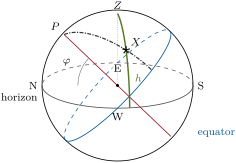
Proposition 1.10 (Culmination and circumpolar stars)
At latitude , a star of declination crosses the meridian () at the altitude , south of the zenith if , north of it if . In the northern hemisphere () it never sets if and never rises if .
Proof. For , , so . The lowest altitude, at , satisfies ; it is positive when . The star stays below the horizon when even its highest altitude is negative, . ∎
Definition 1.11 (Circumpolar star)
A circumpolar star is a star that never sets at the observer’s latitude: it circles the celestial pole, crossing the meridian above the pole and, twelve sidereal hours later, below it.
1.3 Sidereal time and solar time
Definition 1.12 (The ecliptic)
The ecliptic is the great circle of the celestial sphere along which the Sun appears to move in a year, the trace of the plane of the Earth’s orbit. It is inclined to the celestial equator by the obliquity of the ecliptic , the tilt of the Earth’s axis to its orbit. The ecliptic crosses the equator at two points; the vernal equinox point is the one where the Sun crosses the equator northward, in March. The Sun’s ecliptic longitude is its angle along the ecliptic from , counted eastward.
The obliquity is today .
Definition 1.13 (Sidereal time)
The local sidereal time is the hour angle of the vernal equinox point . A sidereal day is the interval between two passages of across the meridian.
Since right ascension is counted eastward from and hour angle westward from the meridian, for every star
where LST is the local sidereal time: a star crosses the meridian when the sidereal time equals its right ascension. An observatory clock showing sidereal time tells at a glance which part of the sky is overhead.
Proposition 1.14 (Sidereal and solar days)
In one tropical year of mean solar days, the Earth turns times relative to the stars. Hence the sidereal day lasts
and with this is : a star crosses the meridian of mean solar time earlier each day.
Proof. Count turns relative to the Sun and relative to the stars over one year. The Sun moves once round the ecliptic eastward in a year, in the direction of the Earth’s rotation. Relative to the Sun the Earth therefore makes one turn fewer than relative to the stars: solar days and sidereal days fill the same year. The sidereal day is of a solar day, that is ; the difference is . This agrees with the Earth’s measured rotation period relative to the stars, . ∎
Definition 1.15 (Solar time)
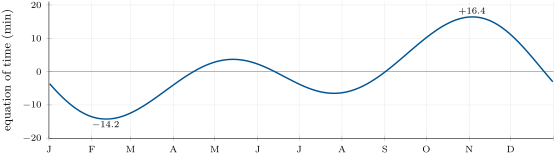
Apparent solar time is the hour angle of the Sun plus 12 hours: a sundial shows it, and it is noon when the Sun crosses the meridian. Mean solar time is the hour angle, plus 12 hours, of a fictitious mean Sun that moves along the celestial equator at a uniform rate, completing a turn in a tropical year. Their difference, apparent minus mean, is the equation of time.
The true Sun runs ahead of and behind the mean Sun for two reasons. The Earth moves faster near perihelion, in early January, than near aphelion, so the Sun’s progress along the ecliptic is uneven (Kepler’s second law); and the Sun moves along the ecliptic, which is inclined to the equator, so that even a uniform motion along the ecliptic projects onto the equator — which is what the hour angle measures — unevenly, faster near the solstices than near the equinoxes. Civil clocks keep mean solar time on a reference meridian of their time zone; the local mean time at longitude is ahead of the time at Greenwich by hours.
1.4 Rising, setting and the Sun
Proposition 1.16 (Rising and setting)
At latitude , a star of declination that rises and sets crosses the horizon at the hour angles with
at the azimuth with (rising; it sets at ). It stays above the horizon for , converted to hours at per hour.
Proof. On the horizon , and Proposition 1.9 gives , and . The hour angle grows uniformly, by per hour, from at rising to at setting. ∎
For the Sun this gives the length of the day, if the Sun is treated as a point and the bending of light by the air is ignored (both add a few minutes of daylight). At the equinoxes , : day and night last twelve hours everywhere, and the Sun rises due east.
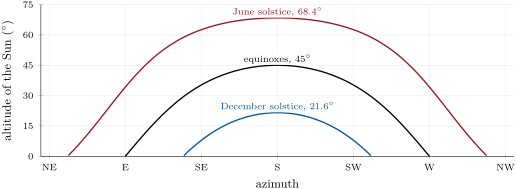
Proposition 1.17 (The Sun’s declination)
When the Sun is at the ecliptic longitude , its declination and right ascension satisfy
Proof. Take axes with toward and toward the north celestial pole. In axes , , attached to the ecliptic, with toward its pole, the Sun’s direction is . The ecliptic axes are those of the equator turned by the angle about , so in equatorial axes the Sun’s direction is . Its component is ; the ratio of its and components is . ∎
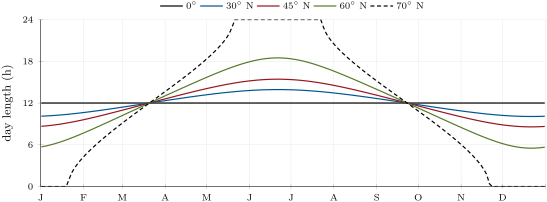
Definition 1.18 (Insolation)
The insolation at a place and an instant is the power of sunlight received per unit area of a horizontal surface at the top of the atmosphere. With the solar irradiance at the mean distance of the Sun, the actual distance and the Sun’s zenith distance,
The factor is the inverse-square law for light (the physics books); the factor appears because a beam of cross-section one square metre spreads over square metres of horizontal ground. With and a Sun–Earth distance between at perihelion and at aphelion, the factor varies by in the year. The tilt of the axis does much more: it changes both the noon altitude and the day length, and these two together make the seasons. The daily and yearly sums of the insolation, which drive the climate, are computed in Chapter 27.
1.5 Calendars
Definition 1.19 (Tropical year)
The tropical year is the mean interval between two passages of the Sun through the vernal equinox point. It governs the seasons; it lasts 365.2422 mean solar days.
The tropical year is about twenty minutes shorter than the sidereal year, the time the Earth takes to come back to the same place among the stars (365.256 days), because the Earth’s axis slowly turns — it precesses — and carries the equinox point backward along the ecliptic (the Year 2 volume). A calendar must fit a whole number of days to the tropical year, so that the seasons come back on the same dates.
Proposition 1.20 (The Gregorian year)
In the Gregorian calendar, a year is a leap year of 366 days if its number is divisible by 4, except the century years, which are leap years only if divisible by 400. Its mean year is
and it drifts against the seasons by one day in about 3300 years.
Proof. In 400 years there are 100 years divisible by 4; among them are four century years, of which three are not divisible by 400. So there are 97 leap years and days, that is 365.2425 days a year. Against a tropical year of 365.2422 days the excess is 0.0003 days a year: one day in years. ∎
History — The reform of 1582
The Julian calendar, inherited from Rome, added a leap day every fourth year: its year of 365.25 days is longer than the tropical year by 0.0078 days, a day in 128 years. Over the centuries the date of the vernal equinox drifted away from 21 March, the date on which the reckoning of Easter relied. In 1582 Pope Gregory XIII introduced the calendar that bears his name, which dropped the accumulated days at once and replaced the Julian rule by the rule of Proposition 1.20. It has become the internationally accepted civil calendar.
In the field — Finding a position from the stars
Before satellite positioning, navigators at sea found their latitude and longitude from the sky. With a sextant they measured the altitude of the Sun at noon, or of two or three stars at dusk, and read the time on a chronometer kept on the time of the Greenwich meridian. Each altitude, with the star’s declination and its hour angle at Greenwich from an almanac, gives a small circle on the Earth on which the ship lies: the circle of points where the star is at that altitude. Two or three such circles cross at the ship’s position — spherical trigonometry solved at sea every day. The noon altitude of the Sun alone gives the latitude (Proposition 1.10); the clock time of local noon gives the longitude, at four minutes of time per degree.

1.6 Exercises
Exercise 1.1 ★
An observer is at latitude N. At what altitude does the north celestial pole stand? Which stars, by their declination, never set there, and which never rise?
Exercise 1.2 ★
Convert a right ascension of into degrees. At a local sidereal time of , what is the hour angle of a star of that right ascension? Is the star east or west of the meridian?
Solution
Solution of Exercise 1.2.
. , that is . The hour angle is positive: the star is west of the meridian, which it crossed three and a quarter sidereal hours ago.
Exercise 1.3 ★
At latitude N, compute the altitude of the Sun at noon at the two solstices and at the equinoxes ().
Solution
Solution of Exercise 1.3.
: at the June solstice, at the equinoxes, at the December solstice.
Exercise 1.4 ★
Was 1900 a leap year? Was 2000? Will 2100 be? By how many days per century does the Julian calendar drift against a tropical year of 365.2422 days, and by how many does the Gregorian calendar?
Solution
Solution of Exercise 1.4.
1900: divisible by 100 but not by 400, not a leap year. 2000: divisible by 400, a leap year. 2100: not a leap year. The Julian year exceeds the tropical year by days, days per century; the Gregorian year by days, days per century.
Exercise 1.5 ★★
Two points lie at latitude N, at longitudes and E. Compute the great-circle distance between them () and the distance along their parallel. Which is shorter, and by how much?
Solution
Solution of Exercise 1.5.
, so and the distance is . Along the parallel, a small circle of radius , the distance is . The great circle is shorter by about .
Exercise 1.6 ★★
At latitude N, a star of declination has the hour angle . Compute its altitude and its azimuth. In which direction should the observer look?
Solution
Solution of Exercise 1.6.
, . , ; the star is west of the meridian (), so : toward the south-west, above the horizon.
Exercise 1.7 ★★
Compute the length of the day at latitude N at the June solstice, the Sun being treated as a point on a geometric horizon. Check your answer on the day-length figure.
Solution
Solution of Exercise 1.7.
, , day length , about , as the N curve shows at the June solstice.
Exercise 1.8 ★★
A star crosses the meridian tonight at 22:00 local mean time. At what time will it cross the meridian in 30 days? In how many days will it cross at noon, invisible in daylight?
Solution
Solution of Exercise 1.8.
The passage moves earlier by a day, so by in 30 days: the star crosses at about 20:02. To cross at noon it must move = earlier, which takes days.
Exercise 1.9 ★★
Compute the insolation at the top of the atmosphere at noon at latitude N (a) at an equinox, taking ; (b) at the June solstice, taking for the aphelion distance. Data: , , aphelion .
Solution
Solution of Exercise 1.9.
(a) At an equinox the noon altitude is : . (b) At the June solstice and : . The higher Sun more than makes up for the larger distance.
Exercise 1.10 ★★★
Using Proposition 1.17, compute the declination and the right ascension of the Sun when its ecliptic longitude is . By how many degrees does the right ascension lag behind the longitude? Explain with this result why the inclination of the ecliptic contributes to the equation of time.
Solution
Solution of Exercise 1.10.
, . , (same quadrant as ). The right ascension lags by , that is of time. A Sun moving uniformly along the ecliptic would still move unevenly in right ascension, the quantity that sets the hour angle and hence the sundial: behind the mean Sun between an equinox and the next solstice, ahead between a solstice and the next equinox. This is the obliquity term of the equation of time.
Exercise 1.11 ★★★
Show that at the June solstice the Sun rises at the azimuth with . At what latitude does it rise exactly in the north-east? What happens to the formula at latitudes above ?
Solution
Solution of Exercise 1.11.
At rising , so Proposition 1.9 gives ; at the June solstice , so . For : , N. Above , : there is no azimuth of rising, because the Sun does not set on that day (midnight Sun).
Exercise 1.12 ★★★
A lune is the part of a sphere between two half great circles joining two opposite points, at the angle to each other. (a) Show that its area is . (b) Each side of a spherical triangle , prolonged into a full great circle, gives with the others three pairs of opposite lunes of angles , , that cover the sphere, the triangle and its opposite being covered three times. Deduce Girard’s theorem: the triangle’s area is . (c) Apply it to the triangle with three right angles, and to the triangle drawn in this chapter (angles , , ).
Solution
Solution of Exercise 1.12.
(a) A lune of angle is the fraction of the sphere: . (b) The three pairs of lunes have total area ; they cover the sphere once, except the triangle and its opposite, each covered three times, that is twice more than needed: , where is the triangle’s area. Hence . (c) Three right angles: , one eighth of the sphere (an octant). The triangle of the figure: , that is radians: , of the sphere.
1.7 Problem: A night at a mountain observatory
Problem 1.1
Weekend problem — where the Paranal Observatory stands, what its sky shows, and how long its longest night lasts
The Paranal Observatory stands in the Atacama desert at latitude S, longitude W. The Royal Observatory at Greenwich, through which longitudes are counted, is at N, . Two bright stars of the southern sky have the coordinates
| star | right ascension | declination |
|---|---|---|
| Sirius | ||
| Canopus |
Take , , a tropical year of 365.2422 days, and treat the Sun as a point on a geometric horizon.
Part I — Paranal on the globe.
- Give the colatitudes of Paranal and Greenwich, and their difference of longitude.
- Write the cosine rule for the triangle North Pole–Paranal–Greenwich and compute the cosine of the angular distance between the two observatories.
- Deduce in degrees and the great-circle distance in kilometres.
- Compute the initial heading from Paranal toward Greenwich (Method 1.4).
- Check the heading with the sine rule.
- Would an aircraft keeping this heading all the way reach Greenwich? Explain.
Part II — The sky of Paranal.
- At what altitude does the south celestial pole stand above the southern horizon of Paranal?
- At what altitude does Sirius cross the meridian, and on which side of the zenith?
- Below which declination is a star circumpolar at Paranal? Is Canopus circumpolar?
- What is the highest altitude Canopus reaches?
- Compute the hour angle at which Sirius rises, and how long it stays above the horizon, in sidereal hours.
- At what azimuth does Sirius rise?
Part III — Clocks.
- What is the local sidereal time when Sirius crosses the meridian?
- Compute the length of the sidereal day, and by how many minutes a star’s meridian passage moves earlier each night.
- Take the local sidereal time at local mean midnight to be on the March equinox (20 March 2026), when the Sun is near the vernal equinox point; it then gains hours a day. How many days after the equinox does Sirius cross the meridian at local mean midnight? On what date?
- On that night, by how much does local mean time at Paranal differ from the time at Greenwich?
- The equation of time is then about . What time does a sundial at the observatory show (apparent solar time) when Sirius crosses the meridian?
- How much earlier does it cross one week later?
Part IV — The longest night.
- What is the Sun’s declination at each solstice?
- Compute the altitude of the Sun at noon at Paranal at the June and December solstices. On which side of the zenith is it in December?
- At the December solstice the Sun–Earth distance is 0.9837 times the mean distance. Compute the insolation at noon at the top of the atmosphere above Paranal ().
- At which solstice is the night longest at Paranal? Compute the hour angle of sunset on that date.
- At what azimuth does the Sun rise on that date?
- Deduce the length of the longest night of the year at Paranal, in hours and minutes.
Solution
Solution of Problem 1.1.
1. Colatitudes and ; difference of longitude .
2. .
3. ; distance , about .
4.
, toward the north-east.
5. , which gives or ; the positive cosine of question 4 selects .
6. No. A constant heading crosses every meridian at the same angle and spirals toward a pole; the great circle’s heading changes continuously (it is only at the start). The aircraft would fly a longer path and arrive elsewhere unless it corrected its heading.
7. The altitude of the south celestial pole equals the latitude’s magnitude: .
8. ; , so Sirius passes north of the zenith.
9. A star never sets if . Canopus, at , is not circumpolar: it sets.
10. , south of the zenith.
11. ; . Sirius stays up of sidereal time, about .
12. : Sirius rises at the azimuth , south of east.
13. When , .
14. ; the passage moves earlier by , , each night.
15. We need , so days. 285 days after 20 March is 30 December: Sirius crosses the meridian at local mean midnight in the night of 30 to 31 December 2026.
16. Paranal is west of Greenwich: local mean time is behind by , .
17. Apparent solar time = mean solar time + equation of time = : the sundial reads about 23:57.
18. earlier.
19. at the June solstice, at the December solstice.
20. June: . December: ; as , the Sun passes north of the zenith.
21. .
22. In June, the southern winter. : the Sun sets at the hour angle .
23. : , north of east.
24. Day length ; the longest night of the year at Paranal lasts , that is .