সব বই

পেশাদার

1 Markets I: The Ecosystem and Exchange-Traded Marketsবাজার অনলাইন 2 Markets II: Rates, FX and Creditবাজার অনলাইন 3 Markets III: Commodities, Energy and Cryptoবাজার অনলাইন 4 Quantitative Methodsপদ্ধতি অনলাইন 5 Derivatives and Volatilityডেরিভেটিভস অনলাইন 6 Rates, Credit, XVA and Riskসুদহার, ঋণ ও ঝুঁকি অনলাইন 7 Research Craft: Predictors, Backtests, Measurement, Portfoliosগবেষণা অনলাইন 8 Strategies I: Equities and Futuresকৌশল অনলাইন 9 Strategies II: Volatility, Relative Value, Macro and the Bank Desksকৌশল অনলাইন 10 Microstructure and Executionএক্সিকিউশন অনলাইন 11 Market Making and High-Frequency Tradingমার্কেট মেকিং অনলাইন 12 Machine Learning for Marketsমেশিন লার্নিং অনলাইন 13 Low-Latency Softwareপ্রযুক্তি অনলাইন 14 Networks, Hardware and Trading Infrastructureপ্রযুক্তি অনলাইন 15 Research, Data and Risk Platformsপ্রযুক্তি অনলাইন 16 The Desk and the Firmপ্রতিষ্ঠান অনলাইন 17 The Industry: Firms, Roles and Careersক্যারিয়ার অনলাইন 18 Interviews I: Maths, Probability and Speedক্যারিয়ার অনলাইন 19 Interviews II: Markets, Trading Games and the Final Roundক্যারিয়ার অনলাইন 20 Interviews III: Codeক্যারিয়ার অনলাইন
অ্যাপ পরিচিতি Coach সাইন ইন পড়া শুরু করো

বইগুলো এখনো বাংলা ভাষায় পাওয়া যায় না — ইংরেজি সংস্করণ দেখানো হচ্ছে।

Earth and Space Sciences · পরিভাষা

Mean grain size, sorting কী?

অন্য নাম: mean grain size · sorting

Definition 21.2 University Earth and Space Sciences — Year 1 · অধ্যায় 21 — Clastic Sediments and Their Environments

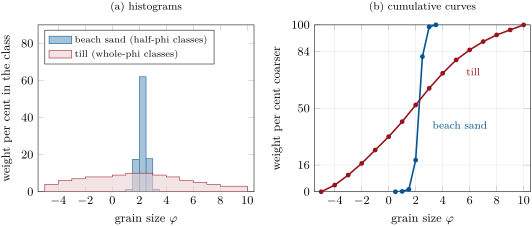
Let the grain sizes of a sediment, in phi units, have the distribution given by the weight in each class. Its mean grain size is the mean of that distribution, and its sorting is the spread of the distribution, measured by its standard deviation in phi units: a sediment is well sorted when its grains are nearly all of one size, and poorly sorted when they cover many classes. Both are computed either from the percentages in the classes, by the method of moments, or from the cumulative curve, by the graphic measures of Folk:

Mz=φ16+φ50+φ843,σI=φ84−φ164+φ95−φ56.6,M_z = \frac{\varphi_{16} + \varphi_{50} + \varphi_{84}}{3}, \qquad \sigma_I = \frac{\varphi_{84} - \varphi_{16}}{4} + \frac{\varphi_{95} - \varphi_{5}}{6.6},

where φp\varphi_p is the size in phi units than which pp per cent of the sample is coarser.

The size distributions of two sediments, from sieve and settling analyses (invented data). (a) Weight per cent in each class: the beach sand falls almost entirely in three half-phi classes of medium and fine sand; the till spreads over fifteen phi classes, from pebbles to clay. (b) The cumulative curves, weight per cent coarser than each size: the steeper the curve, the better the sorting. The graphic measures read at 5, 16, 50, 84 and 95 per cent give for the sand M_z = 2.25\, (0.21\, mm) and _I = 0.36\,, for the till M_z = 1.83\, and _I = 3.84\,.
The size distributions of two sediments, from sieve and settling analyses (invented data). (a) Weight per cent in each class: the beach sand falls almost entirely in three half-phi classes of medium and fine sand; the till spreads over fifteen phi classes, from pebbles to clay. (b) The cumulative curves, weight per cent coarser than each size: the steeper the curve, the better the sorting. The graphic measures read at 5, 16, 50, 84 and 95 per cent give for the sand Mz=2.25 φM_z = 2.25\,\varphi (0.21 mm0.21\,\mathrm{mm}) and σI=0.36 φ\sigma_I = 0.36\,\varphi, for the till Mz=1.83 φM_z = 1.83\,\varphi and σI=3.84 φ\sigma_I = 3.84\,\varphi.
প্রসঙ্গসহ পড়ো →