
সব বই

পেশাদার

1 Markets I: The Ecosystem and Exchange-Traded Marketsবাজার অনলাইন 2 Markets II: Rates, FX and Creditবাজার অনলাইন 3 Markets III: Commodities, Energy and Cryptoবাজার অনলাইন 4 Quantitative Methodsপদ্ধতি অনলাইন 5 Derivatives and Volatilityডেরিভেটিভস অনলাইন 6 Rates, Credit, XVA and Riskসুদহার, ঋণ ও ঝুঁকি অনলাইন 7 Research Craft: Predictors, Backtests, Measurement, Portfoliosগবেষণা অনলাইন 8 Strategies I: Equities and Futuresকৌশল অনলাইন 9 Strategies II: Volatility, Relative Value, Macro and the Bank Desksকৌশল অনলাইন 10 Microstructure and Executionএক্সিকিউশন অনলাইন 11 Market Making and High-Frequency Tradingমার্কেট মেকিং অনলাইন 12 Machine Learning for Marketsমেশিন লার্নিং অনলাইন 13 Low-Latency Softwareপ্রযুক্তি অনলাইন 14 Networks, Hardware and Trading Infrastructureপ্রযুক্তি অনলাইন 15 Research, Data and Risk Platformsপ্রযুক্তি অনলাইন 16 The Desk and the Firmপ্রতিষ্ঠান অনলাইন 17 The Industry: Firms, Roles and Careersক্যারিয়ার অনলাইন 18 Interviews I: Maths, Probability and Speedক্যারিয়ার অনলাইন 19 Interviews II: Markets, Trading Games and the Final Roundক্যারিয়ার অনলাইন 20 Interviews III: Codeক্যারিয়ার অনলাইন
অ্যাপ পরিচিতি Coach সাইন ইন পড়া শুরু করো

বইগুলো এখনো বাংলা ভাষায় পাওয়া যায় না — ইংরেজি সংস্করণ দেখানো হচ্ছে।

Earth and Space Sciences · পরিভাষা

Neutron capture; s process; r process কী?

অন্য নাম: neutron capture · s-process · r-process

Definition 30.5 University Earth and Space Sciences — Year 3 · অধ্যায় 30 — Where the Elements Come From

Neutron capture is the absorption of a free neutron by a nucleus, (Z,A)+n→(Z,A+1)+γ(Z, A) + \mathrm{n} \to (Z, A+1) + \gamma. In the s process (slow), the captures are slower than most beta decays: the time between two captures on one nucleus is hundreds to thousands of years, so an unstable nucleus nearly always decays before it can capture, and the chain of captures and decays follows the valley of stability. In the r process (rapid), the neutron density is so high that captures are far faster than the decays: the nuclei are driven to very neutron-rich isotopes, far from stability, in a few seconds, and decay back to stability once the neutrons run out.
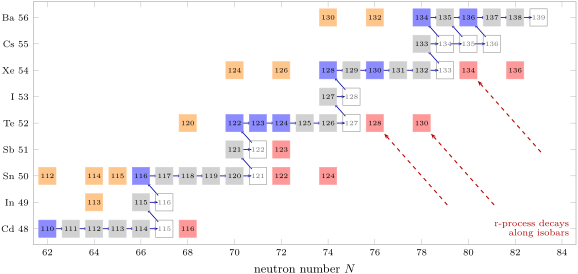
A strip of the chart of the nuclides, from cadmium to barium, neutron numbers 62 to 84. Coloured squares are the nuclei found in nature, labelled with their mass number: blue, s-only; grey, made by both processes; red, r-only; orange, p nuclei, reached by neither. Open squares are the unstable nuclei the s process passes through. Blue arrows: the s path, captures to the right, beta decays diagonally up and to the left (at 134 Cs and 135 Cs the path splits). Dashed red arrows: three of the r-process decay chains, ending on 128 Te, 130 Te and 134 Xe. The classes are computed from the isotopes found in nature (Asplund, Amarsi and Grevesse, 2021) and the half-lives and decay modes of the IAEA chart of nuclides.
A strip of the chart of the nuclides, from cadmium to barium, neutron numbers 62 to 84. Coloured squares are the nuclei found in nature, labelled with their mass number: blue, s-only; grey, made by both processes; red, r-only; orange, p nuclei, reached by neither. Open squares are the unstable nuclei the s process passes through. Blue arrows: the s path, captures to the right, beta decays diagonally up and to the left (at 134Cs^{134}\mathrm{Cs} and 135Cs^{135}\mathrm{Cs} the path splits). Dashed red arrows: three of the r-process decay chains, ending on 128Te^{128}\mathrm{Te}, 130Te^{130}\mathrm{Te} and 134Xe^{134}\mathrm{Xe}. The classes are computed from the isotopes found in nature (Asplund, Amarsi and Grevesse, 2021) and the half-lives and decay modes of the IAEA chart of nuclides.
প্রসঙ্গসহ পড়ো →