 Coach
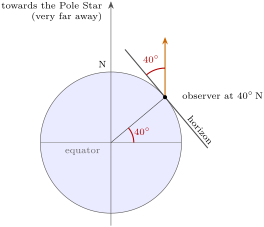
A parallel is a circle drawn round the globe parallel to the equator; all the places on the same parallel are at the same distance from the equator. The latitude of a place is the angle, measured at the centre of the Earth, between the equator and that place. It goes from at the equator to at the poles, and we say whether the place is north (N) or south (S) of the equator.
Examples
Example 14.2 (A navigator at night)
A navigator measures the Pole Star at above the northern horizon. The ship is at latitude N, about km north of the equator. Sailing north, she finds the star a little higher each night; sailing south towards the equator, it sinks towards the horizon. South of the equator the Pole Star cannot be seen at all, since it stays below the horizon: there, the noon Sun gives the latitude.
Example 14.5 (Reading the coordinates of Sydney)
On the map, Sydney lies below the equator: it is in the southern hemisphere, a little above the parallel S, closer to than to ; its latitude is about S. It lies to the right of the prime meridian, a little beyond the meridian E; its longitude is about E. We write: Sydney, S, E.