
সব বই

পেশাদার

1 Markets I: The Ecosystem and Exchange-Traded Marketsবাজার অনলাইন 2 Markets II: Rates, FX and Creditবাজার অনলাইন 3 Markets III: Commodities, Energy and Cryptoবাজার অনলাইন 4 Quantitative Methodsপদ্ধতি অনলাইন 5 Derivatives and Volatilityডেরিভেটিভস অনলাইন 6 Rates, Credit, XVA and Riskসুদহার, ঋণ ও ঝুঁকি অনলাইন 7 Research Craft: Predictors, Backtests, Measurement, Portfoliosগবেষণা অনলাইন 8 Strategies I: Equities and Futuresকৌশল অনলাইন 9 Strategies II: Volatility, Relative Value, Macro and the Bank Desksকৌশল অনলাইন 10 Microstructure and Executionএক্সিকিউশন অনলাইন 11 Market Making and High-Frequency Tradingমার্কেট মেকিং অনলাইন 12 Machine Learning for Marketsমেশিন লার্নিং অনলাইন 13 Low-Latency Softwareপ্রযুক্তি অনলাইন 14 Networks, Hardware and Trading Infrastructureপ্রযুক্তি অনলাইন 15 Research, Data and Risk Platformsপ্রযুক্তি অনলাইন 16 The Desk and the Firmপ্রতিষ্ঠান অনলাইন 17 The Industry: Firms, Roles and Careersক্যারিয়ার অনলাইন 18 Interviews I: Maths, Probability and Speedক্যারিয়ার অনলাইন 19 Interviews II: Markets, Trading Games and the Final Roundক্যারিয়ার অনলাইন 20 Interviews III: Codeক্যারিয়ার অনলাইন
অ্যাপ পরিচিতি Coach সাইন ইন পড়া শুরু করো

বইগুলো এখনো বাংলা ভাষায় পাওয়া যায় না — ইংরেজি সংস্করণ দেখানো হচ্ছে।

Earth and Space Sciences · পরিভাষা

Parallel and latitude কী?

অন্য নাম: parallel · latitude

Definition 14.1 Primary & Middle School Earth and Space Sciences · অধ্যায় 14 — Latitude, Longitude and Time Zones

A parallel is a circle drawn round the globe parallel to the equator; all the places on the same parallel are at the same distance from the equator. The latitude of a place is the angle, measured at the centre of the Earth, between the equator and that place. It goes from 0∘0^\circ at the equator to 90∘90^\circ at the poles, and we say whether the place is north (N) or south (S) of the equator.
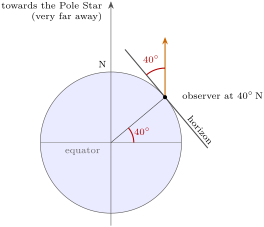
Why the height of the Pole Star equals the latitude (a sketch, not to scale). The light of the Pole Star arrives parallel to the Earth’s axis (orange). The horizon of the observer is at right angles to the radius through the observer; the axis is at right angles to the equator. So the angle between the horizon and the Pole Star is the same as the latitude, the angle at the centre between the equator and the observer.

উদাহরণ

Example 14.2 (A navigator at night)

A navigator measures the Pole Star at 41∘41^\circ above the northern horizon. The ship is at latitude 41∘41^\circ N, about 41×111≈455041 \times 111 \approx 4550 km north of the equator. Sailing north, she finds the star a little higher each night; sailing south towards the equator, it sinks towards the horizon. South of the equator the Pole Star cannot be seen at all, since it stays below the horizon: there, the noon Sun gives the latitude.

Example 14.5 (Reading the coordinates of Sydney)

On the map, Sydney lies below the equator: it is in the southern hemisphere, a little above the parallel 30∘30^\circ S, closer to 30∘30^\circ than to 60∘60^\circ; its latitude is about 34∘34^\circ S. It lies to the right of the prime meridian, a little beyond the meridian 150∘150^\circ E; its longitude is about 151∘151^\circ E. We write: Sydney, 34∘34^\circ S, 151∘151^\circ E.

প্রসঙ্গসহ পড়ো →