
সব বই

পেশাদার

1 Markets I: The Ecosystem and Exchange-Traded Marketsবাজার অনলাইন 2 Markets II: Rates, FX and Creditবাজার অনলাইন 3 Markets III: Commodities, Energy and Cryptoবাজার অনলাইন 4 Quantitative Methodsপদ্ধতি অনলাইন 5 Derivatives and Volatilityডেরিভেটিভস অনলাইন 6 Rates, Credit, XVA and Riskসুদহার, ঋণ ও ঝুঁকি অনলাইন 7 Research Craft: Predictors, Backtests, Measurement, Portfoliosগবেষণা অনলাইন 8 Strategies I: Equities and Futuresকৌশল অনলাইন 9 Strategies II: Volatility, Relative Value, Macro and the Bank Desksকৌশল অনলাইন 10 Microstructure and Executionএক্সিকিউশন অনলাইন 11 Market Making and High-Frequency Tradingমার্কেট মেকিং অনলাইন 12 Machine Learning for Marketsমেশিন লার্নিং অনলাইন 13 Low-Latency Softwareপ্রযুক্তি অনলাইন 14 Networks, Hardware and Trading Infrastructureপ্রযুক্তি অনলাইন 15 Research, Data and Risk Platformsপ্রযুক্তি অনলাইন 16 The Desk and the Firmপ্রতিষ্ঠান অনলাইন 17 The Industry: Firms, Roles and Careersক্যারিয়ার অনলাইন 18 Interviews I: Maths, Probability and Speedক্যারিয়ার অনলাইন 19 Interviews II: Markets, Trading Games and the Final Roundক্যারিয়ার অনলাইন 20 Interviews III: Codeক্যারিয়ার অনলাইন
অ্যাপ পরিচিতি Coach সাইন ইন পড়া শুরু করো

বইগুলো এখনো বাংলা ভাষায় পাওয়া যায় না — ইংরেজি সংস্করণ দেখানো হচ্ছে।

Earth and Space Sciences · পরিভাষা

Saturation; relative humidity কী?

অন্য নাম: saturation · relative humidity

Definition 4.1 High School Earth and Space Sciences · অধ্যায় 4 — Why Clouds Form

Air is saturated when it contains the largest mass of water vapour it can hold at its temperature, its saturation content; any extra vapour condenses into droplets. The relative humidity of air is its content of water vapour divided by its saturation content at the same temperature and pressure, expressed as a percentage.
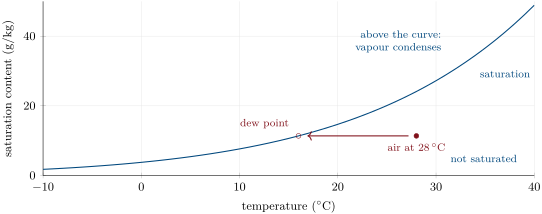
The largest mass of water vapour that a kilogram of air can hold, against temperature, at sea-level pressure (over liquid water; computed from the international standard for water). Air at 28 C holding 11.4\, g/ kg (dot) is far from saturation; cooled without losing water, it becomes saturated at 16 C (circle).
The largest mass of water vapour that a kilogram of air can hold, against temperature, at sea-level pressure (over liquid water; computed from the international standard for water). Air at 28∘C28{}^{\circ}\mathrm{C} holding 11.4 g/kg11.4\,\mathrm{g}/\mathrm{kg} (dot) is far from saturation; cooled without losing water, it becomes saturated at 16∘C16{}^{\circ}\mathrm{C} (circle).

উদাহরণ

Example 4.4 (A summer morning)

At 20∘C20{}^{\circ}\mathrm{C} the air contains 11.4 g/kg11.4\,\mathrm{g}/\mathrm{kg}. The saturation content at 20∘C20{}^{\circ}\mathrm{C} is 14.7 g/kg14.7\,\mathrm{g}/\mathrm{kg}, so the relative humidity is 11.4/14.7≈78 %11.4/14.7 \approx 78\,\%. The saturation content is 11.4 g/kg11.4\,\mathrm{g}/\mathrm{kg} at 16∘C16{}^{\circ}\mathrm{C}: that is the dew point. In the afternoon, the same air warmed to 28∘C28{}^{\circ}\mathrm{C} (saturation content 24.1 g/kg24.1\,\mathrm{g}/\mathrm{kg}) has a relative humidity of only 47 %47\,\% — with exactly the same water in it.

Example 4.9 (An afternoon cumulus)

In the afternoon of Example 4.4, the air at the ground is at 28∘C28{}^{\circ}\mathrm{C} with a dew point of 16∘C16{}^{\circ}\mathrm{C}. Rising bubbles become saturated at 125×12=1500 m125 \times 12 = 1500\,\mathrm{m}: the cumulus have their flat bases about 1.5 km1.5\,\mathrm{km} up. In the morning, at 20∘C20{}^{\circ}\mathrm{C}, the same air would have condensed at only 125×4=500 m125 \times 4 = 500\,\mathrm{m}: cloud bases rise through the day as the ground warms.

Example 4.13 (The warm dry wind of the lee side)

Air at sea level at 20∘C20{}^{\circ}\mathrm{C}, with a dew point of 12∘C12{}^{\circ}\mathrm{C}, is driven over a ridge 2500 m2500\,\mathrm{m} high. It becomes saturated at 125×8=1000 m125 \times 8 = 1000\,\mathrm{m}, at about 10∘C10{}^{\circ}\mathrm{C}. From there to the crest it cools at the saturated rate, to about 2∘C2{}^{\circ}\mathrm{C}, and loses as rain about a third of its water (from 8.78.7 to 6.0 g/kg6.0\,\mathrm{g}/\mathrm{kg}). Coming down the other side it warms at the dry rate over 2.5 km2.5\,\mathrm{km}: it reaches the plain at about 27∘C27{}^{\circ}\mathrm{C}, seven degrees warmer than it started, with a relative humidity of about 27 %27\,\%. Such warm, dry winds blow in the lee of many mountain ranges.

প্রসঙ্গসহ পড়ো →