 Coach
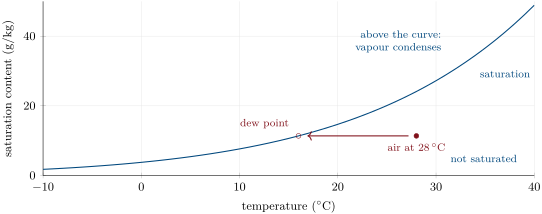
Air is saturated when it contains the largest mass of water vapour it can hold at its temperature, its saturation content; any extra vapour condenses into droplets. The relative humidity of air is its content of water vapour divided by its saturation content at the same temperature and pressure, expressed as a percentage.
示例
Example 4.4 (A summer morning)
At the air contains . The saturation content at is , so the relative humidity is . The saturation content is at : that is the dew point. In the afternoon, the same air warmed to (saturation content ) has a relative humidity of only — with exactly the same water in it.
Example 4.9 (An afternoon cumulus)
In the afternoon of Example 4.4, the air at the ground is at with a dew point of . Rising bubbles become saturated at : the cumulus have their flat bases about up. In the morning, at , the same air would have condensed at only : cloud bases rise through the day as the ground warms.
Example 4.13 (The warm dry wind of the lee side)
Air at sea level at , with a dew point of , is driven over a ridge high. It becomes saturated at , at about . From there to the crest it cools at the saturated rate, to about , and loses as rain about a third of its water (from to ). Coming down the other side it warms at the dry rate over : it reaches the plain at about , seven degrees warmer than it started, with a relative humidity of about . Such warm, dry winds blow in the lee of many mountain ranges.