All books

Professional

Apps About Coach Log in Start reading

Earth and Space Sciences · Glossary

What is Stereographic projection, equal-angle net, equal-area projection, pole?

Also known as: stereographic projection · equal-angle net · equal-area projection (of the sphere) · pole (to a plane)

Definition 8.1 University Earth and Space Sciences — Year 3 · Chapter 8 — Structural Analysis

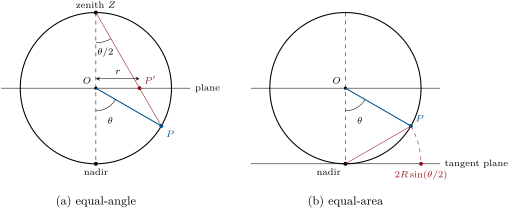
Let a line through the centre OO of a sphere of radius RR meet the lower hemisphere at PP, at the angle θ=90∘−p\theta = 90{}^{\circ} - p from the nadir, where pp is the plunge of the line and tt its trend. The stereographic projection maps PP to the point where the straight line from the zenith to PP crosses the horizontal plane through OO; that point lies at the distance rr from OO in the azimuth tt. The chart of the lower hemisphere drawn this way, with its grid of great and small circles, is the equal-angle net (or Wulff net). The equal-area projection (of the sphere) maps PP to the point at the distance r=R2sin⁡(θ/2)r = R\sqrt2\sin(\theta/2) in the azimuth tt; its net is the Schmidt net. The pole of a plane is its normal line, plotted as a point: for a plane of dip direction α\alpha and dip δ\delta, the pole trends α+180∘\alpha + 180{}^{\circ} and plunges 90∘−δ90{}^{\circ} - \delta.

The two projections, in the vertical plane through the line OP. (a) The stereographic projection sends P to P', where the line from the zenith crosses the horizontal plane: the angle at Z is /2, so r = R ( /2). (b) The equal-area projection carries P, around the nadir, onto the tangent plane at the distance 2R ( /2) of the chord; the chart is then scaled by 1/√2 so that the horizontal lines fall on a primitive of radius R.
The two projections, in the vertical plane through the line OPOP. (a) The stereographic projection sends PP to P′P', where the line from the zenith crosses the horizontal plane: the angle at ZZ is θ/2\theta/2, so r=Rtan⁡(θ/2)r = R\tan(\theta/2). (b) The equal-area projection carries PP, around the nadir, onto the tangent plane at the distance 2Rsin⁡(θ/2)2R\sin(\theta/2) of the chord; the chart is then scaled by 1/21/\sqrt2 so that the horizontal lines fall on a primitive of radius RR.
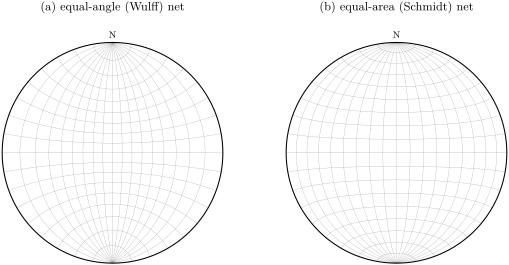
The two nets, drawn from the formulas of the theorem above: great circles of the planes striking north–south and dipping every 10 east and west, and small circles every 10 about the north–south axis. On the equal-angle net the small circles are circles; on the equal-area net they are ovals, but equal areas hold equal shares of the directions.
The two nets, drawn from the formulas of the theorem above: great circles of the planes striking north–south and dipping every 10∘10{}^{\circ} east and west, and small circles every 10∘10{}^{\circ} about the north–south axis. On the equal-angle net the small circles are circles; on the equal-area net they are ovals, but equal areas hold equal shares of the directions.
Read in context →