
全部书籍

专业

应用 关于 Coach 登录 开始阅读

书籍暂未推出简体中文版——当前显示英文版。

Earth and Space Sciences · 术语表

什么是 Subsidence, tectonic subsidence?

又称: subsidence · tectonic subsidence

Definition 23.9 University Earth and Space Sciences — Year 1 · 第 23 章 — Diagenesis and Sedimentary Basins

The subsidence of a basin is the downward motion of its basement, the surface on which its sediments rest, measured relative to a fixed reference such as the centre of the Earth. Its tectonic subsidence is the part due to the processes that make the basin, as distinct from the extra sinking caused by the weight of the sediment and water that fill it; it is measured by the subsidence the basement would have had under water alone.
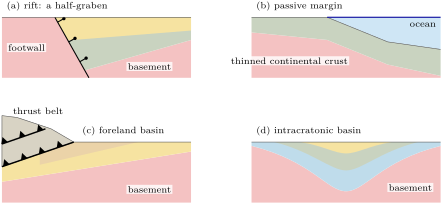
Four kinds of sedimentary basin in cross-section (schematic, not to scale; vertical scale exaggerated). (a) A rift: the fill thickens against the border fault of a half-graben. (b) A passive margin: a wedge of sediment thickening towards the ocean over thinned continental crust. (c) A foreland basin, deepest against the thrust belt whose weight bends it down, and fed by its debris, coarsest (conglomerate) near the belt; the belt overrides the edge of its own basin. (d) An intracratonic basin: a broad sag whose layers thicken towards the centre.
在原文中阅读 →