সব বই

পেশাদার

1 Markets I: The Ecosystem and Exchange-Traded Marketsবাজার অনলাইন 2 Markets II: Rates, FX and Creditবাজার অনলাইন 3 Markets III: Commodities, Energy and Cryptoবাজার অনলাইন 4 Quantitative Methodsপদ্ধতি অনলাইন 5 Derivatives and Volatilityডেরিভেটিভস অনলাইন 6 Rates, Credit, XVA and Riskসুদহার, ঋণ ও ঝুঁকি অনলাইন 7 Research Craft: Predictors, Backtests, Measurement, Portfoliosগবেষণা অনলাইন 8 Strategies I: Equities and Futuresকৌশল অনলাইন 9 Strategies II: Volatility, Relative Value, Macro and the Bank Desksকৌশল অনলাইন 10 Microstructure and Executionএক্সিকিউশন অনলাইন 11 Market Making and High-Frequency Tradingমার্কেট মেকিং অনলাইন 12 Machine Learning for Marketsমেশিন লার্নিং অনলাইন 13 Low-Latency Softwareপ্রযুক্তি অনলাইন 14 Networks, Hardware and Trading Infrastructureপ্রযুক্তি অনলাইন 15 Research, Data and Risk Platformsপ্রযুক্তি অনলাইন 16 The Desk and the Firmপ্রতিষ্ঠান অনলাইন 17 The Industry: Firms, Roles and Careersক্যারিয়ার অনলাইন 18 Interviews I: Maths, Probability and Speedক্যারিয়ার অনলাইন 19 Interviews II: Markets, Trading Games and the Final Roundক্যারিয়ার অনলাইন 20 Interviews III: Codeক্যারিয়ার অনলাইন
অ্যাপ পরিচিতি Coach সাইন ইন পড়া শুরু করো

বইগুলো এখনো বাংলা ভাষায় পাওয়া যায় না — ইংরেজি সংস্করণ দেখানো হচ্ছে।

Earth and Space Sciences · পরিভাষা

The global winds কী?

অন্য নাম: trade winds · westerlies · polar easterlies

Definition 24.3 Primary & Middle School Earth and Space Sciences · অধ্যায় 24 — Winds and the Global Circulation

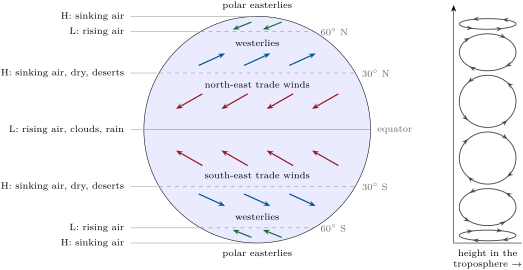
The surface winds that blow most often in each belt of latitude are:

  • the trade winds, between the equator and about 30∘30{}^{\circ}, blowing from the north-east in the northern hemisphere and from the south-east in the southern hemisphere;
  • the westerlies, between about 30∘30{}^{\circ} and 60∘60{}^{\circ}, blowing from the west (from the south-west in the northern hemisphere, from the north-west in the southern);
  • the polar easterlies, between about 60∘60{}^{\circ} and the poles, blowing from the east.
The global circulation, simplified. Left: the belts of high (H) and low (L) pressure at the ground. On the globe: the surface winds, turned aside by the Earth’s rotation. Right: the three convection cells of each hemisphere seen from the side, at the same latitudes (the polar cells are drawn very thin because the polar band is narrow on the globe).

উদাহরণ

Example 24.5 (The wind at 40∘40{}^{\circ} south)

At 40∘40{}^{\circ} S we are in the middle belt, between 30∘30{}^{\circ} and 60∘60{}^{\circ}. There the air at the ground flows towards the pole, that is towards the south. In the southern hemisphere it is turned to the left: for air going south, the left is the east, so the air ends up moving towards the south-east. It therefore comes from the north-west: it is one of the westerlies, blowing from the north-west.

Example 24.7 (Four towns, four belts)

The four towns of the climate charts of Chapter 11 all lie in the northern hemisphere, at very different latitudes. Their yearly rain and snow follow the belts of the global circulation (chart below). Hilo, at 20∘20{}^{\circ} N, is on an island in the trade-wind belt, in the middle of the ocean, where the trade winds pick up water vapour: about 3000 mm3000\,\mathrm{mm} fall there in a year. Phoenix, at 33∘33{}^{\circ} N, lies close to 30∘30{}^{\circ}, under the sinking air: less than 200 mm200\,\mathrm{mm}. Seattle, at 47∘47{}^{\circ} N, is in the westerlies, whose storms bring about 1000 mm1000\,\mathrm{mm} a year, most of it from autumn to spring. Utqiaġvik, at 71∘71{}^{\circ} N, lies under the cold air that sinks near the pole: less than 150 mm150\,\mathrm{mm}, a cold desert.

প্রসঙ্গসহ পড়ো →