
সব বই

পেশাদার

1 Markets I: The Ecosystem and Exchange-Traded Marketsবাজার অনলাইন 2 Markets II: Rates, FX and Creditবাজার অনলাইন 3 Markets III: Commodities, Energy and Cryptoবাজার অনলাইন 4 Quantitative Methodsপদ্ধতি অনলাইন 5 Derivatives and Volatilityডেরিভেটিভস অনলাইন 6 Rates, Credit, XVA and Riskসুদহার, ঋণ ও ঝুঁকি অনলাইন 7 Research Craft: Predictors, Backtests, Measurement, Portfoliosগবেষণা অনলাইন 8 Strategies I: Equities and Futuresকৌশল অনলাইন 9 Strategies II: Volatility, Relative Value, Macro and the Bank Desksকৌশল অনলাইন 10 Microstructure and Executionএক্সিকিউশন অনলাইন 11 Market Making and High-Frequency Tradingমার্কেট মেকিং অনলাইন 12 Machine Learning for Marketsমেশিন লার্নিং অনলাইন 13 Low-Latency Softwareপ্রযুক্তি অনলাইন 14 Networks, Hardware and Trading Infrastructureপ্রযুক্তি অনলাইন 15 Research, Data and Risk Platformsপ্রযুক্তি অনলাইন 16 The Desk and the Firmপ্রতিষ্ঠান অনলাইন 17 The Industry: Firms, Roles and Careersক্যারিয়ার অনলাইন 18 Interviews I: Maths, Probability and Speedক্যারিয়ার অনলাইন 19 Interviews II: Markets, Trading Games and the Final Roundক্যারিয়ার অনলাইন 20 Interviews III: Codeক্যারিয়ার অনলাইন
অ্যাপ পরিচিতি Coach সাইন ইন পড়া শুরু করো

বইগুলো এখনো বাংলা ভাষায় পাওয়া যায় না — ইংরেজি সংস্করণ দেখানো হচ্ছে।

Earth and Space Sciences · পরিভাষা

Triangulation কী?

Definition 1.6 High School Earth and Space Sciences · অধ্যায় 1 — Measuring the Earth

Triangulation locates distant points by a chain of triangles: one side, the baseline, is measured on the ground with great care; all the angles of the triangles are measured from their corners; every other side is then computed.
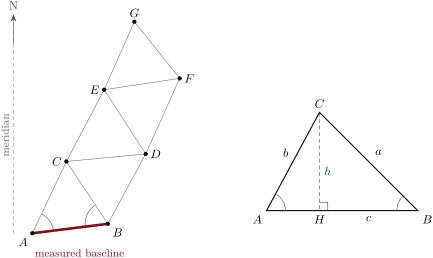
Left: a chain of triangles stretched along a meridian from a measured baseline AB; the arcs mark two of the many angles measured with the instrument. Right: the height h from C, written in two ways, gives the sine rule.
Left: a chain of triangles stretched along a meridian from a measured baseline ABAB; the arcs mark two of the many angles measured with the instrument. Right: the height hh from CC, written in two ways, gives the sine rule.

উদাহরণ

Example 1.9 (One triangle)

A baseline AB=8.000 kmAB = 8.000\,\mathrm{km} is measured; from AA the signal CC is seen at 70∘70{}^{\circ} from the direction of BB, from BB at 60∘60{}^{\circ} from the direction of AA. Then C=50∘C = 50{}^{\circ} and

AC=8.000×sin⁡60∘sin⁡50∘=8.000×0.86600.7660≈9.044 km,BC=8.000×sin⁡70∘sin⁡50∘≈9.814 km.AC = \frac{8.000 \times \sin 60^\circ}{\sin 50^\circ} = \frac{8.000 \times 0.8660}{0.7660} \approx 9.044\,\mathrm{km}, \qquad BC = \frac{8.000 \times \sin 70^\circ}{\sin 50^\circ} \approx 9.814\,\mathrm{km}.

No distance but the baseline was walked.

Example 1.10 (The meridian of the metre)

In March 1791 the metre was defined as one ten-millionth of the distance from the pole to the equator along a meridian. To find that distance, two astronomers, Jean-Baptiste Delambre and Pierre Méchain, measured by triangulation the meridian arc from Dunkirk, on the North Sea, to Barcelona, on the Mediterranean — almost seven years of work, Delambre in the northern two thirds, Méchain in the southern third. The two towns differ by 9.646∘9.646{}^{\circ} of latitude; on the modern ellipsoid the arc between their parallels is 1072.2 km1072.2\,\mathrm{km} long. Knowing the length of an arc and its difference in latitude gives the length of a degree; the shape of the Earth then gives the whole quarter meridian. Platinum standards of the new metre were made in 1799 and kept in the national Archives.

প্রসঙ্গসহ পড়ো →