
Mathematics · Glossary

What is Perpendicular, parallel?

Also known as: perpendicular lines · parallel lines

Definition 26.1 Primary & Middle School Mathematics · Chapter 26 — Lines and Polygons

Two lines are perpendicular when they cross at a right angle (checked with the set square, marked with a little square). Two lines are parallel when they run in the same direction and never cross — like the two rails of a track, always at the same distance from each other.
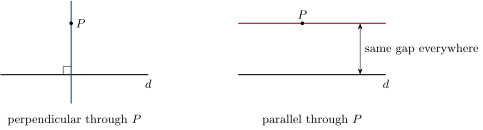
The two constructions. Parallel lines keep a constant gap: measuring the gap at two places is a good check.

Examples

Example 26.3 (Spotting them in figures)

In a rectangle, each side is perpendicular to its two neighbors and parallel to the opposite side. Grid paper is a ready-made network of parallels and perpendiculars — that is what makes it so comfortable to draw on.
Read in context →
Definition 40.2 Primary & Middle School Mathematics · Chapter 40 — Lines, Circles and Angles

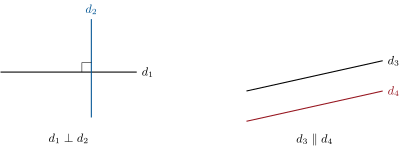
Two lines are perpendicular when they cross at a right angle; we write d1d2d_1 \perp d_2 and mark the right angle with a small square. Two lines are parallel when they never meet, however far they are extended; we write d1d2d_1 \parallel d_2.

A right-angle crossing (marked with the little square) and two parallels: same direction, no crossing point.
Read in context →