Primary & Middle School Mathematics · Grades 1–9
26Lines and Polygons
With a ruler, a set square and a compass, geometry becomes a craft. This chapter teaches the two special positions of lines — perpendicular and parallel — at the tool level, and takes a tour of the polygon family. (The theory of these notions comes in Chapter 40.)
26.1 Perpendicular and parallel
Definition 26.1 (Perpendicular, parallel)
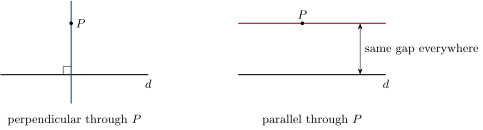
Two lines are perpendicular when they cross at a right angle (checked with the set square, marked with a little square). Two lines are parallel when they run in the same direction and never cross — like the two rails of a track, always at the same distance from each other.
Method 26.2 (Drawing with the set square)
Perpendicular to a line through a point : lay one edge of the right angle along , slide until the other edge reaches , draw.
Parallel to through : lay the set square’s edge along , press the ruler against another edge as a rail, slide the set square along the ruler up to , draw.
Example 26.3 (Spotting them in figures)
In a rectangle, each side is perpendicular to its two neighbors and parallel to the opposite side. Grid paper is a ready-made network of parallels and perpendiculars — that is what makes it so comfortable to draw on.
26.2 Polygons
Definition 26.4 (Polygon)
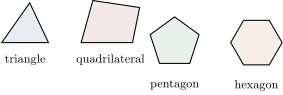
A polygon is a closed figure whose border is made of straight segments, its sides; the corner points are the vertices. Polygons are named by their number of sides: triangle (), quadrilateral (), pentagon (), hexagon (), octagon ().
Example 26.5 (Describing a polygon)
A useful game: describe a figure so precisely that a classmate can redraw it without seeing it. “A quadrilateral with cm, the angle at right, cm …” — vocabulary is what makes the message work.
26.3 The circle and the compass
Definition 26.6 (Circle)
The circle of center and radius cm is the set of all points at exactly cm from . The compass draws it: spike on , opening cm, turn. A diameter is a segment through the center joining two points of the circle; it measures twice the radius.
Example 26.7 (The compass as a distance-keeper)
The compass does more than draw circles: it transports distances. To mark all points at cm from a point , draw the circle of center , radius cm; to compare two segments without a ruler, open the compass on one and test it on the other.
Method 26.8 (Reproducing a figure on a grid)
26.4 Exercises
Exercise 26.1 ★
Draw a line and a point not on it. Construct the perpendicular to through , then the parallel to through (with the ruler-rail method). Mark the right angle.
Solution
Solution of Exercise 26.1.
Constructions with Method 26.2; the little square marks the right angle between and the perpendicular.
Exercise 26.2 ★
Look at the capital letters E, H, N, T, Z. In each, find a pair of parallel strokes and a pair of perpendicular strokes when they exist.
Solution
Solution of Exercise 26.2.
E: the three horizontal strokes are parallel; each is perpendicular to the vertical one. H: the two vertical strokes are parallel, the crossbar is perpendicular to both. N: the two vertical strokes are parallel; the diagonal is neither. T: the two strokes are perpendicular. Z: the top and bottom strokes are parallel; the diagonal is neither.
Exercise 26.3 ★
Name each polygon: sides; sides; sides; sides; sides. How many vertices does each one have?
Exercise 26.4 ★
Draw any pentagon (not necessarily regular) and label its vertices , , , , . How many sides does it have? Draw its diagonals from (segments joining to non-neighbor vertices): how many are there?
Solution
Solution of Exercise 26.4.
A pentagon has sides. From , the non-neighbors are and : two diagonals, and .
Exercise 26.5 ★
Draw a circle of center and radius cm; a diameter ; and a point of the circle not on . Give the lengths , and without measuring.
Exercise 26.6 ★
With the compass as a distance-keeper (Example 26.7), compare the sides of a triangle drawn by a classmate and decide whether it has two equal sides.
Solution
Solution of Exercise 26.6.
Open the compass along one side, then carry that opening to the two other sides: if the spike-and-pencil span fits a second side exactly, those two sides are equal.
Exercise 26.7 ★
On grid paper, reproduce this path and close it into a polygon: start at a point ; go right; up; left; up; then back to in a straight line. What is the name of the polygon you get (count its sides)?
Exercise 26.8 ★
True or false? Explain with a drawing. “Two perpendicular lines always cross.” “Two parallel lines never cross.” “A line can be parallel to one line and perpendicular to another.”
Solution
Solution of Exercise 26.8.
“Perpendicular lines always cross”: true — they cross at the right angle itself.
“Parallel lines never cross”: true — that is their definition.
“A line can be parallel to one line and perpendicular to another”: true — on grid paper, a horizontal line is parallel to every horizontal line and perpendicular to every vertical one.
Exercise 26.9 ★★
Draw a line , then a line perpendicular to , then a line perpendicular to . Look at and : what do you notice? (This observation becomes a theorem in Chapter 40.)
Solution
Solution of Exercise 26.9.
The lines and look parallel — and they always are: two lines perpendicular to the same line are parallel (Proposition 40.3 makes this official).
Exercise 26.10 ★★
Describe the figure below in words for a classmate, without showing it: a square of side cm, with a circle of radius cm centered at the middle of the square (touching the four sides). Write the description as numbered instructions.
Solution
Solution of Exercise 26.10.
One correct program: “1. Draw a square of side cm. 2. Mark the point where its diagonals cross. 3. Draw the circle of center and radius cm.” The circle touches each side at its middle.
Exercise 26.11 ★★
How many diagonals does a quadrilateral have? A pentagon? A hexagon? Draw the three cases, count carefully, and describe the pattern you see.
Solution
Solution of Exercise 26.11.
Quadrilateral: diagonals. Pentagon: . Hexagon: . Each new vertex adds more and more diagonals — the counts grow faster and faster (, then , …).