Primary & Middle School Mathematics · Grades 1–9
40Lines, Circles and Angles
Geometry starts with a ruler, a set square and a compass. This chapter fixes the vocabulary — points, segments, rays, lines, circles — introduces the two special positions of lines (parallel and perpendicular), and teaches how to measure and draw angles.
40.1 Points, segments, lines
Definition 40.1 (Basic objects)
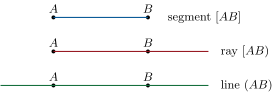
Through two distinct points and pass:
- the segment : the part of the line between and (it has a length, written );
- the ray : starts at , goes through and continues forever;
- the line : extends forever on both sides. Two points determine exactly one line.
Points on the same line are called aligned.
40.2 Parallel and perpendicular lines
Definition 40.2 (Perpendicular, parallel)
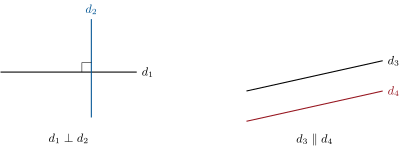
Two lines are perpendicular when they cross at a right angle; we write and mark the right angle with a small square. Two lines are parallel when they never meet, however far they are extended; we write .
Proposition 40.3 (Two useful facts)
- If two lines are both perpendicular to a third line, they are parallel to each other.
- If two lines are parallel, every line perpendicular to one is perpendicular to the other.
Proof. Admitted at this level. ∎
Method 40.4 (Drawing with the set square)
To draw the perpendicular to a line through a point :
- place one edge of the right angle of the set square along ;
- slide the set square along until its other edge reaches ;
- draw the line along that edge, and mark the right angle.
For a parallel through : draw a perpendicular to , then the perpendicular to that line through (Proposition 40.3).
40.3 Circles
Definition 40.5 (Circle)
The circle of center and radius is the set of all points at distance exactly from . A segment from the center to the circle is a radius; a segment joining two points of the circle through the center is a diameter — its length is ; a segment joining two points of the circle is a chord.
![A circle with a radius [OM], a diameter [AB] (a chord through the center, twice as long as the radius) and a chord [CD].](/images/onecourse/chapters/math-1/g6-lines/fig-06b04f0449e5.svg)
Example 40.6
“Draw the circle of center passing through ”: open the compass from to — the radius is the distance — and turn. Every point of this circle is at the same distance from as .
40.4 Angles
Definition 40.7 (Angle)
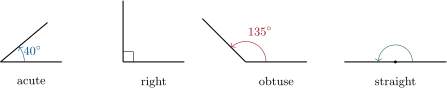
Two rays and with the same starting point form the angle ; the point is its vertex (always the middle letter!). Angles are measured in degrees (), from to for a full turn. An angle is:
- right if it measures ;
- acute if it measures less than ;
- obtuse if it measures between and ;
- straight if it measures (the two rays form a line).
Method 40.8 (Measuring an angle with a protractor)
- Place the center of the protractor exactly on the vertex of the angle;
- align its line with one side of the angle;
- read the graduation crossed by the other side — using the scale that starts at on the aligned side;
- sanity-check with the eye: an acute angle must read less than , an obtuse one more.
Example 40.9
Before measuring, estimate! An angle slightly more open than the corner of a sheet of paper is a little over ; half a right angle is ; a third of a right angle is . If your protractor says for an angle that looks acute, you read the wrong scale: the correct measure is .
40.5 Exercises
Exercise 40.1 ★
Draw three points , , not aligned. Draw in different colors: the segment , the ray , the line .
Solution
Solution of Exercise 40.1.
Free construction. The segment stops at and ; the ray starts at and continues past ; the line continues on both sides of and .
Exercise 40.2 ★
True or false? “ and are the same segment.” “ and are the same ray.” “ and are the same line.” Explain each answer.
Solution
Solution of Exercise 40.2.
“”: true — the part between the two points does not depend on the order.
“”: false — starts at , starts at ; they point in opposite directions.
“”: true — both names describe the same unlimited line.
Exercise 40.3 ★
Draw a line and a point not on . Construct with the set square: the perpendicular to through , then the parallel to through . Describe your steps.
Solution
Solution of Exercise 40.3.
Steps: slide the set square along until its perpendicular edge passes through ; draw that perpendicular, call it . Then draw the perpendicular to through the same way: by Proposition 40.3 it is parallel to .
Exercise 40.4 ★
Lines and are both perpendicular to a line , and a fourth line is perpendicular to . What can you say about and ? About and ? Justify with Proposition 40.3.
Solution
Solution of Exercise 40.4.
and are both perpendicular to the same line , so (fact 1). For and : both are perpendicular to the same line (we are told , and means too), so fact 1 applies again: .
Exercise 40.5 ★
Draw a circle of center with radius cm. Place a point on the circle, a point inside, a point outside. What can you say about the distances , , compared with cm?
Solution
Solution of Exercise 40.5.
cm exactly ( is on the circle); cm ( inside); cm ( outside).
Exercise 40.6 ★
A circle has diameter cm. What is its radius? Another has radius cm: what is its diameter?
Exercise 40.7 ★
Name the marked angle in three letters, then classify it (acute, right, obtuse, straight): an angle of at vertex between rays towards and ; an angle of at vertex between rays towards and ; an angle of at vertex between rays towards and .
Solution
Solution of Exercise 40.7.
: acute. : obtuse. : right. (The vertex is always the middle letter.)
Exercise 40.8 ★
Estimate, then measure with a protractor, the three angles of a triangle you draw yourself. Add the three measures: what do you find? (Keep your answer for Chapter 51.)
Solution
Solution of Exercise 40.8.
Measures depend on the triangle drawn, but the sum of the three angles is always (very close to) — small differences come from measuring imprecision. Chapter 51 proves that the sum is exactly .
Exercise 40.9 ★
Draw an angle of with a protractor, then an angle of . How could you get the second one from the first without the protractor?
Solution
Solution of Exercise 40.9.
Free construction. To get from without the protractor: copy the angle twice side by side (), for instance with tracing paper or a compass-and-ruler angle copy.
Exercise 40.10 ★★
Two villages and are drawn on a map. Where are the points that are at cm from and at cm from ? Draw a picture showing how many such points there can be (, or depending on the distance ).
Solution
Solution of Exercise 40.10.
The points at cm from form the circle of center and radius cm; those at cm from form the circle of center and radius cm. The required points are the intersections of the two circles: two points if the circles cross ( strictly between and cm), one if they touch ( cm or cm), none if they are too far apart or one inside the other.
Exercise 40.11 ★★
A clock shows 3 o’clock: what is the angle between the two hands? Same question at 5 o’clock, and at 6 o’clock. (A full turn is for hours.)
Solution
Solution of Exercise 40.11.
The hour marks split the full turn into angles of . At 3 o’clock the hands span marks: (a right angle). At 5 o’clock: . At 6 o’clock: (a straight angle).
Exercise 40.12 ★★★
Draw a segment of cm. Construct the point such that cm, using only the compass, and measure the angle . What triangle did you build, and what do you conjecture about its angles?
Solution
Solution of Exercise 40.12.
Draw two arcs of radius cm centered at and at ; their crossing point is . All three sides measure cm: the triangle is equilateral, and each angle measures (the measure confirms it). Conjecture: an equilateral triangle has three equal angles of .
40.6 Problem: The geometry of the clock face
Problem 40.1
Weekend problem — angles as fractions of a turn: reading them on a clock, hunting the moments when the hands meet, and slicing a day into a pie
A clock is a protractor that tells the time: its face is a full turn of , cut by the twelve hour marks into twelve equal angles. Exercise 40.11 measured the hands at 3 o’clock and 6 o’clock; this problem builds the complete theory — including the times when neither hand points at a mark — answers a question few adults get right (“how often do the two hands sit exactly on top of each other?”), and ends by slicing a whole day into a pie chart.
Part I — Fractions of a turn.
- A full turn measures . How many degrees are half a turn, a quarter of a turn, a twelfth of a turn?
- The twelve hour marks cut the clock face into twelve equal angles at the center. How many degrees between two neighbouring marks? Recover the answer of Exercise 40.11 for 3 o’clock by counting marks.
- Give the angle between the hands at 1 o’clock, at 4 o’clock and at 7 o’clock. (At 7 o’clock the hands separate the face into two angles; “the angle between the hands” always means the smaller one.)
- The minute hand makes a full turn in minutes. How many degrees does it sweep per minute?
- The hour hand travels from one mark to the next — — in minutes. How many degrees does it sweep per minute? (A decimal number, Chapter 38.)
Part II — Times when nothing points at a mark.
- At 3:30, the minute hand points at the . Where exactly is the hour hand? Compute the angle of each hand from the (measuring clockwise), and deduce the angle between the hands.
- At 6:30 many people guess the hands are on top of each other. Guess first, then compute the angle as in question 6. Who was right?
- Compute the angle between the hands at 9:15.
- Explain why, somewhere between 1:00 and 1:10, the two hands must be exactly on top of each other: where is the minute hand relative to the hour hand at 1:00, and where at 1:10? Which hand runs faster, and why does that settle it?
- In twelve hours, how many times do the two hands sit exactly on top of each other? (One meeting happens in each stretch between successive hours — with one exception: what happens between 11 and 12? List the approximate meeting times and count.) How many times in a whole day?
Part III — Angles around a point: pie charts.
- The twelve sectors of the clock face together fill the face: their angles add up to . Explain why this is true of any collection of angles that share a vertex and fill a full turn around it, with no overlap and no gap.
- Zoe records her day of hours: sleep h, school h, play h, meals h, everything else h. She wants a pie chart: a disk where each activity gets a sector, with angles proportional to the times. What fraction of the day is each activity, and how many degrees does its sector get? Check the five angles add up to .
- Describe, step by step, how to draw Zoe’s pie chart with compass and protractor (Method 40.8): where the first radius goes, and how each new sector starts where the previous one ends.
- In another pie chart of a day, one sector measures exactly . What fraction of the disk is that, and how many hours does it represent?
- The finale, back at the clock: in hours, how many full turns does the hour hand make? The minute hand? The second hand? (One of these answers is over a thousand.)
Solution
Solution of Problem 40.1.
1. Half a turn: . A quarter: . A twelfth: .
2. Twelve equal angles filling : between neighbouring marks. At 3 o’clock the hands span marks: — a right angle, as found in Exercise 40.11.
3. At 1 o’clock: . At 4 o’clock: . At 7 o’clock the hands span marks on one side, , so the angle between the hands is the other side: .
4. in minutes: per minute.
5. in minutes: per minute — half a degree. The hour hand creeps, the minute hand strides.
6. In the minutes since 3:00, the hour hand has moved past the : it sits exactly halfway between the and the , at from the . The minute hand points at the : . Angle between the hands: .
7. Computation beats the guess: the minute hand is at , but the hour hand has left the — it is at . The angle between the hands is : close, but not on top of each other.
8. Minute hand at the : . Hour hand: . Difference: , so the angle between the hands is — almost a straight angle.
9. At 1:00 the minute hand () is behind the hour hand (). At 1:10 the minute hand () is ahead of it (). The minute hand runs faster ( per minute against ), so between 1:00 and 1:10 it catches up and passes the hour hand — at the moment of passing, the two hands are exactly on top of each other.
10. The same catching-up happens over and over: the hands meet at 12:00 exactly, then at about 1:05, 2:11, 3:16, 4:22, 5:27, 6:33, 7:38, 8:44, 9:49 and 10:55. The meeting one might expect between 11 and 12 falls exactly at 12:00, which already begins the next round — so in twelve hours the hands coincide times, not . In a whole day: times.
11. Angles sharing a vertex, with no overlap and no gap, tile the full turn around that vertex: sweeping once around the point passes through each angle exactly once, and a full sweep is . So the measures add up to — whatever the number of angles and their sizes.
12. Each hour of the day is worth . So:
and : the pie is full, with no gap and no overlap (question 11).
13. Draw a circle with the compass and one radius (the starting line). Place the protractor’s center on the center of the circle, its line on the radius, and mark ; draw the new radius: the sleep sector is done. Then place the line on that radius and mark for school, and so on — each sector starts where the previous one ends. After the last sector the drawing closes up exactly on the starting radius.
14. is of the disk (Method 39.7), so it represents a quarter of the day: hours.
15. The hour hand makes one turn in hours: turns per day. The minute hand, one turn per hour: turns. The second hand, one turn per minute: turns per day.